


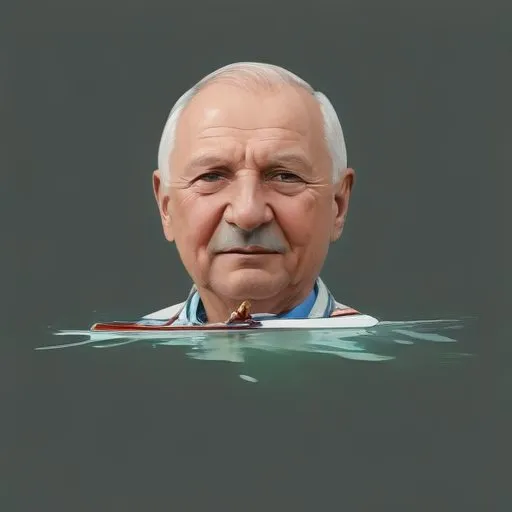
Belarusian canoeist who won Olympic bronze and gold medals, later becoming a politician and serving as the President of the National Olympic Committee of Belarus.
Vladimir Parfenovich is a name synonymous with canoeing excellence. Born on December 2, 1958, this Belarusian sprint canoer made history by becoming the first canoer to win all three events he entered in the Moscow Olympics, clinching gold medals in the K1 500m, K2 500m, and K2 1000m categories.
Parfenovich's impressive Olympic performance was just the beginning. He went on to win a staggering twelve medals at the ICF Canoe Sprint World Championships, including nine gold medals in various events, solidifying his position as one of the greatest canoeists of all time.
Parfenovich's canoeing career was marked by numerous milestones. He won gold medals in the K1 500m, K2 500m, and K2 1000m events at the 1981 and 1982 World Championships, and also secured silver medals in the K1 500m and K2 500m events in 1978 and 1983, respectively. His remarkable achievements earned him a place in the annals of canoeing history.
After retiring from competitions in 1984, following the Soviet Union's decision to boycott the Olympics, Parfenovich went on to pursue a career in politics. He worked as an instructor for the Sport ministry of Belarus and served in the KGB and police forces. In 1995, he became the head of the Canoe-Kayak Federation of Belarus and served as a member of the Belarus Olympic Committee.
In 2000, Parfenovich entered politics and was elected to the National Assembly of the Republic of Belarus. However, his tenure was marked by controversy, particularly when he, along with two other members of parliament, went on a hunger strike in 2004 to protest the government's handling of election code amendments. Although the strike ended without achieving its goals, it highlighted Parfenovich's willingness to take a stand against perceived injustices.
Parfenovich's legacy extends beyond the realm of sports. His involvement in politics and his commitment to promoting canoeing as a sport have inspired countless individuals. As the head coach of the Russian canoeing team, he continues to shape the sport, nurturing new talent and driving innovation.
While Parfenovich's sporting achievements are well-documented, his philosophical contributions are less well-known. However, his actions as a politician and sports administrator suggest a deep commitment to fairness, justice, and the pursuit of excellence. His willingness to challenge authority and push for change reflects a strong sense of conviction and moral principle.
Parfenovich's remarkable career, spanning multiple decades and disciplines, has left an indelible mark on the world of canoeing and beyond. As a pioneering athlete, politician, and coach, he has inspired generations and continues to shape the sport he loves. His legacy serves as a testament to the power of dedication, perseverance, and innovative thinking.
While Parfenovich's achievements are unparalleled, they can be seen in the context of a broader era of canoeing excellence. His contemporaries, such as Sergey Postrekhin and Vladimir Romanovsky, also achieved remarkable success, but Parfenovich's versatility and dominance across multiple events set him apart.
Despite his many achievements, Parfenovich remains humble and grounded. Those who have worked with him describe him as a dedicated coach and mentor, who demands the highest standards from himself and others. His commitment to his craft and his unwavering passion for canoeing continue to inspire those around him.
Vladimir Parfenovich's remarkable journey is a testament to the power of human achievement. From his early days as a promising canoeist to his later years as a respected coach and politician, he has left an indelible mark on the world of sports and beyond.
Born in 1896
A 17th-century Russian nobleman who served as a diplomat and military leader, known for his role in the Russo-Polish War and his efforts to modernize the Russian army.
