


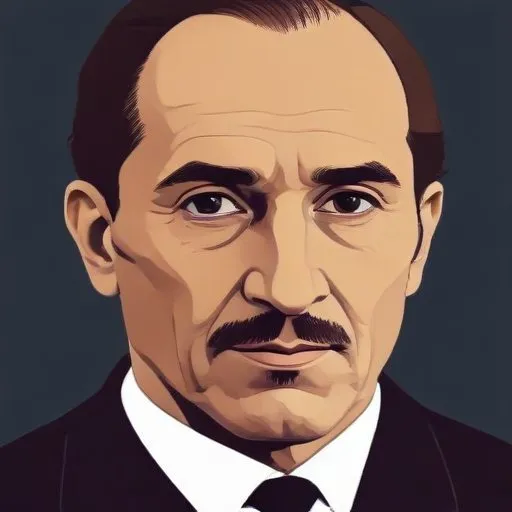
A Croatian poet and lawyer who wrote influential works that explored themes of love, nature, and social justice, leaving a lasting impact on Croatian literature.
Vladimir Vidri, a Croatian poet, is revered as one of the major figures of Croatian secessionist poetry, leaving an indelible mark on the literary world with his unique style and vision. Born on April 20, 1875, in Zagreb, Croatia, Vidri's poetry is characterized by its mythological and classical undertones, transporting readers to a world of ancient grandeur.
Vidri was born into an affluent family of Slovenian origin, and his early life was marked by a passion for learning and a rebellious spirit. He was one of the leaders of the demonstrators who burned the Hungarian flag on the occasion of Emperor Franz Joseph's visit to Zagreb in 1895, showcasing his strong sense of national pride.
He pursued higher education in Prague, Graz, and Vienna, where he studied law and eventually earned his Ph.D. in 1903. Instead of opting for an academic career, Vidri chose to become a lawyer, a decision that would later influence his literary pursuits.
Vidri's poetic journey began in high school, and his talent was first recognized with the publication of his poem "Boni mores" in Vienac in 1897. His unique style, which blended elements of impressionism and visual imagination, set him apart from his contemporaries.
Despite his short literary career, Vidri managed to leave an enduring legacy. His 1907 collection, simply titled "Pjesme" (Poems), contains some of the most remarkable verses ever written in Croatian. Poems like "Jutro" (Morning), "Dva pejzaa" (Two Landscapes), "Adieu," and "Ex Pannonia" showcase his mastery of language and form.
However, Vidri's work was not without controversy. Some critics, including his contemporary Mato, accused him of technical imperfections, citing wrong accents in rhymes and a raw style. Despite these criticisms, Vidri's innovative approach to poetry paved the way for future generations of Croatian writers.
Vidri's personal life was marked by adventure and intellectual curiosity. He was known for his exceptional memory, often reciting memorized poetry to his friends for hours on end. His affiliations with progressive political circles and his involvement in the 1895 flag-burning incident demonstrate his commitment to social and national causes.
Tragically, Vidri's life was cut short when he died under obscure circumstances in a mental hospital in Zagreb in 1909, at the age of 34. Despite his untimely death, Vidri's poetry continues to inspire and influence Croatian literature, earning him a place among the country's most celebrated writers.
Vidri's poetry has been praised for its unique ability to evoke a sense of ancient grandeur and mythological wonder. Ivo Frange, a renowned Croatian literary historian, described Vidri's world as "a fragment of an ancient vase, where the incomplete nature of the preserve is felt."
Today, Vidri's work remains a testament to the power of literature to transport us to new worlds and challenge our understanding of the human experience. His poetry continues to inspire writers, scholars, and readers alike, cementing his place as one of the most important figures in Croatian literary history.
Born in 1893
A renowned Croatian literary figure, celebrated for his diverse and influential works that explored the human condition, social critique, and philosophical themes.
Born in 1905
A renowned Croatian poet and translator, celebrated for his lyrical and introspective works that explore themes of love, nature, and human existence. His translations of world literature into Croatian have greatly enriched the country's cultural heritage.
