


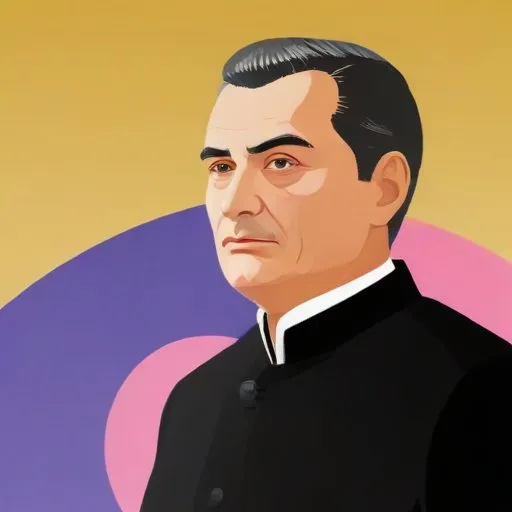
Head of the Soviet secret police during World War II, responsible for overseeing mass deportations, executions, and forced labor camps. Known for his ruthless suppression of dissent and opposition.
Vsevolod Merkulov was a prominent figure in the Soviet Union, known for his role as the head of NKGB (People's Commissariat for State Security) from February to July 1941, and again from April 1943 to March 1946. During his tenure, he was a leading member of what was later derisively described as the "Beria gang," a group of officials closely associated with Lavrentiy Beria, the notorious Soviet politician and security chief.
Merkulov was born on November 27, 1895, in Zagatala, Azerbaijan, to a Russian father and Georgian mother, both minor members of the nobility. His father, an army captain, was convicted of embezzlement around 1900 and died in 1908. Merkulov graduated from the Tiflis Gymnasium with a gold medal in 1913 and became a student at Saint Petersburg University, Department of Physics and Mathematics, although he did not graduate.
In 1916, Merkulov was drafted into the Russian Army, and in 1918, he left the army and moved to Tiflis (now Tbilisi), where he worked as a teacher for a time. After the Red Army invasion of Georgia in 1921, he was enlisted in Cheka, the Soviet secret police, and its successor, the GPU. It was during this period that he met Lavrentiy Beria, who would become his patron and mentor.
Merkulov's career flourished under Beria's guidance. He joined the Communist Party in 1925 and held various positions, including Head of Secret Operations Directorate and Deputy Head of the GPU of Adzharistan from 1925 to 1931. He later became head of the Industry and Transport section of the Georgian CP Central Committee in 1936-1938.
In August 1938, Merkulov was transferred to Moscow, where Beria had been chosen by Stalin to take over control of the NKVD. Merkulov's rapid rise to power continued, and he became the head of NKGB in February 1941, a position he held until July 1941, and again from April 1943 to March 1946.
During his tenure as NKGB head, Merkulov oversaw numerous operations, including the mass deportation of ethnic minorities during World War II. He was also involved in the Soviet Union's intelligence activities, including the recruitment of spies and the infiltration of foreign governments.
Merkulov's legacy is marred by controversy and accusations of human rights abuses. His involvement in the NKGB and his close association with Beria, who was notorious for his brutality, have led many to criticize his actions during the Stalin era.
Despite his controversial past, Merkulov's contributions to the Soviet Union's security apparatus and his role in shaping the country's intelligence services cannot be ignored. His life and career serve as a complex and thought-provoking example of the power struggles and intrigues of the Soviet elite during the Stalin era.
Little is known about Merkulov's personal life. He died on December 23, 1953, at the age of 58, in Moscow.
Vsevolod Merkulov's life and career serve as a reminder of the complex and often troubled history of the Soviet Union, and the men and women who shaped its course.
Born in 1899
Soviet Union's ruthless secret police chief, responsible for millions of deaths and brutal suppressions during Stalin's regime, known for his cunning and feared reputation.
Born in 1878
The Soviet Union's ruthless leader who ruled with an iron fist, implementing policies that led to widespread famine and purges, while also playing a crucial role in defeating Nazi Germany in World War II.
Born in 1890
A Soviet Minister of Foreign Affairs who played a crucial role in shaping the country's foreign policy during World War II and the early Cold War era, known for his diplomatic skills and signature cocktails.
Born in 1895
Head of the Soviet secret police, responsible for millions of arrests, torture, and executions during Stalin's Great Purge, earning the nickname "The Poison Dwarf".
Born in 1896
A Soviet military leader who played a crucial role in defeating Nazi Germany in World War II, and later became a key figure in Soviet politics.
