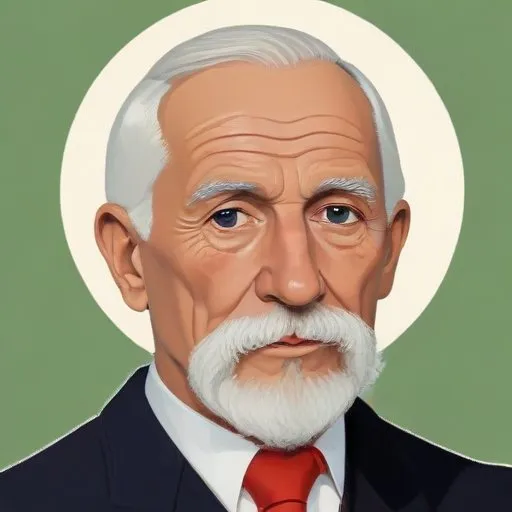
Walter Anderson

Walter Anderson

Walter Anderson was born on October 10th, 1885

Full Name: Walter Anderson
Birthplace: Minsk, Belarus
Birth Year: 1885
Profession: Ethnologist, Academic
Notable Work: Kalevipoeg
Death Year: 1962
Resting Place: Kiel, Germany
Nationality: Belarusian-German

A renowned ethnologist and academic who studied and documented the folklore and mythology of various cultures, particularly in Eastern Europe and the Baltic region.

Written by: Thomas Blackwood Thomas Blackwood

A Life Dedicated to Unveiling the Secrets of Folk Culture

Walter Anderson, a renowned Baltic German ethnologist and folklorist, is best known for his groundbreaking contributions to the study of folk tales, mythology, and cultural anthropology. His extensive research and meticulous documentation of oral traditions have made him a legend in the field, shedding light on the rich cultural heritage of Eastern Europe.

Early Life and Education

Born on October 10, 1885, in Minsk, Belarus (then part of the Russian Empire), Anderson was part of a Baltic German family. His father, Nikolai Anderson, was a professor of Finno-Ugric languages at the University of Kazan, where the family moved in 1894. This exposed Anderson to a diverse cultural environment from an early age, laying the foundation for his future academic pursuits.

Academic Career and Achievements

Anderson's academic journey began at the University of Kazan, where he enrolled in 1904. He later continued his studies in Saint Petersburg, earning a Magister degree from the University of Saint Petersburg in 1911. During this period, he catalogued the folk tales held in the archives of the Imperial Saint Petersburg Academy of Sciences and the Imperial Russian Geographical Society. His thesis, submitted in 1916, focused on the ballad of the Emperor and the Abbot (AT 922), earning him a Doctorate from the University of Kazan in 1918.

Pioneering Work in Folklore and Ethnology

Anderson's most significant contribution was his work on the classification and analysis of folk tales. He developed the "Historical-Geographical Method," a systematic approach to understanding the evolution and dispersion of oral traditions. This methodology, still widely used today, revolutionized the field of folkloristics and cemented Anderson's status as a pioneer.

Teaching and Mentorship

Between 1920 and 1939, Anderson taught at the University of Tartu in Estonia, where he was the first holder of a chair of folklore. During this period, he mentored several notable students, including Oskar Loorits, August Annist, and Isidor Levin, who would go on to become prominent scholars in their own right.

Legacy and Impact

Anderson's work has had a profound impact on our understanding of folk culture and mythology. His meticulous documentation and analysis of oral traditions have preserved the cultural heritage of Eastern Europe for future generations. His influence can be seen in the work of subsequent scholars, who have built upon his foundation to explore new areas of folkloristics.

Personal Life and Later Years

In 1939, Anderson, like many Baltic Germans, was resettled to Germany. He continued his research and writing until his untimely death in 1962, following a traffic accident. His legacy, however, remains unwavering, a testament to his dedication to the study of folk culture.

Selected Works

  • Kaiser und Abt (AT 922): A Study on the Ballad of the Emperor and the Abbot (1916)
  • Folk Tales from the Baltic Region (1920)
  • The Historical-Geographical Method in Folklore Research (1924)
Anderson's contributions to the field of folkloristics and ethnology have left an indelible mark on our understanding of cultural heritage. His pioneering work continues to inspire scholars, ensuring that the rich tapestry of folk culture remains vibrant and alive.
Timeline
1885
Born in Latvia
Walter Anderson was born on August 10, 1885, in Mūrmuiža, Latvia. He would go on to become a renowned ethnologist and academic.
1907
Started Academic Career
Anderson began his academic career, studying ethnology and folklore at the University of Dorpat.
1920
Professor of Ethnology
Anderson became a professor of ethnology at the University of Tartu, where he taught and conducted research.
1930
Research in Estonia
Anderson conducted extensive research on Estonian folklore and ethnology, publishing numerous papers and books.
1962
Died in Germany
Walter Anderson died on August 23, 1962, at the age of 77, leaving behind a legacy in the field of ethnology.
Walter Anderson

Walter Anderson Quiz

Walter Anderson's area of expertise was primarily focused on

Score: 0/5
FAQ
What was Walter Andersons area of expertise in ethnology?
Walter Anderson was a Belarusian-German ethnologist and academic, known for his research on Slavic and Baltic cultures, particularly in the fields of folklore, mythology, and cultural anthropology.
How did Walter Andersons work influence the field of ethnology?
Andersons research and publications significantly contributed to the development of ethnology, providing new insights into Slavic and Baltic cultures, and shaping the disciplines academic landscape.
What were Walter Andersons most notable publications?
Andersons publications, such as Der Feldermann and Kaiser und Abt, are considered seminal works in the field of ethnology, offering comprehensive studies of Slavic and Baltic cultures.
How did Walter Andersons work impact the understanding of cultural identity?
Andersons research helped to promote a deeper understanding of cultural identity, highlighting the significance of folklore, mythology, and cultural heritage in shaping national and ethnic identities.
What is Walter Andersons legacy in the field of ethnology?
Andersons legacy is one of academic excellence, marked by his contributions to the development of ethnology, and his influence on future generations of scholars and researchers.

Related People:

Ferdinand Tönnies

Born in 1855

Developed the concept of Gemeinschaft and Gesellschaft, which distinguishes between community-based and society-based social organizations. His work laid the foundation for modern sociology and social theory.