


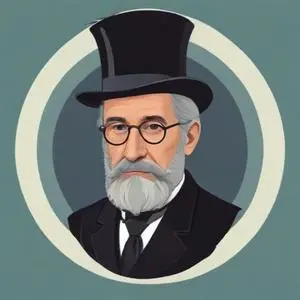
Founded the first formal laboratory of psychology, establishing psychology as a separate field of study and developing the concept of structuralism, which focuses on breaking down mental processes into basic components.
Regarded by many as the pioneer of modern psychology, Wilhelm Wundt is renowned for being the first person to call himself a psychologist, distinguishing psychology as a science from philosophy and biology. In 1879, he founded the first formal laboratory for psychological research at the University of Leipzig, marking psychology as an independent field of study.
Born on August 16, 1832, in Neckarau, Baden (now part of Mannheim), Wundt was the fourth child of Maximilian Wundt, a Lutheran minister, and Marie Frederike, née Arnold. His family moved to Heidelsheim, a small medieval town in Baden-Württemberg, when he was around six years old. Wundt's paternal grandfather, Friedrich Peter Wundt, was a professor of geography and pastor in Wieblingen.
Wundt's contributions to the field of psychology are vast and far-reaching. He established the first academic journal for psychological research, Philosophische Studien, which he published from 1883 to 1903, followed by Psychologische Studien from 1905 to 1917. Through these journals, Wundt published the research of his institute, further solidifying psychology as a distinct field of study.
In 1874, Wundt published his seminal work, Grundzüge der physiologischen Psychologie (Principles of Physiological Psychology), which laid the foundation for modern psychology. This comprehensive treatise explored the relationship between physiology and psychology, paving the way for future research in the field.
Wundt's work had a profound impact on modern society. His establishment of the first psychology laboratory and journal helped to legitimize psychology as a science, leading to a greater understanding of human behavior and mental processes. His research and teachings influenced generations of psychologists, including notable figures such as William James and Sigmund Freud.
Wundt's philosophical contributions centered around the concept of voluntarism, which posits that the will is a fundamental aspect of human consciousness. He believed that human behavior is the result of a complex interplay between conscious and unconscious processes, and that the study of psychology must take into account both the physiological and philosophical aspects of human experience.
In recognition of his groundbreaking work, Wundt received numerous awards and honors. A survey published in American Psychologist in 1991 ranked Wundt's reputation as first for all-time eminence, based on ratings provided by 29 American historians of psychology. William James and Sigmund Freud were ranked a distant second and third, respectively.
Wilhelm Wundt's legacy extends far beyond his own accomplishments. He paved the way for future generations of psychologists, and his work continues to influence the field to this day. As the father of modern psychology, Wundt's contributions to our understanding of human behavior and mental processes are immeasurable.
Through his tireless efforts to establish psychology as a distinct field of study, Wilhelm Wundt left an indelible mark on the world of psychology. His contributions continue to inspire and inform researchers to this day, ensuring his legacy as the father of modern psychology.
Born in 1856
Pioneering psychoanalyst who developed theories on the subconscious mind, childhood experiences, and the structure of personality, revolutionizing our understanding of human behavior and psychology.
Born in 1875
Developed the concept of collective unconscious and archetypes, and founded analytical psychology, which emphasizes the integration of opposites and the process of individuation.
Born in 1842
Pioneering philosopher and psychologist who explored the nature of consciousness, free will, and religious experience, and is known for his pragmatic approach to philosophy and psychology.
Born in 1879
Founded the school of behaviorism, which focused on observable behaviors rather than internal thoughts or feelings, and is known for his controversial "Little Albert" experiment.
Born in 1904
Developed the theory of operant conditioning, which explores the relationship between behavior and environment, and invented the "Skinner box" to study learning and behavior.
Born in 1896
Developed groundbreaking theories on child cognitive development and learning, emphasizing active discovery and hands-on experience. His work has shaped modern education and parenting practices.
Born in 1902
Developed the theory of psychosocial development, which proposes that individuals go through eight stages of development from infancy to old age, each with its own unique challenges and opportunities. His work has had a significant impact on our understanding of human development and identity formation.
Born in 1896
A pioneering psychologist who developed the sociocultural theory, which emphasizes the role of culture and social interaction in shaping human development and learning. His ideas have greatly influenced education and child development.
