


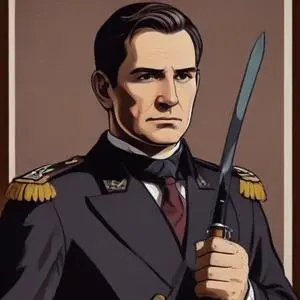
Leader of the Texan rebels during the Battle of the Alamo, famously drawing a line in the sand with his sword, asking the defenders to choose whether to stay and fight or leave. He's a symbol of bravery and patriotism in the fight for Texas independence.
Meet William Barret Travis, the 19th-century American lawyer and soldier who etched his name in the annals of history with his bravery, conviction, and unwavering dedication to the cause of Texas independence. Travis is most renowned for his pivotal role in the Texas Revolution, particularly during the infamous 13-day siege of the Alamo, where he valiantly commanded a small band of rebels against the imposing Mexican army.
Travis' grandfather, Berwick Travis, ventured to the British Colonies of North America as a young boy, only to be indentured for over a decade. Berwick's ancestors, the Travers of Tulketh Castle in Preston, England, had once known glory and wealth, but his own life was a far cry from their storied past. After serving his indenture, Berwick traveled to South Carolina, where he received a grant of over 100 acres of land in what is now Saluda County.
Travis' life took a dramatic turn when he became embroiled in the Texas Revolution. As a lieutenant colonel in the Texian Army, he took command of the Alamo, a small mission in San Antonio, along with a band of rebels, including Davy Crockett and Jim Bowie. In February 1836, the Mexican army, led by General Santa Anna, besieged the Alamo, prompting Travis to pen his now-famous "Victory or Death" letter, pleading for reinforcements to aid the beleaguered garrison.
The letter, a testament to Travis' unwavering commitment to the cause, has become an iconic symbol of American bravery and determination. Though the defenders of the Alamo ultimately fell to the Mexican army on March 6, 1836, Travis' sacrifice has immortalized him as a martyr for Texas independence.
The cry "Remember the Alamo!" became the rallying cry for the Texan rebels, and eventually, the official motto of Texas from 1836 to 1930. Today, the Alamo stands as a National Landmark and UNESCO World Heritage Site, attracting millions of visitors each year. Travis' name has been immortalized in various institutions, including Fort Travis, Travis Park, Travis County, and numerous schools.
Travis' "Victory or Death" letter has become a testament to his unwavering determination and bravery. In it, he wrote, "I am besieged, by a thousand or more of the Mexicans under Santa Anna—I have sustained a continual Bombardment and cannonade for 24 hours and have not lost a man—the enemy has demanded a surrender at discretion, otherwise, the garrison are to be put to the sword, if the fort is taken—I have answered the demand with a cannon shot, and our flag still waves proudly from the walls—I shall never surrender or retreat."
The letter's poignant final sentence has become a symbol of Travis' unyielding commitment to the cause: " Victory or death!"
While Travis' bravery and sacrifice are beyond dispute, his life was not without controversy. He was known to be hot-tempered and had a reputation for being involved in duels. Additionally, his role in the Texas Revolution has been subject to varying interpretations, with some regarding him as a hero and others viewing him as a rebellious outlaw.
Despite these controversies, Travis' legacy has endured, solidifying his place as an American icon and martyr for the cause of freedom and independence.
Born in 1793
First president of the Republic of Texas, leading the fight for independence from Mexico and later becoming a US senator and governor. Known for his bravery and strong leadership during Texas's formative years.
Born in 1786
Frontiersman and congressman who fought in the Battle of the Alamo, symbolizing bravery and patriotism in the face of overwhelming odds. He also promoted democracy and education in Tennessee.
Born in 1793
Pioneer of Texas colonization, instrumental in bringing American settlers to the region, and played a key role in the fight for Texas independence.
