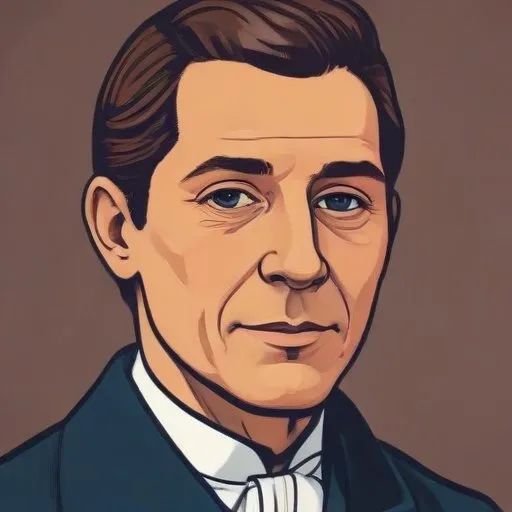
William Chester Minor: The Lexicographical Luminarian
A Convict's Contribution to the Oxford English Dictionary
William Chester Minor, a man of multifaceted talents and tumultuous life, is renowned for his extraordinary contributions to the Oxford English Dictionary (OED) while being an inmate in a psychiatric hospital. His unwavering dedication to lexicography, despite being confined, earned him a place in the annals of literary history.
Early Life and Career
Born on June 22, 1834, in Ceylon (now Sri Lanka), Minor was the son of Eastman Strong Minor and Lucy Bailey, Congregational church missionaries from New England. He had numerous half-siblings, including Thomas T. Minor, the future mayor of Seattle, Washington. Minor's early life was marked by relocation, as he was sent to the United States at the age of 14 to live with relatives in New Haven, where he attended Hopkins Grammar School.
Minor's academic pursuits took him to the Yale School of Medicine, where he graduated in 1863 with a medical degree and a specialization in comparative anatomy. During his medical studies, he supported himself by working as an instructor at the Russell Academy and as an assistant on the 1864 revision of Webster's Dictionary, under the supervision of Noah Porter.
Military Career and the Fateful Incident
Minor joined the Union Army as a surgeon and may have served at the Battle of the Wilderness in May 1864. After the war, he moved to England, where he became afflicted with delusions, leading him to shoot a man he believed had broken into his room. This incident led to his commitment to a secure British psychiatric hospital from 1872 to 1910.
The Lexicographical Legacy
During his incarceration, Minor discovered an escape from his delusions through reading and researching. He became an important contributor to the OED, pouring over his extensive personal library of antiquarian books and compiling quotations that illustrated the usage of particular words.
Minor's work was instrumental in shaping the OED, with his contributions considered some of the most valuable and accurate. His dedication to lexicography earned him recognition from the dictionary's editors, who praised his meticulous attention to detail and unwavering commitment.
Late Life and Deportation
In 1910, responding to protests about Minor's treatment,
Winston Churchill, then British Home Secretary, ordered Minor deported to the United States. He was hospitalized in Connecticut, where he spent the remainder of his life, passing away on March 26, 1920.
Legacy and Impact
William Chester Minor's extraordinary story serves as a testament to the power of human resilience and the importance of intellectual pursuits. Despite being confined, Minor's contributions to the OED continue to inspire and inform scholars, writers, and linguists to this day.
- Minor's work on the OED has been recognized as a significant milestone in lexicographical research.
- His legacy extends beyond the dictionary, inspiring generations of scholars and intellectuals.
- Minor's story has been immortalized in Simon Winchester's book, The Professor and the Madman: A Tale of Murder, Insanity, and the Making of the Oxford English Dictionary.
William Chester Minor's remarkable journey, marked by both tragedy and triumph, will forever be remembered as a testament to the transformative power of knowledge and the human spirit.
FAQ
What was William Chester Minors contribution to the Oxford English Dictionary?
William Chester Minor was an American surgeon and linguist who made significant contributions to the Oxford English Dictionary. He was a prolific contributor, submitting over 10,000 quotations to the dictionary, and his work helped to shape the dictionarys development.
How did Minors experience as a surgeon influence his work on the Oxford English Dictionary?
Minors experience as a surgeon gave him a unique perspective on language and its uses. His familiarity with medical terminology and his attention to detail helped him to identify and provide accurate quotations for the dictionary.
What was Minors relationship with the Oxford English Dictionarys editors?
Minor worked closely with the Oxford English Dictionarys editors, particularly James Murray, and developed a close friendship with him. Despite being a contributor, Minors input was highly valued, and he was considered an integral part of the dictionarys development team.
What were Minors other linguistic interests and pursuits?
Minor was a polyglot and had a deep interest in languages, including Chinese, Japanese, and Sanskrit. He was also an avid collector of rare books and manuscripts, and his collection was donated to the Yale University Library after his death.
What is William Chester Minors legacy in the history of lexicography?
Minors legacy lies in his contributions to the Oxford English Dictionary, which remain an essential part of the dictionarys development. His meticulous attention to detail and his passion for language have made him a revered figure in the history of lexicography.