


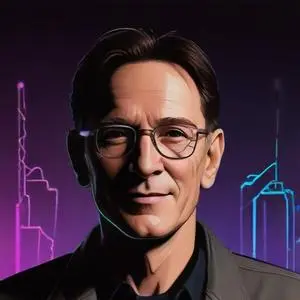
Pioneering science fiction author and screenwriter, credited with popularizing the concept of "cyberpunk" and exploring the intersection of technology and humanity in works like "Neuromancer".
William Gibson, an American-Canadian speculative fiction writer and essayist, is widely credited with pioneering the science fiction subgenre known as cyberpunk. His works have been instrumental in shaping our understanding of the intersection of technology and humanity, earning him the reputation as one of the most influential writers of the past few decades.
Gibson was born on March 17, 1948, in Conway, South Carolina. He spent his childhood moving between the United States and Canada, where he developed a fascination with science fiction and literature. In the late 1970s, he began his writing career, exploring the darker aspects of human nature through noir-inspired, near-future stories.
Gibson's early works, such as his short story "Burning Chrome" (1982), introduced the concept of cyberspace, which he popularized in his debut novel "Neuromancer" (1984). This novel, along with its successors "Count Zero" (1986) and "Mona Lisa Overdrive" (1988), formed the dystopian Sprawl trilogy, which revamped science fiction literature in the 1980s. The term "cyberpunk" was coined to describe this new subgenre, which captivated readers with its gritty, high-tech, and often nihilistic vision of the future.
In the 1990s, Gibson collaborated with Bruce Sterling on the alternate history novel "The Difference Engine" (1990), a landmark work of steampunk. This marked a departure from his cyberpunk roots, as he began to explore other genres and themes. The Bridge trilogy, comprising "Virtual Light" (1993), "Idoru" (1996), and "All Tomorrow's Parties" (1999), delved into the sociology of near-future urban environments, post-industrial society, and late capitalism.
The turn of the century saw Gibson transition towards more realist novels, such as "Pattern Recognition" (2003), "Spook Country" (2007), and "Zero History" (2010). These works, set in a roughly contemporary world, brought his writing to mainstream bestseller lists for the first time. This shift towards realism marked a new direction in his career, as he continued to explore the intersections of technology, culture, and humanity.
Gibson's latest novels, "The Peripheral" (2014) and "Agency" (2020), return to his science fiction roots, revisiting familiar themes of technology and human experience. Throughout his career, Gibson has been credited with predicting and influencing the development of the internet, virtual reality, and other technologies. His work has been recognized with numerous awards, and he continues to be a driving force in shaping our understanding of the complex relationships between technology, humanity, and society.
Gibson's writing often explores the consequences of emerging technologies on human relationships and societal structures. He has expressed concerns about the potential dangers of unchecked technological progress, advocating for a more mindful approach to innovation. His work frequently delves into the tension between individual freedom and corporate influence, highlighting the importance of critical thinking in the face of rapid technological change.
Gibson's ideas have permeated popular culture, inspiring countless works of fiction, film, and art. His concept of cyberspace has become a ubiquitous term, symbolizing the interconnected digital landscape of the 21st century. He has been cited as an influence by numerous writers, filmmakers, and musicians, including the Wachowskis, the creators of "The Matrix" film trilogy.
"The future is already here – it's just not very evenly distributed." – William Gibson, "The Economist" (2004)
"Cyberspace is the product of a global network of interconnected computers, and it exists, in some sense, simultaneously everywhere and nowhere." – William Gibson, "Neuromancer" (1984)
Through his visionary writing, William Gibson has left an indelible mark on our understanding of technology, humanity, and the complex relationships between them. As a pioneer of cyberpunk and a master of speculative fiction, his work continues to inspire and provoke, offering a glimpse into the possibilities and pitfalls of our shared future.
89 Years Old
A postmodern novelist known for blending paranoia, history, and surrealism in complex, sprawling narratives that defy easy interpretation. His works often explore the interconnectedness of conspiracy, technology, and human experience.
89 Years Old
Acclaimed author of novels, essays, and plays that explore American culture, politics, and identity, often blending fiction and reality. Known for his unique writing style and thought-provoking themes.
95 Years Old
A visionary writer who explored the intersection of technology, psychology, and society through surreal and often dystopian narratives, known for his prophetic and influential works.
97 Years Old
Pioneering science fiction author and philosopher who explored the nature of reality, identity, and humanity through thought-provoking novels and short stories. His works often delved into the consequences of advanced technology and alternate realities.
66 Years Old
Prolific science fiction and historical fiction author, known for blending historical and philosophical themes with speculative fiction and exploring the intersection of technology and society.
55 Years Old
A science fiction author and digital rights activist, known for his advocacy of Creative Commons and criticism of corporate control over digital media.
