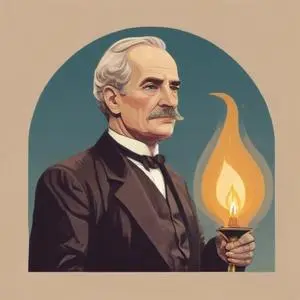
William Jennings Bryan: The Great Commoner
A Leader of the People, a Voice for Change
William Jennings Bryan was a prominent American lawyer, orator, and politician who dominated the Democratic Party in the late 19th and early 20th centuries. He is best known for his passionate advocacy for the common people, his rhetorical power, and his three-time candidacy for President of the United States.
A Life of Service
Bryan was born on March 19, 1860, in Salem, Illinois, and grew up in a family of modest means. He studied law and began his practice in Jacksonville, Illinois, before moving to Nebraska in the 1880s. In 1890, he was elected to the U.S. House of Representatives, where he served two terms and championed populist causes.
The Cross of Gold Speech
Bryan's most famous speech, the Cross of Gold, delivered at the 1896 Democratic National Convention, catapulted him to national prominence. In this speech, he denounced the gold standard and argued for the free coinage of silver, which he believed would benefit the common people and farmers. His impassioned plea, "You shall not crucify mankind upon a cross of gold," earned him the nomination for president.
A Political Career Marked by Passion and Principle
Bryan's presidential campaigns in 1896, 1900, and 1908, though ultimately unsuccessful, solidified his reputation as a champion of the people. He served as Secretary of State under President
Woodrow Wilson from 1913 to 1915, resigning in protest of Wilson's foreign policy. Throughout his career, Bryan remained true to his principles, consistently advocating for progressive reforms and humanitarian causes.
Influence on Modern Society
Bryan's legacy extends beyond his political career. He was a vocal advocate for women's suffrage, labor rights, and prohibition. His populist movement paved the way for future reformers and continues to influence American politics today.
Personal Milestones and Key Life Events
- Married to Mary Elizabeth Baird in 1884, with whom he had three children
- Served as a Presbyterian elder and was known for his Christian values
- Founded the weekly newspaper, The Commoner, which became a platform for his progressive ideas
Philosophical Contributions and Beliefs
Bryan's philosophy centered around the idea that the government should serve the people, not the interests of the wealthy and powerful. He believed in the power of the common people to effect change and advocated for policies that promoted social justice and equality.
Quotes and Memorable Sayings
- "You shall not crucify mankind upon a cross of gold."
- "Destiny is not a matter of chance, it is a matter of choice."
Historical Context and Legacy
Bryan's life and career were marked by a commitment to the people and a passion for progressive change. Though his presidential campaigns were unsuccessful, his legacy continues to inspire generations of Americans to fight for social justice and equality.
FAQ
What was William Jennings Bryans role in the Scopes Trial?
William Jennings Bryan was the prosecutor in the 1925 Scopes Trial, also known as the Monkey Trial, where he argued against the teaching of evolution in schools. He believed that evolution contradicted the Bible and was therefore unconstitutional. The trial was a major controversy at the time and remains a significant event in American legal history.
What were William Jennings Bryans views on imperialism?
William Jennings Bryan was a strong opponent of imperialism and imperialism. He believed that the US should not engage in colonialism and that the countrys role was to spread democracy and freedom, not to expand its territory. He famously spoke out against the annexation of Hawaii and the Philippines.
What was William Jennings Bryans cross of gold speech about?
William Jennings Bryans Cross of Gold speech was a famous speech he delivered at the 1896 Democratic National Convention. In it, he argued against the gold standard, which he believed favored the wealthy and hurt the common people. The speech catapulted him to national fame and made him a hero to many Americans.
What was William Jennings Bryans role in the Democratic Party?
William Jennings Bryan was a prominent figure in the Democratic Party and ran for president three times. He was a leader of the progressive wing of the party and advocated for policies such as free silver, government regulation of business, and labor rights. He was also a vocal critic of big business and corporate power.
What were William Jennings Bryans accomplishments as Secretary of State?
As Secretary of State from 1913 to 1915, William Jennings Bryan played a key role in shaping US foreign policy. He advocated for neutrality in World War I and helped to negotiate several international agreements, including the Bryan-Chamorro Treaty. He also worked to promote peace and arbitration in international conflicts.