


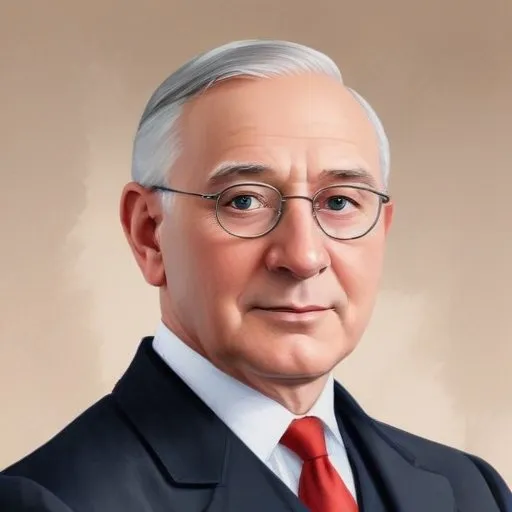
The 20th Solicitor General of Canada, a prominent lawyer and politician, played a significant role in shaping the country's justice system and laws. He is most known for his contributions to Canadian legal reform and policy-making.
William Joseph Browne was a Canadian lawyer, judge, and politician who left an indelible mark on the country's political and legal landscape. Throughout his illustrious career, he served in the Newfoundland House of Assembly, the House of Commons of Canada, and held various cabinet positions, cementing his legacy as a dedicated public servant.
Born on May 3, 1897, in St. John's, Newfoundland, Browne was the son of Liberius Browne and Bridget O'Reilly. He received his education from Holy Cross School, Saint Bonaventure's College, Merton College, Oxford, the University of Toronto, and Gray's Inn in London, laying the foundation for his future success.
Browne's foray into politics began in 1923, when he ran unsuccessfully for the Placentia-St. Mary's seat in the Newfoundland assembly. However, he didn't let this setback deter him. He was elected to the assembly in 1924, representing St. John's West, and went on to serve as a cabinet minister in the government of Frederick C. Alderdice, holding portfolios such as Minister of Finance and Customs and Minister of Justice.
In 1949, Browne was elected to the House of Commons of Canada, representing St. John's West, and became a member of the Progressive Conservative party. He served as a Minister without Portfolio in John Diefenbaker's cabinet from 1957 to 1960 and later as the Solicitor General of Canada from 1960 to 1962.
From 1934 to 1939, Browne served as a judge in the Central District Court, earning the prestigious title of King's Counsel in 1934. His judicial expertise and fairness earned him great respect in the legal community.
Browne was married four times, first to Mary Grace Harris in 1924, and later to Margaret, Muriel, and Ruth. In 1981, he published his biography, Eighty-four Years a Newfoundlander: Memoirs of William J. Browne, offering a glimpse into his eventful life and remarkable career.
William Joseph Browne's contributions to Canadian politics, law, and society are undeniable. His dedication to public service, commitment to justice, and passion for his community have left a lasting impact on the country. As a testament to his enduring legacy, his story continues to inspire future generations of leaders and lawyers.
Born in 1897
A Canadian leader who served as Prime Minister and won the Nobel Peace Prize for resolving the Suez Canal Crisis, known for his diplomatic efforts and peacekeeping initiatives.
Born in 1919
The charismatic leader who championed Canadian unity and implemented progressive policies, known for his iconic style and influential legacy in shaping modern Canada.
92 Years Old
The 20th Prime Minister of Canada, serving from 1993 to 2003, known for his leadership during the Quebec sovereignty movement and his role in shaping Canada's national unity. He implemented policies like the Clarity Act and the National Child Benefit.
45 Years Old
American professional ice hockey player who won two Stanley Cup championships and was a four-time NHL All-Star. Known for his rugged defensive play and physical presence on the ice.
70 Years Old
A Canadian politician and sociologist who served as Minister of the Environment, known for his advocacy on climate change and implementation of the Kyoto Protocol. He led the Liberal Party of Canada and was a key figure in shaping the country's environmental policies.
79 Years Old
A Canadian journalist and politician who served as the leader of the Liberal Party of Canada and was a prominent public intellectual, known for his writings on politics, history, and human rights.
97 Years Old
The 17th Prime Minister of Canada, serving from 1984 to 1985, is most known for his brief tenure and struggles to maintain party unity. He's also recognized for his prior role as Minister of Justice, where he introduced significant reforms.
79 Years Old
The first and only female Prime Minister of Canada, serving for a brief four months in 1993, known for her efforts to reform the country's justice system. She was also a strong advocate for women's rights and gender equality.
