


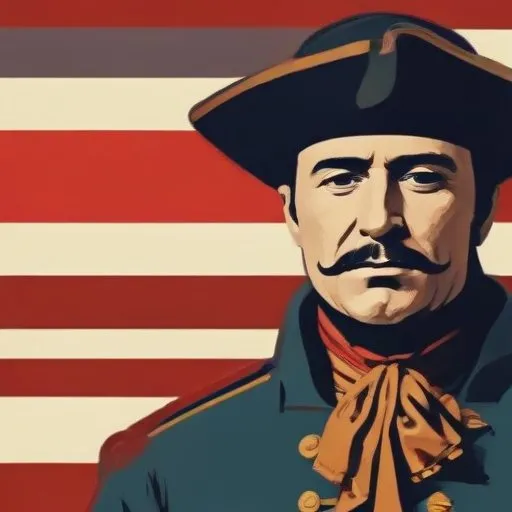
Led a successful expedition to capture the French fortress of Louisbourg in 1745, a significant victory in King George's War. He was the first American-born person to be awarded a British baronetcy.
Sir William Pepperrell, 1st Baronet, is renowned for his instrumental role in orchestrating, financing, and leading the 1745 expedition that successfully captured the French fortress of Louisbourg during King George's War. This remarkable feat not only showcased his exceptional military prowess but also cemented his position as one of the most influential figures in colonial Massachusetts.
William Pepperrell was born on June 27, 1696, in Kittery, Maine, which was then a part of the Province of Massachusetts Bay. He was the son of William Pepperrell, a Massachusetts settler of Welsh descent, and Margery Bray, the daughter of a well-to-do Kittery merchant. Pepperrell's family was steeped in a tradition of entrepreneurship and commerce, with his father being a shipbuilder and fishing boat owner.
After studying surveying and navigation, Pepperrell joined his father's business, eventually assuming responsibility for the family's mercantile enterprise following the death of his elder brother in 1713. He expanded the business to become one of the most prosperous mercantile houses in New England, with ships carrying lumber, fish, and other products to the West Indies and Europe. Pepperrell's entrepreneurial acumen was complemented by his military service, where he rose through the ranks of the Massachusetts militia, becoming a captain in 1717, major, lieutenant-colonel, and eventually colonel in 1726.
Pepperrell's leadership skills and strategic thinking were also evident in his political career. He served in the Massachusetts General Court, the provincial legislature, from 1726 to 1727, and was a member of the Governor's Council from 1727 to 1759, serving eighteen years as its president. Despite not being a trained lawyer, Pepperrell demonstrated exceptional judicial acumen, serving as the chief justice of the Massachusetts Superior Court.
Pepperrell married Mary Hirst, daughter of a wealthy Boston merchant, in 1723, and together they had four children, two of whom died in infancy. Throughout his life, Pepperrell owned around twenty enslaved people, a practice that was prevalent during that era. Despite this controversy, Pepperrell's legacy is marked by his vision, courage, and strategic brilliance, which continue to inspire generations.
Pepperrell's capture of Louisbourg in 1745 was a pivotal moment in King George's War, marking a significant turning point in the conflict. The victory not only boosted British morale but also paved the way for further British expansion in North America. Pepperrell's legacy extends beyond his military achievements, as his mercantile ventures and judicial leadership contributed to the growth and development of colonial Massachusetts.
In comparison to his contemporaries, Pepperrell's achievements stand out for their sheer scope and impact. While other colonial leaders focused on local concerns, Pepperrell's vision extended to the broader implications of British colonial expansion. His ability to balance military and mercantile interests, while navigating the complexities of colonial politics, sets him apart as a truly exceptional leader of his time.
Sir William Pepperrell's remarkable life and legacy serve as a testament to his vision, courage, and strategic brilliance. From his entrepreneurial ventures to his military and judicial leadership, Pepperrell's impact on colonial Massachusetts and beyond is undeniable. As we reflect on his life, we are reminded of the power of visionary leadership and the importance of understanding the complexities of our shared history.
Born in 1732
The first President of the United States, a military hero who led the country to independence, and set the standard for the office of the presidency. He's known for his honesty, integrity, and leadership skills.
Born in 1706
A founding father of the United States, he was a leading figure in the Enlightenment, known for his groundbreaking inventions, scientific discoveries, and influential writings. He played a key role in shaping American history and politics.
Born in 1735
This American patriot and artisan is famous for his midnight ride during the American Revolution, warning colonists that the British were coming, and for his iconic engravings, including the Boston Massacre depiction.
Born in 1737
First Governor of Massachusetts, instrumental in American independence and famously signed the Declaration of Independence with a large, bold signature .
Born in 1722
A leading figure in the American Revolution, he played a key role in shaping the country's independence and democracy. He's also famous for his Boston Beer Company, which still brews his namesake beer today.
79 Years Old
A Pulitzer Prize-winning composer, known for blending minimalism with complex rhythms, creating a unique sound that resonates with audiences worldwide.
Born in 1743
The principal author of the Declaration of Independence and a strong advocate for individual liberties and limited government, shaping America's foundational principles. He oversaw the Louisiana Purchase, doubling the country's territory.
Born in 1725
A leading advocate for American independence from Britain, known for his passionate arguments against taxation without representation, inspiring the Boston Patriots and shaping the Revolution.
