


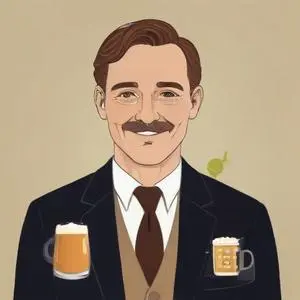
Developed statistical methods, particularly the t-test, to analyze small samples, revolutionizing quality control in industries. Known for publishing under the pseudonym "Student".
William Sealy Gosset, better known by his pen name "Student," was a trailblazing English statistician, chemist, and brewer who revolutionized the field of statistics with his groundbreaking work on small sample experimental design and analysis. His most famous contribution, Student's t-distribution, remains a cornerstone of statistical significance testing to this day.
Gosset was born on June 13, 1876, in Canterbury, England, to Colonel Frederic Gosset and Agnes Sealy Vidal. He received his early education at Winchester College before matriculating as a Winchester Scholar in natural sciences and mathematics at New College, Oxford. Upon graduating in 1899, he joined the brewery of Arthur Guinness Son in Dublin, Ireland, where he spent the next 38 years of his career.
Gosset's self-taught skills in statistics led him to develop innovative methods for experimental design and analysis, which he applied in his role as Head Experimental Brewer at Guinness. He pioneered the use of small sample, stratified, and repeated balanced experiments on barley to identify the best yielding varieties. His work in the brewery and on the farm laid the foundation for modern statistical techniques, including decision theory interpretation of statistics.
Gosset's collaboration with Karl Pearson, a renowned mathematician, played a significant role in shaping his statistical methods. During his two-term stint at Pearson's Biometrics laboratory in 1906-1907, Gosset gained valuable insights and knowledge that he later applied in his work. The two maintained a good relationship, with Pearson providing mathematical support to Gosset's innovative ideas.
Gosset married Marjory Gosset (née Phillpotts) and had three children: Harry Gosset, a consultant pediatrician; Bertha Marian Gosset, a geographer and nurse; and Ruth Gosset, who married the Oxford mathematician Douglas Roaf and had five children. Gosset's legacy extends beyond his statistical contributions, as his children went on to make notable achievements in their respective fields.
Gosset's work embodied a practical approach to statistics, focusing on economic significance and decision theory interpretation. He believed in the importance of combining theoretical knowledge with real-world experience, as evident in his self-taught skills and collaborative approach. His philosophy has inspired generations of statisticians, encouraging them to adopt a pragmatic and problem-solving mindset.
Gosset's statistical methods have had a profound impact on various fields, including agriculture, medicine, and social sciences. His work on small sample experimental design and analysis has enabled researchers to make informed decisions with limited data, leading to breakthroughs in numerous areas. Today, his methods remain an essential part of statistical analysis, influencing decision-making processes worldwide.
"The only statistician is he who, having calculated a thing, takes into account the fact that he is himself only one of many and that others may have calculated the same thing in a different way." - William Sealy Gosset
Gosset's work in the early 20th century paved the way for modern statistical analysis. His pioneering efforts in small sample experimental design and analysis have led to the development of new statistical techniques, cementing his place as one of the most influential statisticians of the 20th century. His legacy continues to inspire researchers, scientists, and statisticians, ensuring that his contributions remain relevant and valuable in today's data-driven world.
Born in 1890
A pioneer in statistics and genetics, he developed techniques for data analysis and laid the foundations for modern evolutionary theory. His work has far-reaching implications in fields like medicine, agriculture, and social sciences.
Born in 1857
Developed statistical methods and championed eugenics, a now-discredited theory of genetic improvement through selective breeding. His work in statistics, particularly correlation coefficient, remains influential in modern data analysis.
Born in 1915
Developed statistical methods and data visualization techniques that transformed the field of data analysis, making complex data more accessible and understandable.
Born in 1783
A Romantic-era artist capturing the beauty of the English countryside through serene and detailed landscapes, often featuring tranquil skies and rustic scenery.
