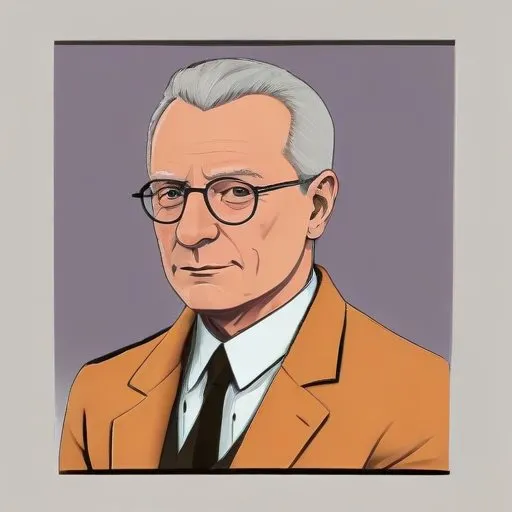
The Topological Trailblazer: Witold Hurewicz
A Legacy of Mathematical Marvels
Witold Hurewicz, a Polish mathematician, left an indelible mark on the realm of topology, shaping the discipline with his groundbreaking contributions. His name is synonymous with the development of algebraic topology, and his work continues to inspire mathematicians to this day.
Early Life and Education: A Polish Prodigy
Born on June 29, 1904, in Łódź, Poland, Hurewicz grew up in an era of great change. His father, Mieczysław Hurewicz, was an industrialist, and his mother, Katarzyna Finkelsztain, hailed from a town with a rich cultural heritage. This diverse background laid the foundation for Hurewicz's future endeavors.
During World War I, Hurewicz's education was disrupted, but he persevered, eventually enrolling in the University of Warsaw. It was here that he discovered his passion for topology, which became the focal point of his mathematical pursuits.
The Vienna Years: A Turning Point
Hurewicz's decision to pursue his graduate studies in Vienna under the guidance of
Hans Hahn and
Karl Menger proved pivotal. In 1926, he received his Ph.D. and embarked on a journey that would take him to Amsterdam, where he worked alongside L.E.J. Brouwer. This period marked the beginning of his remarkable contributions to topology.
The Amsterdam Era: A Leap in Algebraic Topology
As an assistant to Brouwer, Hurewicz delved deeper into the realm of algebraic topology. His work during this period laid the groundwork for his future research and cemented his reputation as a trailblazer in the field.
- His Rockefeller scholarship allowed him to spend a year in Amsterdam, where he made significant strides in understanding the connections between algebra and topology.
- His research on the homotopy groups of spaces paved the way for future generations of mathematicians to explore this area.
A New Chapter: The United States and Beyond
In 1936, Hurewicz decided to remain in the United States, opting not to return to his position in Amsterdam. This marked the beginning of a new chapter in his life, as he went on to work at the University of North Carolina at Chapel Hill and contribute to the war effort with his research on applied mathematics.
War Effort and Classified Research
During World War II, Hurewicz's work took on a new dimension. His research on servomechanisms was classified due to its military significance, showcasing the practical applications of his mathematical expertise.
Throughout his career, Hurewicz's contributions extended beyond the realm of pure mathematics, demonstrating the far-reaching impact of his work.
A Lasting Legacy
Today, Witold Hurewicz is remembered as a pioneering figure in topology. His work has inspired generations of mathematicians, and his influence continues to be felt in the field. As we reflect on his remarkable journey, we are reminded of the power of human ingenuity and the boundless potential of the human mind.
FAQ
What is Witold Hurewiczs most notable mathematical contribution?
Witold Hurewicz made significant contributions to topology, particularly in the field of homotopy theory. His work on the Hurewicz theorem, which relates the fundamental group of a space to its homotopy groups, is considered a fundamental result in algebraic topology.
How did Witold Hurewiczs work influence modern mathematics?
Witold Hurewiczs research laid the foundation for subsequent developments in algebraic topology, homological algebra, and geometric topology. His work has had a lasting impact on the field, influencing prominent mathematicians such as Stephen Smale and John Milnor.
What was Witold Hurewiczs educational background?
Witold Hurewicz earned his Ph.D. in mathematics from the University of Warsaw in 1926. He later worked at the University of Cambridge, where he collaborated with prominent mathematicians, including John von Neumann and Béla Kerékjártó.
What awards did Witold Hurewicz receive for his contributions to mathematics?
Witold Hurewicz was awarded several honors for his contributions to mathematics, including the Prix Bordin from the French Academy of Sciences in 1931 and the National Medal of Science in 1983.
What was Witold Hurewiczs role in the development of the Hurewicz fibration?
Witold Hurewicz introduced the concept of the Hurewicz fibration, a fundamental construction in homotopy theory. This innovation has far-reaching implications in algebraic topology, differential geometry, and geometric topology.