


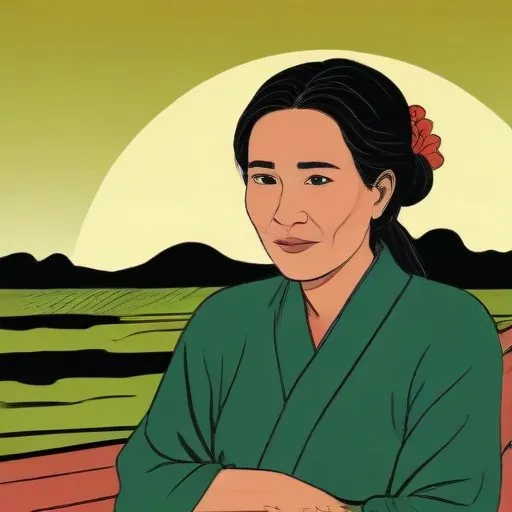
A renowned Vietnamese poet and author celebrated for his lyrical and introspective works that explored themes of love, nature, and social change. His poetry is cherished for its accessibility and depth, resonating with readers across generations.
Xun Diu, a prominent figure of the twentieth-century Thơ Mới (New Poetry) Movement, is best known for his distinct voice influenced by Western literature, notably French symbolism. His poetry collection, Thớt, published in 1938, showcased his unique style, which earned him the title "the newest of the New Poets."
Xun Diu was born on February 2, 1916, in his mother's hometown of G Bi, Phc Ha Commune, Tuy Phc District, Bnh nh Province. His father, Ng Xun Th, and mother, Nguyn Th Hip, instilled in him a love for literature and the arts. Due to Vietnamese traditions, his official hometown was recognized as the village of Tro Nha in Can Lc District, H Tnh Province, which he later used as a pseudonym.
Xun Diu's poetry, characterized by a desperation for love and a desire to experience the beauty of the world, resonated with the Vietnamese people during the 1930s and 1940s. His unique blend of Western influences and traditional Vietnamese themes catapulted him to fame, earning him recognition as one of the leading figures of the Thơ Mới Movement.
In 1945, Xun Diu joined the Vietnamese Communist Party, which marked a significant shift in his poetry. His works began to focus on the Party's resistance against the French and American forces, showcasing his commitment to the revolution.
Although Xun Diu's love poems used expressions and pronouns commonly associated with heterosexual relationships, he was known to be gay. This aspect of his personal life was confirmed by his close friends, including writer T Hoi. The impact of his sexual orientation on his poetry remains a topic of discussion among scholars and critics.
Xun Diu left behind a vast collection of around 450 poems, as well as numerous short stories, essays, and literary criticisms. His contributions to Vietnamese literature are undeniable, and his poetry continues to inspire generations of writers and readers alike.
Xun Diu's life and works serve as a testament to his commitment to the revolution and his passion for literature. His poetry continues to inspire and influence writers, solidifying his position as one of the most important figures in Vietnamese literary history.
Born in 1870
A renowned Vietnamese poet and satirist, celebrated for his witty and poignant works that critiqued social norms and politics, leaving a lasting impact on Vietnamese literature.
