


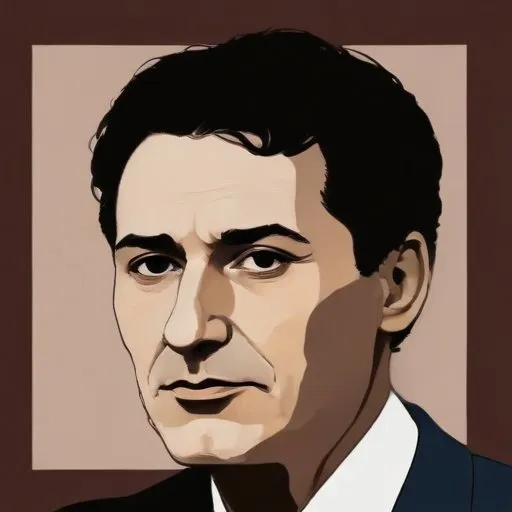
A Russian-Israeli journalist and poet who wrote about the struggles of Jewish immigrants and the establishment of the State of Israel, using symbolism and imagery to convey powerful emotions.
Yitzhak Lamdan, a luminary of Hebrew literature, is renowned for his epic poem Masada: A Historical Epic, which has become an anthem for the Jewish struggle for survival and a testament to the indomitable spirit of the Zionist enterprise.
Born Itzi-Yehuda Lubes or Lobes in 1899 in Mlynov, Russia (now Ukraine), Lamdan's life was marked by upheaval and displacement. His family's affluent status did little to shield them from the ravages of World War I and the subsequent civil wars. Forced to flee, Lamdan wandered through Southern Russia with his brother before joining the Red Army.
In 1920, tragedy struck when his parents' home was destroyed, and his brother was killed. Thispersonal loss propelled Lamdan to immigrate to Mandatory Palestine as part of a socialist youth group, a move that would come to be known as the Third Aliyah.
In 1927, Lamdan published his magnum opus, Masada: A Historical Epic, a sweeping poem that would shake the foundations of Hebrew literature. This powerful work reimagined the ancient stronghold of Masada as a symbol of the Land of Israel and the Zionist endeavor, casting it as both a refuge and a potential trap.
Award-winning literary scholar and cultural historian David G. Roskies asserts that Lamdan's poem even inspired the uprising in the Warsaw Ghetto. This seismic impact cemented Lamdan's status as a preeminent poet and thinker of his generation.
In 1955, Lamdan was posthumously awarded the Israel Prize for Literature, a testament to his enduring influence on the country's literary landscape.
The Ramat Gan Municipality, in conjunction with the Hebrew Writers Association in Israel, instituted the annual Lamdan Prize in 1954, honoring the poet's legacy by recognizing outstanding literary works for children and youth.
Yitzhak Lamdan's poetry and legacy continue to inspire generations of writers, thinkers, and freedom fighters. His unwavering commitment to the Zionist cause and his unflinching portrayal of the human experience have left an indelible mark on the literary world.
Through his work, Lamdan reminds us of the power of art to shape our understanding of ourselves and our place in the world. As we reflect on his life and legacy, we are reminded of the importance of creativity, resilience, and the unbroken spirit of humanity.
Today, Yitzhak Lamdan's poetry continues to resonate, a beacon of hope and defiance in the face of adversity, inspiring us to persevere and to dream of a brighter tomorrow.
Born in 1873
A Ukrainian-Austrian journalist, author, and poet who played a significant role in shaping modern Hebrew literature and is considered one of the pioneers of modern Hebrew poetry. He's known for his lyrical and symbolic style, which explored themes of Jewish identity and culture.
