


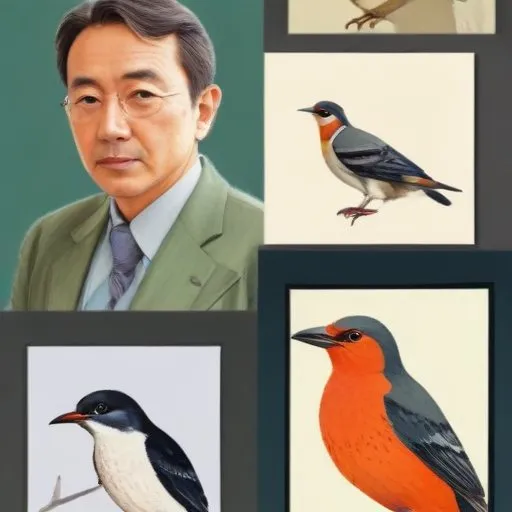
Founded the Yamashina Institute for Ornithology, a renowned research center dedicated to the study and conservation of birds, making significant contributions to the field of ornithology.
Yoshimaro Yamashina, a renowned Japanese ornithologist, is best known for his groundbreaking contributions to the field of ornithology, particularly in the study of Asian and Pacific avian species. He is also credited with establishing the esteemed Yamashina Institute for Ornithology, a pioneering research center dedicated to the study of birds.
Yamashina was born on July 5, 1900, in Kojimachi, Tokyo, as the second son of Prince Kikumaro Yamashina and Princess Noriko Kujo Yamashina. Through his mother, he was the nephew of the then Crown Prince Yoshihito, the future Taishō Emperor. Growing up on the vast Yamashina estate in Tokyo, he developed a strong fascination with birds, which would eventually become his life's passion.
Yamashina attended the prestigious Gakushuin Peers School and later enrolled in the Imperial Japanese Army Academy, graduating with a specialty in artillery in 1920. He was promoted to the rank of lieutenant and conferred with the Grand Cordon of the Order of the Rising Sun. However, he resigned from the army in 1929 to pursue his interest in zoology, enrolling in Tokyo Imperial University and graduating in 1931.
In 1932, Yamashina established the Yamashina Institute for Ornithology at his home in Shibuya, Tokyo, to house his extensive bird collections, ornithological library, and research facilities. This institute became a hub for ornithological research in Japan, attracting scholars and researchers from around the world.
Yamashina's research focused on the avian species of Asia and the Pacific Ocean. He conducted his doctoral research on avian cytology, in affiliation with Hokkaido University, and obtained his doctorate in 1942 with studies on hybrid sterility under Professor Oguma Mamoru of Hokkaido Imperial University. His work significantly advanced the field of ornithology, shedding light on the diversity and complexity of bird species in the region.
Yamashina was awarded the Grand Cordon of the Order of the Rising Sun in 1920 and was conferred with the title of marquis (kōshaku) in 1929. He was also promoted to the rank of lieutenant in the Imperial Japanese Army.
Yamashina's contributions to ornithology have left an enduring legacy, inspiring generations of researchers and scientists. The Yamashina Institute for Ornithology continues to be a leading research center in Japan, fostering collaboration and advancing our understanding of the natural world. Yamashina's dedication to the study of birds has not only enriched our knowledge of ornithology but has also contributed to the preservation and conservation of avian species.
Yoshimaro Yamashina's remarkable journey, marked by his passion for ornithology, has left an indelible mark on the scientific community. His pioneering work continues to inspire future generations of researchers, ensuring the preservation of avian species for years to come.
Born in 1908
Renowned for creating detailed and accessible field guides, this ornithologist helped popularize birdwatching and conservation, making nature more accessible to the masses.
Born in 1909
A renowned British ornithologist, conservationist, and artist, known for founding the Wildfowl and Wetlands Trust and designing the logo of the World Wildlife Fund. His artwork and conservation efforts have inspired generations of naturalists and artists.
Born in 1896
Renowned Indian ornithologist and author, known for his groundbreaking work on Indian birds, contributing significantly to the field of ornithology and inspiring a new generation of bird enthusiasts.
Born in 1904
A renowned biologist and ornithologist who pioneered the modern synthesis of evolutionary biology, shaping our understanding of species and their diversity.
Born in 1903
A renowned expert in animal behavior, he pioneered the study of instinct and imprinting, and is famous for his work on aggression and his book "On Aggression".
