


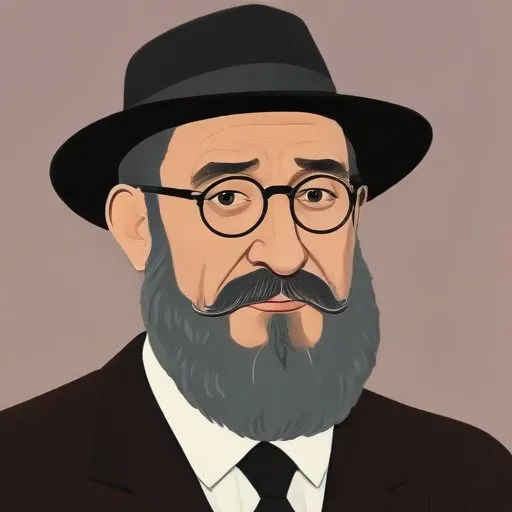
A pioneer of Jewish Renewal, he blended traditional Judaism with modern spirituality and psychology, creating a more inclusive and ecstatic approach to faith. He's known for his work in interfaith dialogue and spiritual direction.
Zalman Schachter-Shalomi, affectionately known as Reb Zalman, was a trailblazing rabbi, scholar, and spiritual leader who spearheaded the Jewish Renewal movement, revolutionizing the way Jews engaged with their faith and tradition. As a pioneer in ecumenical dialogue, Reb Zalman bridged the gap between different religious communities, fostering a deeper understanding and appreciation of diverse spiritual practices.
Born in 1924 in Poland, now Ukraine, Schachter-Shalomi grew up in Vienna, Austria, where he was immersed in a rich cultural heritage. His father, a liberal Belzer Hasid, encouraged Zalman's education in both Zionist high school and Orthodox yeshiva, laying the foundation for his future spiritual pursuits.
During World War II, Reb Zalman was interned in detention camps under the Vichy French government, eventually fleeing to the United States in 1941 to escape the Nazi regime. This experience would later shape his commitment to interfaith dialogue and understanding.
In 1947, Reb Zalman was ordained as an Orthodox rabbi within the Chabad Lubavitch Hasidic community, under the guidance of the sixth Lubavitcher Rebbe, Yosef Yitzchok Schneersohn. He went on to serve Chabad congregations in Massachusetts and Connecticut, further solidifying his roots in Jewish tradition.
However, Reb Zalman's spiritual curiosity soon led him to explore beyond the boundaries of Orthodox Judaism. In the 1950s, he began to delve into meditation and contemplative practices, eventually publishing one of the first English-language books on Jewish meditation in 1958.
In the 1960s, Reb Zalman's spiritual journey took a pivotal turn. He began to explore the intersection of Jewish mysticism and psychedelic experiences, famously experimenting with LSD as a means of spiritual expansion. This period of exploration led him to diverge from the Chabad Lubavitch community and forge a new path, which would eventually become the Jewish Renewal movement.
Through his teachings, writings, and workshops, Reb Zalman fostered a movement that emphasized personal spiritual growth, ecumenical dialogue, and a renewed connection to Jewish mysticism. He drew inspiration from Sufism, Buddhism, and Native American spirituality, among other traditions, to create a unique synthesis of Jewish spirituality.
Reb Zalman's influence extends far beyond the Jewish community. His work has inspired countless individuals from diverse faith backgrounds to explore the depth of their own spiritual traditions. Through his writings, teachings, and mentorship, he has left an indelible mark on modern spirituality.
Today, Reb Zalman's legacy continues to inspire a new generation of spiritual seekers, fostering a deeper understanding of Jewish mysticism and its relevance to modern society.
"The only way to get what we want is to give up what we want. The only way to get what we need is to give up what we think we need."
"Judaism is not just a relic of the past, but a living, breathing, evolving tradition that must be reinterpreted and re-expressed for each new generation."
Reb Zalman Schachter-Shalomi passed away on July 3, 2014, leaving behind a rich tapestry of wisdom, love, and inspiration. His life's work serves as a testament to the power of spiritual exploration, interfaith dialogue, and the pursuit of a deeper connection to the divine.
