


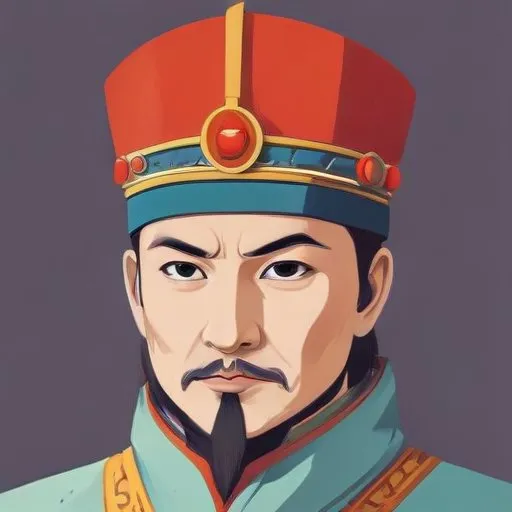
Ruling China from 1505 to 1521, he's remembered for his eunuch-dominated government, lavish spending, and military campaigns that expanded the empire's borders. His reign was marked by extravagance and external conflicts.
The Zhengde Emperor, also known as Zhu Houzhao, was the 11th emperor of the Ming dynasty, reigning from 1505 to 1521. He is infamous for his childlike behavior, extravagance, and favoritism towards eunuchs, which led to reckless decisions and a tumultuous reign.
Zhu Houzhao was born on October 26, 1491, as the eldest son of the Hongzhi Emperor. He was made crown prince at a very early age and received a thorough education in Confucian literature, excelling in his studies. His younger brother died in infancy, ensuring that Zhu Houzhao would succeed his father without contest.
Zhu Houzhao ascended the throne as the Zhengde Emperor at the age of 14, taking the era name Zhengde, meaning "right virtue" or "rectification of virtue." Despite his ministers' expectations of a benevolent and brilliant emperor, the Zhengde Emperor proved to be reckless, foolish, and disinterested in ruling.
He indulged in a luxurious and prodigal lifestyle, neglecting state affairs and favoring eunuchs such as Liu Jin, who took advantage of their position to squander vast sums of money. The emperor's actions have been considered pointless and lacking in responsibility.
Despite his shortcomings, the Zhengde Emperor led an expedition against the Northern Yuan in the 1510s and squashed rebellions by Prince Anhua and Prince Ning. He also engaged in correspondences with the Malaccan government about their mutual distrust against the Portuguese, with whom the Ming dynasty fought several conflicts.
The Zhengde Emperor's personal life was marked by extravagance and indulgence. He was known for his numerous concubines and mistresses, and it was said that he had thousands of women in his harem.
The emperor's reckless behavior ultimately led to his downfall. He died on April 20, 1521, at the age of 29, after contracting an illness following a drunken fall from a boat into the Yellow River. He left behind no sons and was succeeded by his first cousin, Zhu Houcong.
The Zhengde Emperor's reign was marked by turmoil and extravagance, and his legacy is often viewed as a period of decline for the Ming dynasty. Despite his shortcomings, however, the emperor's reign also saw significant cultural and economic developments, including the creation of new porcelain and ceramic techniques.
The Zhengde Emperor's story serves as a cautionary tale about the dangers of unchecked power and the importance of responsible leadership. Despite his many flaws, the emperor's reign remains an important chapter in Chinese history, offering valuable lessons for future generations.
Born in 1476
A high-ranking official during the Ming Dynasty, known for his role in suppressing the Mongol invasion and implementing key administrative reforms.
Born in 1472
A 16th-century Chinese philosopher who merged Confucianism with Taoist and Buddhist elements, emphasizing individual moral intuition and the unity of knowledge and action.
