


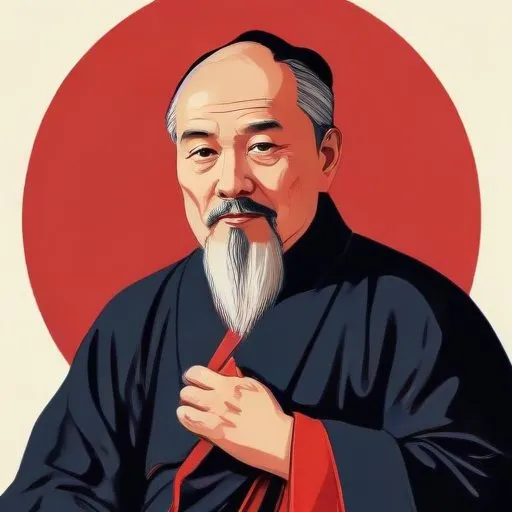
A leading figure in Confucianism, he synthesized Confucian classics into a coherent philosophical system, influencing East Asian thought for centuries. His teachings emphasized moral cultivation and self-reflection.
Zhu Xi, a 12th-century Chinese philosopher, historian, poet, and politician, is renowned for his profound contributions to the development of Neo-Confucianism, which fundamentally reshaped the Chinese worldview. His seminal works, including his commentaries to the Four Books, have had a lasting impact on Chinese philosophy, politics, and culture.
Zhu Xi was born on October 18, 1130, in Fujian, China, to a family of modest means. His father, a government official, instilled in him a deep love for learning, which would become a hallmark of Zhu's life. After his father was forced from office, Zhu received instruction at home, where he demonstrated remarkable precocity, exhibiting a deep understanding of classical texts, including the Classic of Filiality, by the age of eight.
Zhu Xi's philosophical contributions were rooted in his interpretations of Confucian classics, particularly the Four Books. He developed a comprehensive philosophical system that emphasized the importance of moral cultivation, self-reflection, and personal growth. Zhu's concept of li (principle) and qi (vital force) introduced a new metaphysical dimension to Confucian thought, influencing generations of scholars and thinkers.
Zhu Xi's literary output was staggering, with nearly a hundred books to his credit. His commentaries to the Four Books, which included the Analects, the Mencius, the Great Learning, and the Doctrine of the Mean, became the cornerstone of Confucian education in Imperial China for centuries. His other notable works include Reflections on Things at Hand and Classified Conversations, which recorded his conversations with students and scholars.
Zhu Xi's ideas have had a profound impact on Chinese society, influencing education, politics, and culture. His emphasis on moral education and personal growth shaped the country's civil service examination system, which remained in place until the early 20th century. His philosophical insights continue to inspire contemporary thinkers, scholars, and policymakers.
Zhu Xi's life was marked by significant personal milestones, including his appointment as a government official, which he later abandoned to focus on his scholarly pursuits. He maintained close relationships with other prominent scholars, including his mentor, Li Tong, and his student, Chen Chun. These relationships played a crucial role in the development and dissemination of his ideas.
Zhu Xi's legacy extends far beyond his own lifetime, shaping the course of Chinese philosophy, politics, and culture for centuries. His ideas continue to inspire and influence thinkers around the world, ensuring his place as one of the most important figures in Chinese intellectual history.
Born in 1472
A 16th-century Chinese philosopher who merged Confucianism with Taoist and Buddhist elements, emphasizing individual moral intuition and the unity of knowledge and action.
