


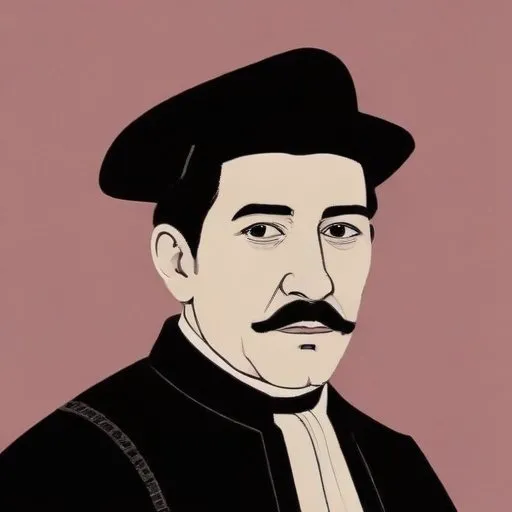
A 15th-century Spanish poet and politician who wrote influential courtly love poetry and served as a diplomat and governor, known for his lyrical and expressive style.
Iñigo López de Mendoza, 1st Marquis of Santillana, was a towering figure in 15th-century Castile, renowned for his exceptional literary talent and illustrious political career. As a poet, politician, and nobleman, he left an indelible mark on the cultural and literary landscape of his time.
Born on August 19, 1398, in Carrión de los Condes, Old Castile, Iñigo López de Mendoza was born into a noble family with a rich cultural heritage. His grandfather, Pedro González de Mendoza I, and father, Diego Hurtado de Mendoza, Admiral of Castile, were both poets with strong connections to prominent literary figures of the era, including Chancellor López de Ayala, Fernán Pérez de Guzmán, and Gómez Manrique.
After his father's untimely death when Iñigo was just five years old, his family faced financial difficulties, and he spent part of his childhood living with his maternal grandmother and uncle, the future Archbishop of Toledo. This exposure to the intellectual and cultural circles of the time would shape his future as a politician and poet.
As a young man, Iñigo spent time at the court of King Alfonso V of Aragon, where he was introduced to the works of poets from the Provençal, Valencian, and Catalan traditions, as well as the classical humanist works of Virgil and Dante Alighieri. This rich cultural tapestry would later inform his own literary style.
In 1412, Iñigo married the wealthy heiress Catarina Suárez de Figueroa, acquiring a vast fortune and becoming one of the most powerful nobles of his time. This union also brought him closer to the royal court, where he remained loyal to King Juan II throughout his life.
In 1445, after the First Battle of Olmedo, Iñigo was rewarded with the title of Marquis of Santillana, solidifying his position as a prominent figure in Castilian politics.
Iñigo López de Mendoza was a prolific poet, and his work is characterized by its allegorical and Dantesque style, reflecting his deep admiration for Dante Alighieri. His poetry explores themes of love, chivalry, and morality, showcasing his mastery of language and form.
As a poet, Iñigo was part of a vibrant cultural movement that sought to revitalize the intellectual and artistic heritage of medieval Europe. His work not only reflects the literary traditions of his time but also helps to shape the course of Spanish literature in the centuries that follow.
After the death of his wife, Doña Catarina de Figueroa, Iñigo retired to his palace in Guadalajara, where he spent the remainder of his life in peaceful study and contemplation.
Throughout his life, Iñigo López de Mendoza, 1st Marquis of Santillana, embodied the ideals of the Renaissance humanist, combining a deep love of learning with a strong sense of civic duty and responsibility. His remarkable life and legacy continue to inspire and captivate scholars and literature enthusiasts to this day.
Iñigo López de Mendoza's contribution to Spanish literature and politics is immeasurable. As a poet, he helped to shape the course of Spanish poetry, while as a politician, he played a key role in shaping the destiny of Castile during a tumultuous period in its history.
Today, his legacy continues to inspire new generations of writers, scholars, and artists, ensuring that his remarkable life and work remain an integral part of Spain's rich cultural heritage.
Born in 1497
Spanish conquistador who conquered northern Chile, establishing the city of Santiago and claiming the region for Spain. He's known for his bravery and strategic military skills.
