


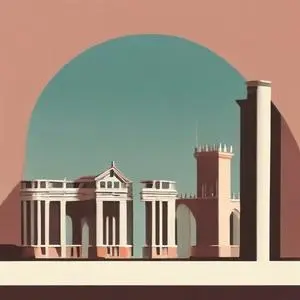
Designed futuristic and monumental buildings, blending neoclassicism with visionary ideals, and is considered a pioneer of visionary architecture.
Étienne-Louis Boullée, the renowned French neoclassical architect, left an indelible mark on the world of architecture with his revolutionary designs and philosophical approach. He is best known for his groundbreaking work in the development of a distinctive abstract geometric style, which characterized by the removal of all unnecessary ornamentation, inflating geometric forms to a huge scale, and repeating elements such as columns in huge ranges.
Boullée was born on February 12, 1728, in Paris, France, to a family of modest means. He demonstrated a keen interest in architecture from a young age and went on to study under the tutelage of esteemed architects Jacques-François Blondel, Germain Boffrand, and Jean-Laurent Le Geay. Thistraining laid the foundation for his future work, which blended mainstream French Classical architecture of the 17th and 18th centuries with the emerging Neoclassicism of the mid-18th century.
In 1762, Boullée was elected to the prestigious Académie Royale d'Architecture, a testament to his growing reputation in the architectural community. The same year, he was appointed chief architect to Frederick II of Prussia, a largely honorary title that further solidified his status as a leading architect of his time.
Boullée's architectural oeuvre is marked by its emphasis on simplicity, symmetry, and geometric forms. His most notable works include the Hôtel de Brunoy (demolished in 1930) and the Hôtel Alexandre, both in Paris. Although many of his designs have been lost to time, his influence on contemporary architects is undeniable.
Between 1778 and 1788, Boullée taught at the École Nationale des Ponts et Chaussées, where he developed and refined his abstract geometric style. He emphasized the importance of regularity, symmetry, and variety in architectural design, principles that would later become a hallmark of Beaux-Arts architectural training.
One of Boullée's most celebrated proposals is his design for a cenotaph in honor of Sir Isaac Newton. This monumental project exemplifies his concept of "architecture parlante" or "talking architecture," where the building's design is expressive of its purpose. This idea would go on to shape the course of architectural history in the centuries that followed.
Boullée's work has had a profound impact on the development of Neoclassical architecture. Alongside Claude Nicolas Ledoux, he is regarded as one of the most influential figures of French Neoclassicism. His emphasis on geometric forms, simplicity, and functionality has inspired generations of architects, cementing his place as a visionary and pioneer in the world of architecture.
Boullée's architectural philosophy was deeply rooted in his belief in the power of design to evoke emotions and convey meaning. He advocated for the removal of unnecessary ornamentation, instead opting for simplicity and geometric forms to create a sense of grandeur and monumentality. This approach not only reflected his aesthetic values but also spoke to his desire to create buildings that were functional, efficient, and expressive of their purpose.
Through his groundbreaking designs, philosophical approach, and influential teaching, Étienne-Louis Boullée has left an indelible mark on the world of architecture. His legacy continues to inspire architects, designers, and scholars alike, cementing his place as one of the most important figures in the history of Neoclassical architecture.
Born in 1902
Pioneering creator of iconic American musicals, blending music, dance, and drama to craft timeless classics like Oklahoma! and The Sound of Music.
Born in 1867
Visionary architect behind iconic, harmonious structures that blend seamlessly into their surroundings, redefining modern American architecture.
Born in 1887
A pioneer of modern architecture, famous for designing innovative, functional, and visually striking buildings that transformed urban landscapes. His works continue to inspire architects and designers worldwide.
Born in 1856
Designed iconic buildings that blended functionality with ornate details, revolutionizing American architecture with his innovative "form follows function" philosophy.
Born in 1832
Co-designer of the iconic Eiffel Tower, a pioneering engineer who revolutionized bridge building and urban infrastructure with innovative iron constructions.
