


In the midst of a long-standing conflict between the Algerian government and Islamist militants, the village of Si Zerrouk witnessed a brutal and devastating attack that would leave an indelible mark on the country's history. On that fateful day, approximately 50 innocent civilians lost their lives in a senseless act of violence, sending shockwaves throughout Algeria and beyond.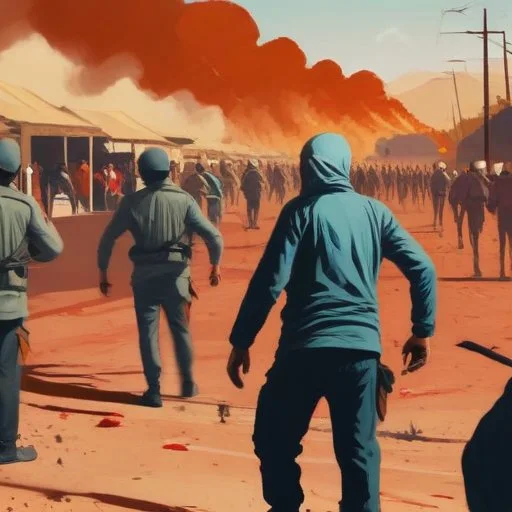
In the years leading up to the massacre, Algeria had been plagued by sporadic outbreaks of violence between the government and various Islamist groups. The conflict had its roots in the country's struggle for independence from France, which had ended in 1962. However, the subsequent political and economic instability created an environment conducive to extremist ideologies.
On the day of the massacre, a group of heavily armed militants stormed into the village of Si Zerrouk, unleashing a wave of terror upon its unsuspecting residents. The attackers, allegedly linked to the Armed Islamic Group (GIA), showed no mercy, killing men, women, and children indiscriminately. The brutal assault left behind a trail of destruction, with homes reduced to rubble and the streets littered with the bodies of the innocent.
While the exact identities of the perpetrators remain unknown, the GIA, led by Antar Zouabri, was widely suspected of being responsible for the massacre. Zouabri, a notorious Islamist militant, had been instrumental in orchestrating several attacks against civilians and government targets in the years preceding the Si Zerrouk massacre.
The Si Zerrouk massacre marked a turning point in Algeria's conflict, prompting a shift in the government's approach to combating Islamist militancy. The attack led to a renewed focus on security and a more aggressive pursuit of militants, which ultimately contributed to a decline in violence in the following years.
The massacre had a profound impact on Algerian society, leaving deep scars that would take years to heal. The attack sparked widespread outrage and demands for greater government accountability, leading to increased scrutiny of the country's security services and the role of Islamist groups in Algerian politics.
The Si Zerrouk massacre remains a highly controversial topic in Algeria, with many questions surrounding the government's response to the attack and its role in the broader conflict. Critics have accused the government of perpetuating a culture of impunity, allowing Islamist militants to operate with relative freedom.
In the years since the massacre, Si Zerrouk has become a symbol of Algeria's resilience and determination to rebuild. The village has been rebuilt, and memorials have been erected to honor the victims of that fateful day. As Algeria continues to grapple with the legacy of its conflict, the people of Si Zerrouk remain a testament to the power of human spirit in the face of unimaginable tragedy.
The Si Zerrouk massacre has been a subject of intense historiographical debate, with various interpretations and narratives emerging over time. Some historians have framed the event as a symbol of Algeria's struggle for independence and self-determination, while others have viewed it as a manifestation of the country's descent into chaos and violence.
Recent scholarship has sought to contextualize the massacre within the broader framework of Algeria's complex history, highlighting the role of colonialism, nationalism, and Islamist militancy in shaping the country's trajectory. By examining the massacre through a historiographical lens, scholars have been able to tease out the nuances and complexities of this pivotal event.
A closer look at the historical recordsArchival research has revealed that the French colonial authorities had long been aware of the existence of Islamist groups in Algeria, but chose to downplay their significance. This omission has been cited as a contributing factor to the massacre, as it allowed the GIA to operate with relative impunity.

Antar Zouabri, the leader of the Armed Islamic Group (GIA), was a mastermind of terror and violence. His rise to prominence in the early 1990s marked a shift in the Algerian insurgency, as the GIA began to target civilians and government officials with increasing frequency.
Zouabri's radical ideology was shaped by his experiences as a mujahideen fighter in Afghanistan, where he had been influenced by the teachings of Islamist ideologues. Upon his return to Algeria, he leveraged his charisma and military expertise to recruit and mobilize a new generation of Islamist militants.
Zouabri's GIA: A catalyst for violenceUnder Zouabri's leadership, the GIA carried out numerous attacks against civilians, including the Si Zerrouk massacre. His ruthless tactics and unwavering commitment to Islamist ideology made him a formidable foe, feared by both the Algerian government and the general population.
The Si Zerrouk massacre had a profound impact on Algerian culture, leaving an indelible mark on the country's collective psyche. The attack sparked widespread outrage and shock, as Algerians struggled to come to terms with the scale of the violence.
In the aftermath of the massacre, Algerian artists and intellectuals responded with a flurry of creative works, including poetry, music, and visual art. These works served as a form of catharsis, allowing Algerians to process their emotions and reflect on the significance of the event.
Remembering the victims through artOne notable example is the work of Algerian painter, Baya Mahieddine, who created a series of powerful and poignant pieces in response to the massacre. Her artwork, characterized by bold colors and haunting imagery, serves as a testament to the enduring power of art in the face of tragedy.

The Si Zerrouk massacre prompted a swift and unequivocal response from the Algerian government, which launched a crackdown on Islamist groups and implemented a range of security measures to prevent future attacks.
However, critics have argued that the government's response was heavy-handed, and that its policies ultimately exacerbated the violence and instability. The government's decision to suspend civil liberties and impose martial law in certain regions has been cited as a key factor in the perpetuation of human rights abuses.
A delicate balance between security and human rightsIn the years that followed, the Algerian government faced intense international pressure to address concerns about its human rights record. As the country navigated the complex terrain of counter-terrorism and security, it was forced to confront the difficult trade-offs between protecting its citizens and upholding their fundamental rights.
The Si Zerrouk massacre took place against the backdrop of a rapidly evolving global jihadist movement. The 1990s saw the rise of transnational Islamist networks, which sought to capitalize on the instability and chaos of the post-Cold War era.
Algeria's geographic location, bordering the Sahel region and the Mediterranean, made it a key battleground in the global struggle against Islamist militancy. The country's experiences during this period were closely tied to the broader dynamics of international relations, including the role of foreign powers and the Middle East peace process.
A nexus of global and regional trendsThe Si Zerrouk massacre was a manifestation of the complex interplay between local, regional, and global forces. As Algeria struggled to contain the spread of Islamist militancy, it found itself at the center of a maelstrom of competing interests and ideologies.