


The Battle of Mogadishu, also known as the Day of the Rangers, is etched in the annals of modern military history as one of the most disastrous and decisive battles of the post-Cold War era. On October 3, 1993, eighteen American soldiers and over 350 Somalis lost their lives in a firefight that would have far-reaching consequences for international relations, military strategy, and humanitarian intervention.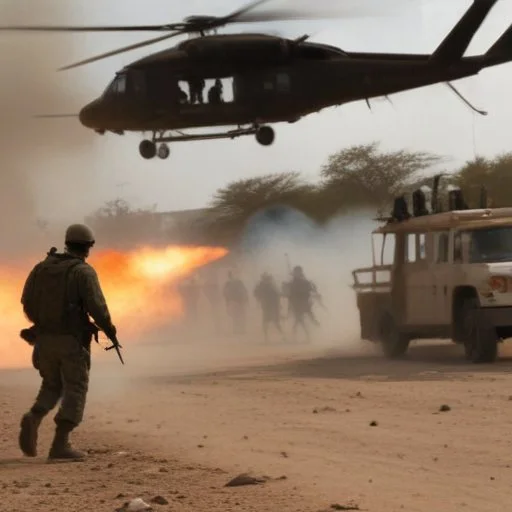
In the aftermath of the Somali Civil War, the country was torn apart by factional fighting and famine. The international community, led by the United States, intervened in 1992 with Operation Restore Hope, aiming to deliver humanitarian aid and stabilize the region. However, the situation on the ground proved more complex, and the operation soon escalated into a full-scale military intervention.
Task Force Ranger, a specialized unit of U.S. Army Rangers, was dispatched to Mogadishu to capture top lieutenants of the powerful Somali warlord Mohamed Farrah Aidid. The mission, codenamed Operation Gothic Serpent, was planned as a swift and precise operation, with the Rangers expected to infiltrate, extract their targets, and exfiltrate within a matter of hours.
As the Rangers descended upon Mogadishu in helicopters, they were met with fierce resistance from Somali militiamen. The operation quickly deteriorated into a 15-hour battle, with the outnumbered Americans fighting for their lives. Two Black Hawk helicopters were shot down, leaving the soldiers stranded and vulnerable. Amidst the chaos, the Rangers fought bravely, but they were vastly outnumbered and outgunned.
The battle resulted in the death of 18 American soldiers, with many more wounded. The Somali toll was staggering, with estimates suggesting over 350 militiamen and civilians lost their lives. The international community was shocked by the scale of the disaster, and the U.S. government was forced to re-evaluate its involvement in Somalia.
The Battle of Mogadishu had a profound impact on the public perception of military intervention. The vivid images of American soldiers being dragged through the streets of Mogadishu, broadcast on international television, shocked the American public and fueled anti-war sentiment. The incident also raised questions about the effectiveness of humanitarian intervention and the limitations of military power.
"Leave no man behind." - The motto of Task Force Ranger, which became a rallying cry for the soldiers during the battle.
The Battle of Mogadishu marked a turning point in U.S. foreign policy, with a renewed focus on multilateralism and a more cautious approach to military intervention. The incident also led to significant changes in U.S. military strategy, including the development of new tactics and technologies for urban warfare.
The Battle of Mogadishu serves as a poignant reminder of the complexities and risks of military intervention. As the international community continues to grapple with the challenges of global governance, the lessons of Mogadishu remain as relevant today as they were on that fateful day in 1993.
The roots of the Somali Civil War can be traced back to the country's independence from Italy in 1960. The newly formed government, led by Mohamed Siad Barre, was plagued by corruption and nepotism, leading to widespread dissatisfaction among the population. As the government's grip on power began to slip, various factions and clans started to vie for control, setting the stage for the conflict that would eventualy ensnare the international community.
The famine that ravaged Somalia in the early 1990s was a direct result of the civil war, with warring factions blocking humanitarian aid and exacerbating the crisis. The international community's response, including Operation Restore Hope, was initially well-intentioned but ultimately ineffective in stemming the tide of violence and instability.
Understanding the complex web of alliances and rivalries between Somalia's various clans and factions is crucial to grasping the context of the Battle of Mogadishu.
General William F. Garrison, the commander of Task Force Ranger, was a seasoned military veteran with a reputation for bravery and tactical acumen. Born in 1944, Garrison graduated from the United States Military Academy and went on to serve in Vietnam, earning several decorations for valor.
Under Garrison's leadership, Task Force Ranger was trained to conduct unconventional warfare, including counter-terrorism and direct action missions. Although the operation in Mogadishu was a disaster, Garrison's leadership and bravery during the battle were widely praised, and he was eventually awarded the Distinguished Service Medal.
The Clinton administration's decision to intervene in Somalia was motivated by a desire to demonstrate American leadership and humanitarian commitment in the post-Cold War era. However, the operation's poor planning and execution exposed the limitations of American military power and raised questions about the wisdom of humanitarian intervention.
The fallout from the Battle of Mogadishu had significant implications for American foreign policy, leading to a re-evaluation of the country's role in international crisis management. The incident also strengthened the hand of Congressional opponents of humanitarian intervention, who argued that such operations were too costly and prone to mission creep.

The vivid images of American soldiers being dragged through the streets of Mogadishu, broadcast on international television, had a profound impact on the American public's perception of military intervention. The incident was seized upon by anti-war activists, who argued that the operation was a failed experiment in nation-building.
The cultural resonance of the Battle of Mogadishu was cemented by Mark Bowden's bestselling book "Black Hawk Down," which provided a gripping account of the battle. The book was later adapted into a successful film, further cementing the incident's place in the popular imagination.
Historiographical assessments of the Battle of Mogadishu have often focused on the operation's military and tactical dimensions, with some scholars arguing that the incident marked a turning point in the development of modern warfare.
Other historians have emphasized the battle's significance as a symbol of American hubris and overreach, highlighting the ways in which the operation reflected broader cultural and political trends of the 1990s. Despite these differing interpretations, all agree that the Battle of Mogadishu was a pivotal event in modern military history.