Union troops assault Confederate salient at Spotsylvania Court House
Fierce combat erupts as Union forces, determined to crush the Confederate stronghold, launch a daring assault on the notorious "Mule Shoe" salient at Spotsylvania Court House. General Ulysses S. Grant's troops clash with General Robert E. Lee's army in brutal, hand-to-hand combat at "the Bloody Angle", a gruesome and intense fight that would go down in history as one of the war's most savage battles.
The Battle of Spotsylvania Court House: A Turning Point in the American Civil War
Fierce Combat and Hand-to-Hand Fighting at the Bloody Angle
The Battle of Spotsylvania Court House, fought from May 8 to May 21, 1864, is renowned for its brutal and intense combat, particularly at the Bloody Angle, where Union and Confederate troops clashed in some of the war's most savage fighting. The battle is also notable for the daring assault on the notorious Mule Shoe salient, a Confederate stronghold that proved to be a formidable obstacle for the Union army.
Historical Background
In the spring of 1864, the Union army, under the command of General
Ulysses S. Grant, launched the Overland Campaign, a series of battles designed to defeat the Confederate army and capture the capital of Richmond. The Confederate army, led by General
Robert E. Lee, was determined to resist the Union advance and protect its capital.
The Mule Shoe Salient: A Formidable Defensive Position
The Mule Shoe salient, a curved line of earthworks and trenches, was a key component of the Confederate defenses at Spotsylvania Court House. The salient was heavily fortified with artillery and infantry, making it a formidable obstacle for the Union army.
The Battle Unfolds
On May 8, 1864, Grant's army launched a dawn assault on the Mule Shoe salient, hoping to break through the Confederate defenses and split Lee's army. The Union troops, led by General
Winfield Scott Hancock's II Corps, advanced through dense woods and across open fields, only to be met by fierce Confederate resistance.
The Bloody Angle: A Frenzied and Brutal Fight
As the Union troops approached the Mule Shoe, they encountered the Bloody Angle, a narrow, V-shaped trench system that funneled the attackers into a killing zone. The fighting at the Bloody Angle was intense and brutal, with soldiers on both sides engaging in hand-to-hand combat, often using bayonets and clubbed muskets to gain advantage.
Key Figures Involved
- General Ulysses S. Grant: Commander of the Union army during the Overland Campaign
- General Robert E. Lee: Commander of the Confederate army during the Overland Campaign
- General Winfield Scott Hancock: Commander of the Union II Corps during the Battle of Spotsylvania Court House
Major Outcomes and Impacts
The Battle of Spotsylvania Court House was a tactical stalemate, with both sides suffering heavy casualties. However, the battle had significant strategic implications, as it prevented Lee's army from retreating to Richmond and allowed Grant's army to maintain its momentum.
Casualties and Aftermath
The battle resulted in over 27,000 casualties (killed, wounded, or missing) on both sides. The Union army suffered over 18,000 casualties, while the Confederate army lost over 9,000 men. The battle marked a turning point in the Overland Campaign, as Grant's army continued to push forward, ultimately leading to the siege of Petersburg and the eventual fall of Richmond.
Cultural and Social Influences
The Battle of Spotsylvania Court House has had a lasting impact on American culture and society. The battle is often remembered as one of the most brutal and intense fights of the Civil War, and its legacy continues to inspire and educate Americans to this day.
Quotes and Memorable Sayings
"The battle of Spotsylvania was one of the most desperate and bloody of the war." - General Ulysses S.Grant
"The Bloody Angle was a sight that I will never forget. It was a slaughter pen, a butcher's shop, a charnel house." - Captain Charles Francis Adams, Jr., 1st Massachusetts Cavalry
Comparative Analysis with Similar Events
The Battle of Spotsylvania Court House is often compared to other brutal and intense battles of the Civil War, such as the Battle of Cold Harbor and the Battle of Wilderness. However, the battle's unique combination of trench warfare, artillery bombardments, and hand-to-hand combat make it a singular event in American military history.
Personal Accounts and Anecdotes
Private James R. Binford, 16th Virginia Infantry, recalled the horrors of the Bloody Angle: "I saw men shot and killed, and their bodies trampled upon by the horses. I saw men with their heads blown off, and their brains scattered upon the ground."
Impact on Future Events
The Battle of Spotsylvania Court House had significant implications for the outcome of the Civil War. The battle forced Lee's army to retreat to Richmond, ultimately leading to the siege of Petersburg and the fall of the Confederate capital.
Conclusion
The Battle of Spotsylvania Court House was a pivotal moment in the American Civil War, marked by fierce combat, brutal hand-to-hand fighting, and significant strategic implications. The battle's legacy continues to inspire and educate Americans, serving as a powerful reminder of the sacrifices made during the nation's most tumultuous period.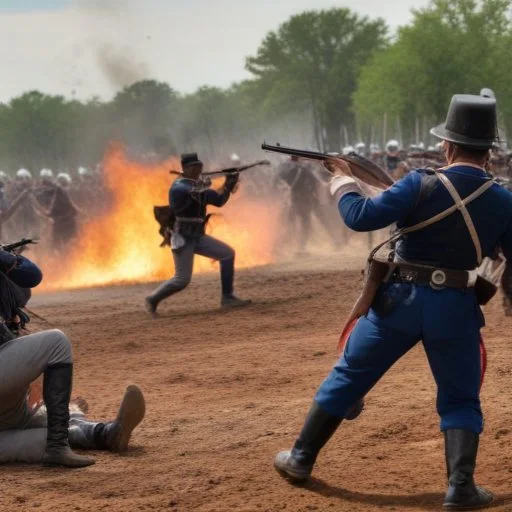
Character Overview
General Winfield Scott Hancock: The Hero of Spotsylvania
General Winfield Scott Hancock, known for his bravery and tactical prowess, played a crucial role in the Battle of Spotsylvania Court House. Born on February 14, 1824, in Montgomery Square, Pennsylvania, Hancock graduated from the United States Military Academy in 1844. During the Mexican-American War, he served under General Zachary Taylor and later became a quartermaster in the Army.
Hancock's II Corps was instrumental in the Union army's assault on the Mule Shoe salient. His leadership and strategic decisions helped to breach the Confederate defenses, leading to the intense fighting at the Bloody Angle.

Comparative Study
Comparing the Bloody Angle to the Battle of Cold Harbor
While both the Battle of Spotsylvania Court House and the Battle of Cold Harbor were brutal and intense, there are some key differences between the two battles. At Spotsylvania, the Bloody Angle's unique trench system and artillery bombardments created a killing zone that favored the Confederate defenders. In contrast, Cold Harbor's open fields and scattered breastworks allowed for more fluid movement and cavalry charges.
Despite these differences, both battles showcased the ferocity and determination of the Union and Confederate armies. The high casualty rates and sheer brutality of these battles underscore the brutal nature of the American Civil War.
Cultural Significance Study
The Cultural Significance of the Bloody Angle
The Bloody Angle has become an enduring symbol of the American Civil War's brutality and intensity. The trench system, now recreated at the Spotsylvania Court House National Military Park, serves as a poignant reminder of the sacrifices made by soldiers on both sides.
The battle has also inspired numerous works of literature and art, including Michael Shaara's novel The Last Full Measure and the film Gettysburg. The Bloody Angle's legacy continues to captivate and educate Americans, serving as a powerful reminder of the nation's tumultuous past.

Historiographical Review
Historiographical Perspectives on the Battle of Spotsylvania
Historians have long debated the significance of the Battle of Spotsylvania Court House, with some arguing that it was a crucial Union victory and others seeing it as a tactical stalemate. Some, like Edwin B. Coddington, have emphasized the battle's importance in the larger context of the Overland Campaign, while others, such as Gordon C. Rhea, have focused on the battle's brutal combat and human cost.
Regardless of interpretation, the Battle of Spotsylvania remains a pivotal moment in American history, offering a unique window into the strategies, tactics, and experiences of soldiers during the Civil War.
In-Depth Document Analysis
The Diary of Captain Charles Francis Adams, Jr.
"The Bloody Angle was a sight that I will never forget. It was a slaughter pen, a butcher's shop, a charnel house." - Captain Charles Francis Adams, Jr., 1st Massachusetts Cavalry
Captain Adams' diary provides a gripping first-hand account of the Battle of Spotsylvania Court House, offering a unique glimpse into the thoughts and experiences of a Union soldier. The diary is a valuable artifact, offering insights into the daily life, struggles, and triumphs of soldiers during the Civil War.


