


Edmund Kirby Smith, the architect of the Confederate TransMississippi division, holds a unique distinction in the annals of the American Civil War – he was the last full general of the Confederate Army to lay down his arms, finally surrendering in Galveston, Texas. This pivotal event on May 26, 1865, marked the definitive end of the Confederacy, paving the way for the tumultuous era of Reconstruction.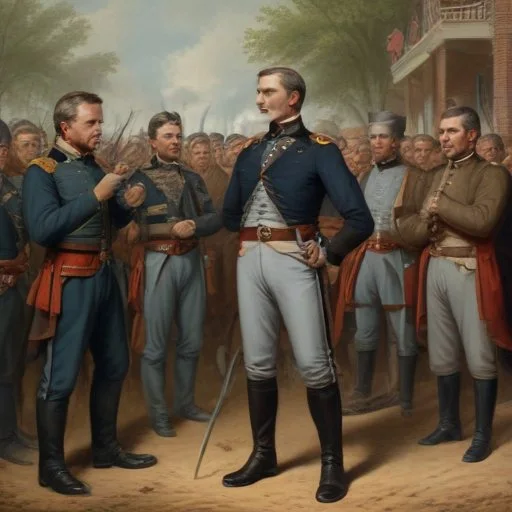
Born in 1824 in Florida, Edmund Kirby Smith was a West Point graduate who had served in the United States Army during the Mexican-American War. When the secession crisis erupted, Smith sided with the Confederacy, citing his loyalty to his home state and the Southern way of life. He quickly rose through the ranks, earning the respect of his peers and the admiration of his troops.
Smith's military acumen was showcased in the TransMississippi Theater, a vast and oft-overlooked region comprising Texas, Louisiana, and Arkansas. As commander of the TransMississippi division, Smith played a crucial role in defending this vital territory against Union incursions. Despite being vastly outnumbered and outgunned, Smith's forces managed to hold out against the Union army, earning a reputation as a cunning and resourceful commander.
As news of Robert E. Lee's surrender at Appomattox spread, Smith realized the futility of continued resistance. On May 26, 1865, he gathered his senior officers in Galveston, Texas, and delivered a poignant address, acknowledging the impossibility of further resistance. With a heavy heart, Smith formally surrendered his army, bringing an end to the Confederate war effort.
Surrender was not a defeat for Smith; it was a necessary step towards reconciliation and rebuilding. Throughout the Reconstruction era, Smith remained a vocal advocate for the rights of Southerners, while also acknowledging the wrongs of the past. His commitment to duty, honor, and country has inspired generations of historians, military strategists, and ordinary citizens alike.
In a letter to his wife, Cassie, written just days before his surrender, Smith penned a poignant reflection: "I shall always be proud to have borne the flag of the Confederacy, though it may have been tattered and worn." This sentiment encapsulates the complexity of Smith's character – a man driven by duty, loyalty, and a deep sense of honor, even in the face of defeat.
Edmund Kirby Smith's surrender at Galveston, Texas, marked a turning point in American history, ushering in a new era of reconciliation and nation-building. As we reflect on this pivotal moment, we are reminded of the power of duty, loyalty, and honor – qualities that Smith embodied throughout his life, and that continue to inspire generations to come.
Comparing Edmund Kirby Smith's surrender to other notable Civil War surrenders, such as Robert E. Lee's at Appomattox or Joseph E. Johnston's at Bennett Place, highlights the unique circumstances surrounding Smith's reluctance to lay down his arms. While Lee's surrender marked the effective end of the Confederacy, Smith's delay in surrendering was largely due to his isolation in the TransMississippi Theater, where news of the war's outcome was slower to reach. This comparative analysis underscores the complexities of Smith's decision-making process and the challenges he faced in coming to terms with defeat.
The historiographical significance of Edmund Kirby Smith's surrender is multifaceted, with different historical interpretations emphasizing various aspects of the event. Some historians view Smith's surrender as a pragmatic recognition of the futility of continued resistance, while others see it as a symbol of the Confederacy's final collapse. Additionally, Smith's post-war activities, including his advocacy for Reconstruction-era rights, have led some historians to reassess his legacy as a whole.
More recently, historians have explored the cultural significance of Smith's surrender, examining how it reflects the broader themes of defeat, occupation, and reconciliation in the post-Civil War era.
The geopolitical context of the TransMississippi Theater, where Smith's army operated, played a significant role in his decision to surrender. The region's vast distance from the main battlefields of the Eastern Theater and its limited access to supplies and communication networks created a unique set of challenges for Smith's forces. Furthermore, the Theater's border with Mexico and the Spanish Empire's influence in the region introduced additional complexities, as Smith had to navigate the diplomatic implications of surrendering to Union forces.
In this sense, Smith's surrender can be seen as a microcosm of the larger geopolitical dynamics at play during the Civil War and Reconstruction era.
Edmund Kirby Smith's surrender had significant political implications, both in the immediate aftermath of the war and in the decades that followed. In the short term, Smith's surrender marked the effective end of the Confederacy, paving the way for the Reconstruction era and the tumultuous process of rebuilding the nation.
In the longer term, Smith's post-war activities, including his advocacy for the rights of former Confederates and his involvement in Reconstruction-era politics, demonstrate his ongoing commitment to the principles of states' rights and limited federal authority.
The environmental impact of the American Civil War, including Edmund Kirby Smith's surrender, is often overlooked in traditional historical narratives. However, the war's ecological consequences, including widespread deforestation, soil degradation, and the displacement of wildlife habitats, were far-reaching and devastating. In the TransMississippi Theater, where Smith's army operated, the environmental costs of the war were particularly acute, with the region's fragile ecosystems struggling to recover in the war's aftermath.
Smith's surrender, in this context, can be seen as a symbol of the war's broader ecological toll, highlighting the need for environmental considerations to be integrated into our understanding of historical events.