


The First Battle of Bull Run, fought on July 21, 1861, is etched in American history as the first major land battle of the American Civil War. It was a clash that would foreshadow the brutal and devastating conflict that would ravage the nation for the next four years.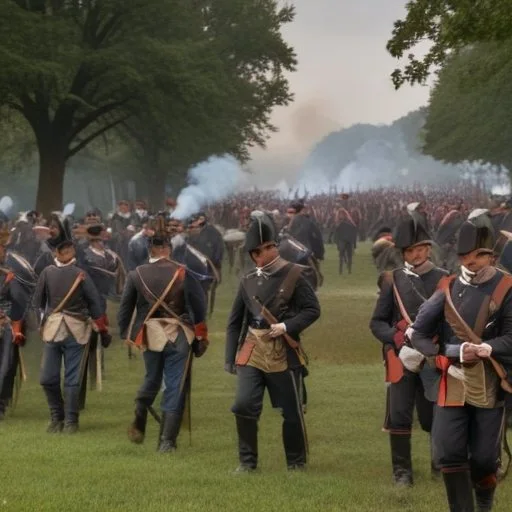
In the sweltering summer heat, 28,400 Union troops embarked on a 25-mile march into the heart of Virginia, following President Abraham Lincoln's orders. The atmosphere was tense, with soldiers and civilians alike holding their breath as the fate of a nation hung in the balance.
The battle took place near a small creek in a clearing near Manassas, Virginia. The Confederate forces, led by General P.G.T. Beauregard, had been anticipating the Union's move and were well-prepared to defend their territory. Meanwhile, the Union troops, led by General Irvin McDowell, were determined to crush the rebellion and bring a quick end to the war.
The battle commenced at around 10:00 am, with the Union troops launching a series of attacks against the Confederate lines. Initially, the Union forces made gains, but the Confederates held firm, buoyed by the arrival of reinforcements. As the day wore on, the battle raged back and forth, with both sides suffering heavy casualties.
The Confederates gained the upper hand when General Thomas "Stonewall" Jackson's troops arrived on the battlefield, providing a crucial boost to the Confederate forces. The Union troops, exhausted and demoralized, began to retreat, leaving behind many of their wounded and dead.
The First Battle of Bull Run was a decisive Confederate victory, with the Union troops suffering over 2,800 casualties, compared to the Confederates' 1,900. The battle was a wake-up call for both sides, revealing the harsh realities of war and the determination of their enemies.
The First Battle of Bull Run had a profound impact on the American Civil War, and American history as a whole. It marked a shift from a perceived quick victory to a prolonged and brutal conflict. The battle also led to a surge in recruitment and mobilization on both sides, as well as a heightened sense of urgency and determination.
"The battle was the most awful and sublime thing I ever witnessed." - Lieutenant Charles Augustus, 14th Brooklyn Regiment
"I saw the panic-stricken creatures, men and horses, rushing by, and the solid columns of the enemy advancing." - Captain Charles Francis Adams Jr., 1st Massachusetts Regiment
The First Battle of Bull Run serves as a poignant reminder of the devastating consequences of war and the bravery of those who fought and died on both sides. Today, the battlefield is a revered site, where visitors can walk in the footsteps of history and pay tribute to the fallen.
The First Battle of Bull Run will forever be etched in American history as a pivotal moment in the nation's struggle for unity and identity. It is a testament to the enduring spirit of those who fought, and a sobering reminder of the devastating price of war.
The First Battle of Bull Run has been subject to varying interpretations by historians over the years. While some have viewed it as a decisive Confederate victory, others have argued that it was a missed opportunity for the Union to crush the rebellion early on. The battle has also been seen as a turning point in the war, marking a shift from a perceived quick victory to a prolonged and brutal conflict.
Historians have also debated the role of General Irvin McDowell, with some criticizing his decision to launch a frontal assault against the Confederate lines. Others have praised his bravery and tactical skills, arguing that he did the best he could with the resources available to him.
The First Battle of Bull Run took place in the midst of a complex and volatile geopolitical landscape. The secession of 11 southern states had created a new nation, the Confederate States of America, which was determined to defend its independence against the Union.
The battle was also influenced by the European powers, who were watching the conflict with great interest. Britain and France, in particular, had significant economic interests in the South and were weighing the possibility of recognizing the Confederacy as a sovereign state.
General Thomas "Stonewall" Jackson was a pivotal figure in the First Battle of Bull Run. His timely arrival on the battlefield, along with his brigade of Virginian troops, provided a crucial boost to the Confederate forces.
Jackson's bravery and tactical skills were instrumental in repelling the Union attacks, and his nickname "Stonewall" was coined during the battle. Despite his relatively junior rank, Jackson's leadership and composure under fire inspired confidence in his troops and earned him great respect from his superiors.
The First Battle of Bull Run had significant economic implications for both the Union and the Confederacy. The battle disrupted trade and commerce in the region, leading to shortages of food and supplies.
The Union's defeat also led to a decline in investor confidence, causing a sharp drop in stock prices and a tightening of credit markets. The Confederacy, on the other hand, saw a surge in patriotic fervor and donations, which helped to bolster its war effort.
The McDowell Report, written by General Irvin McDowell after the battle, provides a unique insight into the Union's strategy and tactics during the First Battle of Bull Run.
The report, which is housed in the National Archives, offers a detailed account of the battle, including the Union's plans, troop movements, and casualties. It also sheds light on McDowell's decision-making process, and his perceptions of the Confederate forces.