


The Gettysburg Address, delivered by President Abraham Lincoln on November 19, 1863, is one of the most iconic speeches in American history, redefining the purpose of the Civil War and the principles of American democracy. In a mere 272 words, Lincoln honored the fallen Union soldiers and reaffirmed the nation's commitment to liberty and equality.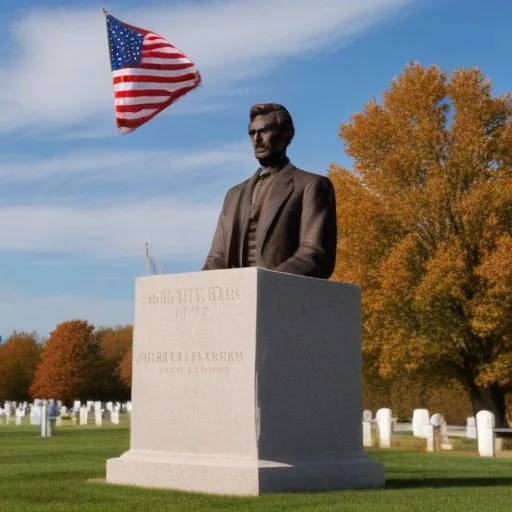
The American Civil War had been raging for over two years, with the Union and Confederacy clashing in a brutal struggle that would ultimately claim the lives of an estimated 620,000 to 750,000 soldiers. The Battle of Gettysburg, fought from July 1 to July 3, 1863, was a turning point in the war, with the Union emerging victorious but at great cost. The town of Gettysburg, Pennsylvania, was left scarred and grieving, with over 50,000 casualties and countless families torn apart by the conflict.
To honor the fallen soldiers, a national cemetery was established in Gettysburg, and a dedication ceremony was planned for November 19, 1863. Edward Everett, a renowned orator, was invited to deliver the main speech, but it was President Lincoln who would steal the show with his impromptu remarks. Lincoln's speech was not the main event, but it would become the most memorable and enduring part of the ceremony.
Lincoln's speech was a masterclass in eloquence and simplicity, invoking the principles of liberty and equality upon which the United States was founded. He honored the fallen soldiers, reaffirmed the nation's commitment to democracy, and redefined the purpose of the war as a test of whether a nation "conceived in liberty and dedicated to the proposition that all men are created equal" could long endure. The speech was met with applause and tears from the crowd, and it would go on to become one of the most celebrated speeches in American history.
The Gettysburg Address had a profound impact on the American psyche, reinvigorating public support for the war effort and reaffirming the nation's commitment to democracy and equality. It also cemented Lincoln's status as a master orator and a champion of freedom, and it would go on to inspire generations of Americans to strive for a more perfect union.
The Gettysburg Address has been a cultural touchstone for over a century, inspiring countless works of art, literature, and music. It has been referenced in films, books, and songs, and it continues to be studied and revered by scholars and citizens alike.
According to eyewitness accounts, Lincoln's speech was met with silence at first, as the crowd was taken aback by its simplicity and eloquence. However, as the speech came to a close, the crowd erupted into applause, with some witnesses reporting that they shed tears of joy and gratitude.
The Gettysburg Address paved the way for the abolition of slavery, the expansion of civil rights, and the continued struggle for social justice in the United States. It remains an enduring symbol of American democracy and a beacon of hope for a more perfect union.
Edward Everett was a celebrated American orator, politician, and educator who delivered the main speech at the Gettysburg National Cemetery dedication ceremony. Born on April 11, 1794, in Dorchester, Massachusetts, Everett was a Harvard University graduate and later served as the President of Harvard from 1846 to 1849. His speech at Gettysburg was reportedly over two hours long, and while it was well-received by the crowd, it was ultimately overshadowed by Lincoln's Gettysburg Address.
The American Civil War was fought during a time of great global upheaval. The European powers, particularly Britain and France, were struggling to maintain their colonial empires, while the United States was torn apart by internal conflict. The war was also influenced by the global economy, with the Union and Confederacy seeking to control trade routes and markets. The Gettysburg Address, with its emphasis on democracy and equality, was a beacon of hope for nations around the world.
The war also had significant implications for the global balance of power, as European nations closely watched the conflict and weighed the possibility of intervention. In the end, the Union's victory at Gettysburg helped to solidify the United States' position as a major world power.
The Gettysburg Address has had a profound impact on American culture, inspiring countless works of art, literature, and music. The speech's themes of freedom, equality, and democracy have resonated with generations of Americans, and it continues to be referenced in popular culture today.
From sculptures and paintings to poems and songs, the Gettysburg Address has been reinterpreted and reimagined in countless ways. It has also been referenced in films, television shows, and even advertising campaigns, cementing its place as an enduring symbol of American values.
The Gettysburg Address was a masterful political speech, redefining the purpose of the Civil War and reaffirming the principles of American democracy. Lincoln's speech was a clever blend of patriotism, politics, and emotional appeal, and it helped to shift public opinion in favor of the war effort.
The speech was also a significant moment in Lincoln's presidency, cementing his reputation as a skilled politician and orator. It marked a turning point in the war, as public opinion began to shift in favor of the Union and against the Confederacy.
Historians have long debated the significance of the Gettysburg Address, with some arguing that it was a turning point in the Civil War and others seeing it as a moment of rhetorical brilliance. Regardless, the speech remains a powerful symbol of American democracy and a testament to Lincoln's skill as an orator.
Recent historical scholarship has focused on the speech's reception and impact, exploring how it was received by different audiences and how it influenced public opinion. Other historians have examined the speech's place within the broader context of American history, analyzing its themes and motifs in relation to other significant events and speeches.