


The Siege of Port Hudson, a grueling 48-day ordeal, culminated in a decisive Union victory, granting the North unparalleled control of the Mississippi River and sealing the fate of the Confederacy. Alongside the fall of Vicksburg just five days prior, this triumph marked a crucial turning point in the war, severing the Confederacy's main supply line and paving the way for future Union victories.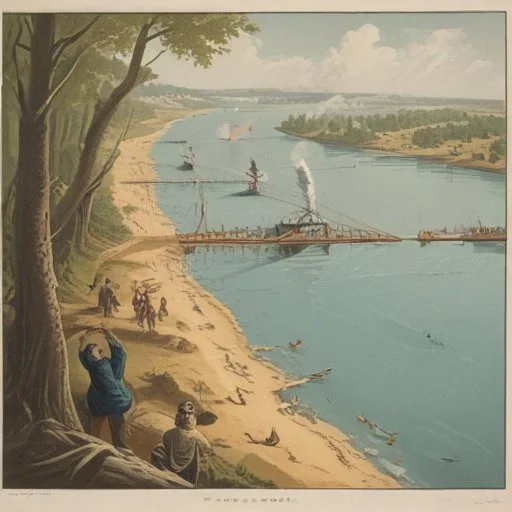
Situated on the eastern bank of the Mississippi River, Port Hudson was a linchpin in the Confederacy's defenses, connecting the states of Louisiana, Mississippi, and Arkansas. The stronghold was critical for the transportation of goods, supplies, and troops, making it a prime target for the Union army.
At the helm of the Union forces was Major General Nathaniel P. Banks, a seasoned commander known for his cunning tactics. Banks' counterpart, Confederate Major General Franklin Gardner, was equally determined to hold the strategic stronghold, despite being vastly outnumbered and outgunned.
The siege commenced on May 22, 1863, as Banks' forces launched a series of assaults on the Confederate defenses. Gardner's troops, though vastly outnumbered, held their ground, repelling wave after wave of Union attacks. As the days turned into weeks, both sides suffered heavy casualties, and the Confederates' supplies began to dwindle.
On July 9, 1863, Gardner's exhausted and depleted forces laid down their arms, marking a crushing defeat for the Confederacy. The fall of Port Hudson, coupled with the surrender of Vicksburg just five days prior, handed the Union complete control of the Mississippi River, effectively splitting the Confederacy in two.
The Siege of Port Hudson was a testament to the grit and determination of both Union and Confederate forces. The victory buoyed the Union war effort, galvanizing public support and paving the way for future victories. The fall of Port Hudson also marked a shift in the war's momentum, as the Confederacy's supply lines were severely disrupted, ultimately contributing to their defeat.
The Siege of Port Hudson was a testament to the human spirit, as soldiers on both sides endured unimaginable hardship, sacrifice, and loss. The bravery and dedication of these individuals serve as a poignant reminder of the devastating consequences of war and the importance of honoring the memories of those who fought and died.
Born on January 5, 1816, in Wallingford, Vermont, Nathaniel Prentice Banks was a seasoned military commander who played a crucial role in the Siege of Port Hudson. Banks' military career spanned over two decades, during which he fought in the Mexican-American War and later became a prominent figure in the American Civil War.
Known for his cunning tactics and unwavering resolve, Banks was appointed as the commander of the Union Army's Department of the Gulf in November 1862. His leadership skills and strategic thinking were instrumental in the Union's ultimate victory at Port Hudson.

The Mississippi River, stretching over 2,320 miles from its source in Lake Itasca to the Gulf of Mexico, was a vital artery for transportation, commerce, and communication during the American Civil War. The river's strategic importance was evident in its ability to connect the Confederacy's western states to the Gulf of Mexico, facilitating the transportation of goods and supplies.
The Union's control of the Mississippi River, following the fall of Vicksburg and Port Hudson, severely disrupted the Confederacy's supply lines, crippling their ability to wage war.
Among the artifacts preserved from the Siege of Port Hudson is the diary of Lieutenant Commander Charles Watson, a Union naval officer who participated in the siege. The diary provides a firsthand account of the grueling 48-day ordeal, offering insights into the daily life of soldiers, the Union's military strategy, and the psychological toll of war.
One entry, dated June 14, 1863, reads: "The enemy's artillery is intense today... our men are fighting valiantly, but the rebels are well-entrenched."

The Siege of Port Hudson has been immortalized in various forms of popular culture, from literature to film. In The Civil War: A Narrative, historian Shelby Foote dedicates an entire chapter to the siege, highlighting its significance in the broader context of the American Civil War.
In the 2012 film Lincoln, directed by Steven Spielberg, the Siege of Port Hudson is mentioned in a scene where President Abraham Lincoln (played by Daniel Day-Lewis) discusses the war effort with his advisors.
The fall of Port Hudson had far-reaching economic consequences for the Confederacy. The loss of this strategic stronghold disrupted the Confederacy's ability to transport goods and supplies, leading to severe shortages and inflation.
The Union's control of the Mississippi River also allowed them to impose a naval blockade, crippling the Confederacy's economy and paving the way for their ultimate defeat.