


During the American Civil War, the Vicksburg Campaign was a pivotal moment in the conflict, and one daring maneuver by acting Rear Admiral David Dixon Porter and his gunboats would forever change the course of history. On a fateful day in May 1863, Porter's fleet of gunboats bravely outran a hail of Confederate artillery fire as they fled downriver from Vicksburg, securing a vital lifeline for Union forces besieging the city.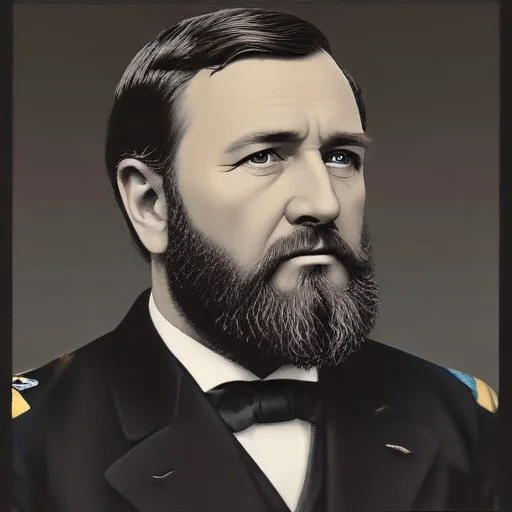
The Vicksburg Campaign was part of the larger Union strategy to gain control of the Mississippi River, splitting the Confederacy in two. By 1863, General Ulysses S. Grant's Army of the Tennessee had pushed deep into Mississippi, but Vicksburg, situated on the bluffs of the Mississippi River, remained a formidable obstacle.
Acting Rear Admiral David Dixon Porter, a seasoned naval officer, played a crucial role in the Vicksburg Campaign. With his fleet of gunboats, Porter provided critical support to General Grant's army, transporting troops and supplies up the Mississippi River. Grant, meanwhile, relied heavily on Porter's naval might to outmaneuver the Confederate forces.
Porter's daring escape and the subsequent union of his fleet with Grant's army marked a significant turning point in the Vicksburg Campaign. The Confederacy's grip on the Mississippi River began to slip, and Union control of the river would eventually sever the Confederacy in two. The campaign would ultimately culminate in the surrender of Vicksburg on July 4, 1863, opening the door to Union control of the entire Mississippi River.
Porter's bravery during the Vicksburg Campaign cemented his place in American history, earning him a reputation as one of the most daring naval commanders of the Civil War era. His actions would inspire future generations of naval officers and shape the course of American military strategy.
Did you know that David Dixon Porter was known for his eccentric personality? He was often seen wearing a pet parrot on his shoulder and was rumored to have a fondness for cigars and fine champagne.
Porter's bravery during the Vicksburg Campaign serves as a testament to the power of courage and determination in the face of overwhelming odds. His unwavering commitment to the Union cause inspired his fellow sailors and soldiers, and his legacy continues to inspire generations of Americans today.
Early Life and Career: Born on June 8, 1813, in Chester, Pennsylvania, David Dixon Porter was the fifth son of Commodore David Porter, a veteran of the War of 1812. Porter's early life was marked by a passion for the sea, and he began his naval career at the age of 10 as a midshipman on his father's ship.
Porter's rise through the ranks was swift, driven by his intelligence, courage, and tactical acumen. By the outbreak of the American Civil War, Porter had already established himself as a seasoned naval officer, serving in the Mexican-American War and later as the commander of the USS Supply.

The Vicksburg Campaign has been the subject of intense historiographical debate, with historians disagreeing on its significance and impact on the outcome of the American Civil War. Some have argued that the campaign was a crucial Union victory, securing control of the Mississippi River and splitting the Confederacy in two, while others have downplayed its importance, citing the simultaneous Union victories at Gettysburg and Chattanooga.
Recent scholarship has sought to reevaluate the campaign's significance, highlighting the role of naval power and the interplay between Grant's army and Porter's fleet. This reassessment has led to a greater appreciation for the Vicksburg Campaign as a pivotal moment in the war, showcasing the Union's ability to adapt and innovate in the face of Confederate resistance.
Porter's daring escape down the Mississippi River has become an iconic moment in American history, symbolizing the Union's determination and perseverance in the face of adversity. The bravery and audacity of Porter's actions have captivated the American imagination, inspiring generations of artists, writers, and filmmakers.
In the aftermath of the Civil War, Porter's escape was celebrated in popular culture, with songs, poems, and plays commemorating the event. The incident has since been immortalized in works of art, from the paintings of Thomas Hart Benton to the films of Ken Burns.

The Vicksburg Campaign took place against a backdrop of complex geopolitical rivalries and strategic calculations. The Union's control of the Mississippi River was crucial to its ability to project power and split the Confederacy in two, while the Confederacy saw the river as a vital artery for supplies and communication.
The campaign was also influenced by international events, as European powers like Britain and France watched the conflict unfold. The Union's victory at Vicksburg helped to undermine Confederate diplomatic efforts, leading to a shift in European opinion and diminishing the likelihood of intervention on behalf of the South.
The Vicksburg Campaign showcased the importance of naval technology in modern warfare, as Porter's fleet of ironclads and gunboats proved decisive in the Union's victory. The campaign demonstrated the power of steam-powered vessels, which could outmaneuver and outgun their Confederate counterparts.
The campaign also witnessed the introduction of new technologies, such as torpedoes and minefields, which were deployed by the Confederacy to impede Union naval movements. The innovations of the Vicksburg Campaign paved the way for future naval developments, as navies around the world adopted and adapted these technologies in the decades that followed.