


In a ceremony marked by hope and skepticism, Egyptian President Anwar al-Sadat, Israeli Prime Minister Menachem Begin, and U.S. President Jimmy Carter converged at the White House on March 26, 1979, to sign the Egypt-Israel Peace Treaty, a groundbreaking agreement that would redefine the Middle East's geopolitical landscape.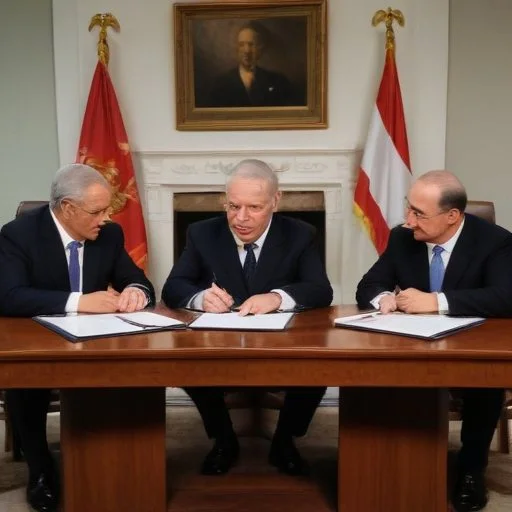
This landmark treaty, the first between an Arab state and Israel, was the culmination of years of clandestine diplomacy, negotiation, and compromise. It formalized the mutual recognition of Israel and Egypt, mandated the withdrawal of Israeli forces from the Sinai Peninsula, and cemented a commitment to peaceful relations between the two nations.
The 1970s were marked by turmoil in the Middle East, with the 1973 Yom Kippur War and the 1978 Camp David Accords setting the stage for the treaty. The Accords, brokered by Carter, established a framework for peace between Israel and Egypt, paving the way for the treaty's signing.
Three titans of international diplomacy played instrumental roles in the treaty's realization:
The road to the treaty's signing was marked by several pivotal milestones:
The treaty's far-reaching consequences included:
The treaty's signing had significant cultural and social implications:
The treaty's reception was not universally applauded:
Words of wisdom and foresight from the protagonists:
The Egypt-Israel Peace Treaty's enduring legacy is:
Menachem Begin's Journey to Peace
Begin's perspective was shaped by his experiences as a refugee, having lost family members in the Holocaust. This personal history instilled in him a deep appreciation for the importance of securing a safe haven for the Jewish people.
Despite his hardline reputation, Begin proved to be a shrewd and calculating leader who understood the importance of timing and diplomacy in achieving his goals. His ability to find common ground with Anwar al-Sadat and Jimmy Carter was critical to the success of the treaty.

The Peace Treaty's Cultural Ripple Effect
The signing of the Egypt-Israel Peace Treaty had far-reaching cultural implications, extending beyond the political realm to touch the lives of ordinary citizens. The treaty facilitated increased people-to-people diplomacy, as Egyptians and Israelis began to engage in cultural exchanges, academic collaborations, and tourism.
This newfound openness enabled artists, writers, and musicians from both countries to explore themes of peace, coexistence, and reconciliation in their work. The treaty also spawned a new generation of Peace Corps volunteers and exchange students, promoting cross-cultural understanding and friendship.
The Broader Geopolitical Context of the Treaty
The Egypt-Israel Peace Treaty was forged against the backdrop of a rapidly shifting global landscape. The 1970s saw the decline of traditional Cold War rivalries, as the United States and the Soviet Union began to pursue more pragmatic and regionally focused foreign policies.
This created an opportunity for regional actors like Egypt and Israel to assert their independence and pursue bilateral agreements. The treaty marked a subtle shift in the global balance of power, as the United States solidified its influence in the Middle East and Egypt emerged as a key regional player.

Economic Dividends of Peace
The Egypt-Israel Peace Treaty had significant economic benefits for both signatory countries. The treaty paved the way for increased trade and investment between Egypt and Israel, as well as with other nations.
The agreement also led to the development of natural gas fields in the Sinai Peninsula, generating significant revenue for both countries. Additionally, the treaty facilitated the growth of tourism, as visitors from around the world flocked to experience the region's rich cultural heritage.
The economic dividends of peace have been lasting, with Egypt and Israel continuing to cooperate on major infrastructure projects and industrial ventures.
A Framework for Future Peace Agreements
The Egypt-Israel Peace Treaty served as a template for future peace agreements in the region. Its success demonstrated the feasibility of negotiated settlements, even between longtime adversaries.
The treaty's framework, which emphasized mutual recognition, territorial compromise, and security guarantees, provided a model for subsequent agreements, such as the Oslo Accords and the Jordan-Israel Peace Treaty.
Moreover, the treaty showed that peace agreements could be achieved through a combination of diplomatic pressure, compromise, and creative problem-solving, offering a pathway for resolving other protracted conflicts in the Middle East.