


Apollo 11, a mission that would etch itself in the annals of human history, successfully landed astronauts on the Moon's surface, marking a monumental achievement in space exploration. Launched from the Kennedy Space Center at Cape Kennedy, Florida, on July 16, 1969, this extraordinary feat symbolized a collective triumph for humanity, pushing the boundaries of innovation and scientific discovery.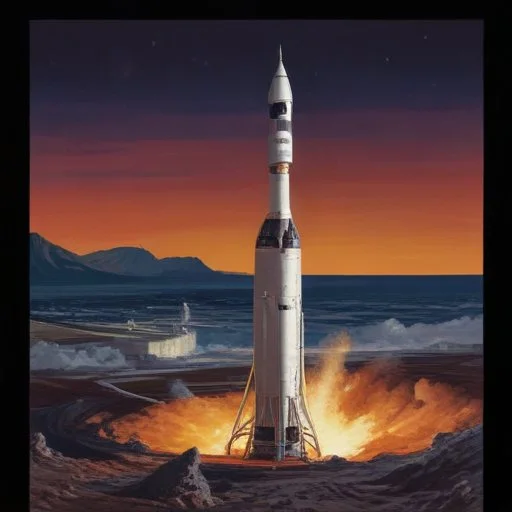
The Apollo program, conceived in 1961, was a direct response to Soviet Union's successful launch of Sputnik, the world's first artificial satellite, in 1957. As the Cold War intensified, the United States government recognized the imperative to demonstrate its technological prowess, leading to the establishment of the National Aeronautics and Space Administration (NASA) in 1958. The Apollo program aimed to accomplish what was thought to be impossible – landing humans on the Moon and returning them safely to Earth.
The triumvirate of astronauts, Neil Armstrong, Edwin "Buzz" Aldrin, and Michael Collins, were handpicked for this extraordinary mission. Armstrong, a decorated naval aviator and test pilot, commanded the mission, while Aldrin, a fighter pilot and doctorate holder in astronautics, served as the lunar module pilot. Collins, a seasoned Air Force pilot, remained in orbit around the Moon, piloting the command module.
The Apollo 11 mission achieved a multitude of milestones, including:
Apollo 11's success captivated the world's imagination, inspiring a generation of scientists, engineers, and explorers. The mission transcended borders, uniting humanity in a shared sense of wonder and awe.
"That's one small step for man, one giant leap for mankind," Armstrong's iconic declaration, became an emblem of humanity's collective achievement, echoing across the globe.
Despite the mission's success, Conspiracy theories surrounding the moon landing persisted, questioning the authenticity of the event. Technical difficulties, such as the Lunar Module's computer malfunction, also sparked concerns about the mission's feasibility.
Apollo 11's lunar landing shares parallels with the Wright brothers' inaugural powered flight in 1903, both marking watershed moments in aviation and space exploration. The mission's significance is further underscored by its precedents in the Soviet Union's Luna program, which had successfully impacted the Moon's surface in 1959.
Apollo 11 paved the way for subsequent lunar explorations, including the Apollo 15, 16, and 17 missions. The mission's technological advancements and operational expertise laid the foundation for modern spaceflight, influencing the development of space shuttle programs and the International Space Station.
Neil Armstrong's journey to becoming the first person to set foot on the Moon was marked by his passion for flight and exploration. Born on August 5, 1930, in Wapakoneta, Ohio, Armstrong developed an interest in aviation at a young age and earned his pilot's license at 15. He studied aeronautical engineering at Purdue University and later became a naval aviator in the Korean War. After the war, Armstrong became a test pilot at the National Advisory Committee for Aeronautics (NACA), which later became NASA.
Armstrong's exceptional skills as a pilot and engineer, combined with his experience in spaceflight, made him an ideal candidate for the Apollo 11 mission.
A lesser-known fact about Armstrong is his humble and private nature. Despite being an international celebrity, Armstrong shied away from the spotlight, preferring to focus on his work and family. He remained humble about his achievements and continued to work as an engineer and professor after his retirement from NASA.

Apollo 11's success had a profound impact on popular culture, inspiring countless works of art, music, and literature. The mission's themes of exploration, innovation, and human achievement resonated with people around the world, transcending national boundaries and cultural differences.
The mission's influence can be seen in films like 2001: A Space Odyssey and Apollo 13, as well as in music, such as David Bowie's
Apollo 11's cultural significance extends beyond the arts, with the mission's themes of exploration and innovation inspiring generations of scientists, engineers, and explorers.
The Apollo 11 mission marked a significant technological milestone, demonstrating the feasibility of lunar landing and space exploration. The mission's success was made possible by the development of advanced technologies, including the Saturn V rocket, the Command and Service Module, and the Lunar Module.
The mission's technological innovations had far-reaching impacts, paving the way for future spaceflight and exploration. The development of precision navigation and communication systems, for example, enabled future missions to explore the Moon and beyond.
Apollo 11's technological legacy can be seen in modern space exploration, from the International Space Station to ongoing efforts to explore Mars and beyond.

The Apollo 11 mission was not just a historic achievement; it was also a testament to the culmination of years of hard work, dedication, and perseverance. The mission's success was the result of a decade-long effort to land humans on the Moon, an effort that involved thousands of people working tirelessly behind the scenes.
The mission's journey began in the early 1960s, with the formation of the Apollo program in response to the Soviet Union's Space Race Challenge. The program faced numerous challenges, from technical difficulties to budget constraints, but the team persevered, driven by their shared goal of reaching the Moon.
The mission's success was a testament to the power of human collaboration and innovation, demonstrating that even the most ambitious goals can be achieved with determination and hard work.
Apollo 11's success had a profound impact on the social and cultural fabric of the United States and beyond. The mission's themes of exploration, innovation, and human achievement resonated with people from all walks of life, inspiring a new generation of scientists, engineers, and explorers.
The mission's influence can be seen in the rise of STEM education, as well as in the growing interest in space exploration and science. The mission's legacy has also inspired social and cultural movements, from environmentalism to feminism, as people began to see the possibilities of what humanity could achieve when working together.
Apollo 11's social impact extends beyond the United States, with the mission's themes and imagery inspiring people around the world to strive for greatness and push beyond their perceived limits.