


On April 27, 1989, Tiananmen Square in Beijing became the epicenter of a unprecedented uprising, as thousands of students, workers, intellectuals, and even some government officials converged to demand greater autonomy and an end to corruption. This massive protest, triggered by a scathing editorial in the People's Daily, marked a turning point in the Tiananmen Square protests, a pivotal moment in modern Chinese history.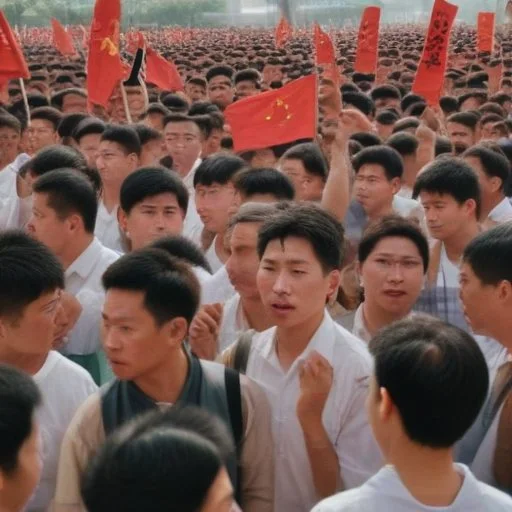
The catalyst for the April 27 demonstrations was an editorial published in the People's Daily, the Communist Party's official mouthpiece, on April 26, 1989. The article, titled "The Necessity for Strengthening Dictatorship," denounced the growing pro-democracy movement as "turmoil" and warned of the dangers of "bourgeois liberalization." This provocative piece was seen as a direct attack on the student-led protests, which had been gaining momentum since mid-April.
On the morning of April 27, thousands of students, many from Beijing University and other prestigious institutions, poured into Tiananmen Square, chanting slogans and brandishing banners. They were soon joined by workers, intellectuals, and even some government officials, who were inspired by the students' courage and determination. The crowd, estimated to be around 50,000-100,000 strong, was a testament to the widespread discontent with the Communist Party's authoritarian rule.
The April 27 demonstrations marked a significant shift in the Tiananmen Square protests, as the movement gained momentum and legitimacy. The event caught the government off guard, forcing them to reevaluate their response to the growing unrest. The protests continued to escalate, ultimately leading to the tragic events of June 4, 1989, when the military was deployed to quell the uprising.
The April 27 demonstrations heralded a new era of dissent in China, as students, workers, and intellectuals began to question the Communist Party's authority. The protests inspired a wave of activism, with demands for greater autonomy, democracy, and human rights becoming a rallying cry for many.
The event also sparked a global response, with international leaders and media outlets condemning the Chinese government's handling of the protests. The April 27 demonstrations cemented Tiananmen Square's place in history as a symbol of resistance against authoritarian rule.
In the words of Wu'er Kaixi, "We were not just fighting for democracy, we were fighting for our future."
The April 27 demonstrations were not an isolated event, but rather part of a larger wave of protests that had been building across China since the 1980s. student-led movements, inspired by the relaxation of economic and social controls, had been gaining momentum in cities such as Shanghai and Guangzhou. The Tiananmen Square protests, however, marked a turning point in this movement, as students, workers, and intellectuals from all over the country converged on Beijing to demand greater autonomy and democratic reforms.
In the months leading up to April 27, protests had been simmering in various cities, with students and workers calling for greater freedom of expression and an end to corruption. The government, initially caught off guard, responded with a mixture of conciliatory gestures and crackdowns, but ultimately failed to stem the tide of discontent.
The protests were not limited to urban areas; peasants and workers in rural areas, who had been affected by economic liberalization and rising inequality, also began to mobilize, demanding greater rights and representation.
Wu'er Kaixi, a charismatic student leader, played a key role in organizing the April 27 demonstrations. Born in 1968, Wu'er Kaixi was a Uyghur from Xinjiang Province, who had studied at Beijing Normal University before becoming involved in the pro-democracy movement. With his quick wit and eloquence, he soon became a prominent figure in the Tiananmen Square protests, addressing crowds and negotiating with government officials.
Despite his prominent role, Wu'er Kaixi was not without controversy; some critics accused him of being too radical, while others saw him as a unifying figure. Nevertheless, his courage and determination helped to galvanize the movement, inspiring thousands to take to the streets.
Comparing the April 27 demonstrations to other key protests in modern Chinese history, such as the 1919 May Fourth Movement and the 1986 student-led protests, reveals interesting parallels and contrasts. While all three movements shared a desire for greater autonomy and democratic reforms, the April 27 demonstrations were unique in their scale and intensity.
The 1919 May Fourth Movement, for example, was primarily an intellectual-led movement, focused on cultural and educational reform, whereas the April 27 demonstrations were a broad-based social movement, encompassing students, workers, and intellectuals. In contrast to the 1986 student-led protests, which were largely contained within university campuses, the April 27 demonstrations spilled out into the streets, occupying public spaces and confronting government authorities directly.
The April 27 demonstrations had a profound impact on Chinese culture and society. The protests marked a turning point in the country's cultural landscape, as artists, writers, and intellectuals began to question the government's authority and demand greater creative freedom.
The demonstrations inspired a wave of activism and dissent, as students, workers, and intellectuals began to challenge traditional norms and values. This newfound sense of empowerment and autonomy helped to pave the way for the emergence of independent film, music, and art movements in the 1990s.
The April 27 demonstrations took place within a complex geopolitical context, marked by rising tensions between China and the West. The protests coincided with a visit by Soviet leader Mikhail Gorbachev, which had sparked hopes of greater political reform within China.
The demonstrations were closely watched by international leaders, who saw them as an opportunity to pressure the Chinese government to adopt more democratic reforms. The protests also sparked widespread international condemnation of the government's handling of the crisis, further isolating China in the global community.