


February 15, 2011, marked the beginning of the end of Muammar Gaddafi's 42-year reign in Libya. On this day, protests erupted in Benghazi, sparked by the arrest of human rights activist Fethi Tarbel, and rapidly spread across the country, demanding an end to Gaddafi's regime.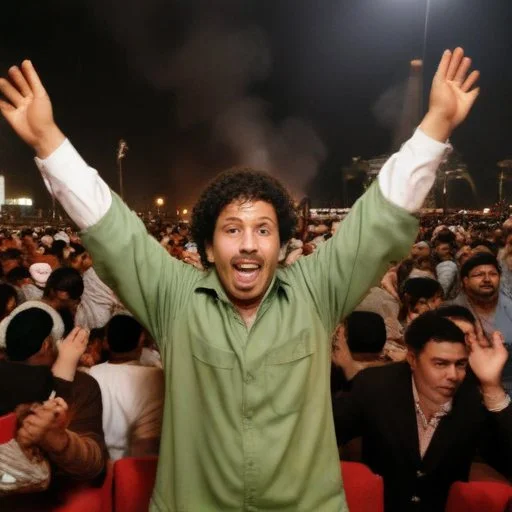
The once-unshakeable Gaddafi regime had long been marred by corruption, nepotism, and human rights abuses. For decades, Libyans had suffered under the iron grip of the authoritarian leader, who ruled with an iron fist and crushed any dissent. As the global economy began to stagnate, Libya's oil-rich economy also began to feel the pinch, further exacerbating the discontent among the population.
Fethi Tarbel, a human rights lawyer and activist, was arrested on February 15, 2011, for investigating the deaths of over 1,000 political prisoners in Tripoli's Abu Salim prison. Tarbel's arrest was the final straw for the long-oppressed Libyan people, who took to the streets in droves to demand his release and an end to Gaddafi's regime.
The initial protests, led mainly by young Libyans, were met with brutal force by government security forces. Protesters were attacked with live ammunition, tear gas, and batons, resulting in numerous deaths and injuries. Despite the violent crackdown, the protests continued to grow in intensity and spread to other cities, including Tripoli, Tobruk, and Zawiya.
As the situation escalated, the international community began to take notice. The United Nations Security Council imposed economic sanctions on Libya, and NATO intervened with airstrikes against Gaddafi's forces. The Arab League, a regional organization of Arab states, also suspended Libya's membership.
After months of intense fighting, Gaddafi's regime finally collapsed on August 20, 2011, when rebels captured Tripoli. Gaddafi himself was killed on October 20, 2011, while trying to flee his hometown of Sirte. The fall of Gaddafi marked the end of a dark era in Libyan history, but it also ushered in a period of instability and violence, as the country struggled to rebuild and reconcile.
The Libyan Arab Spring protests sent shockwaves across the Arab world, inspiring similar uprisings in Tunisia, Egypt, Bahrain, and Syria. Although the Libyan revolution was marked by violence and instability, it also brought about a sense of hope and freedom for the Libyan people, who, for the first time in decades, were able to imagine a future without Gaddafi's regime.
Fethi Tarbel, the human rights lawyer and activist, was not only the face of the Libyan Arab Spring but also a symbol of resistance against the Gaddafi regime. Born in 1963, Tarbel came from a family of modest means and was raised with a strong sense of social justice. Throughout his career, he championed the cause of political prisoners and victims of human rights abuses, earning him the respect and admiration of the Libyan people.
Tarbel's activism was not limited to Libya. He was a vocal critic of human rights abuses across the Arab world and worked closely with international organizations to promote democracy and freedom. His arrest on February 15, 2011, was a catalyst for the protests that eventually led to the downfall of the Gaddafi regime.
The Libyan Arab Spring was a significant event in the historiography of the Middle East and North Africa. It marked a turning point in the region's history, as people began to demand democratic reforms and an end to authoritarian rule. For historians, the event provides a unique opportunity to study the dynamics of revolution and the role of civil society in bringing about change.
Historians have drawn parallels between the Libyan Arab Spring and other significant events in world history, including the French Revolution and the American Civil Rights Movement. The use of social media and other digital technologies to mobilize protests and disseminate information has also been studied by historians as a new form of revolutionary discourse.
The Libyan Arab Spring did not occur in isolation from the broader geopolitical context of the region. The uprising was closely watched by neighboring countries, including Egypt, Tunisia, and Algeria, where similar protests were taking place. The event also had significant implications for the global balance of power, as Western powers such as the United States and France intervened militarily to support the rebels.
The role of regional organizations such as the Arab League and the African Union was also significant, as they provided a framework for international response and mediation. The Libyan Arab Spring highlighted the complexity of regional politics and the need for effective diplomacy and cooperation in addressing crises.
The Libyan Arab Spring had a profound impact on the country's economy, which was heavily dependent on oil exports. The conflict disrupted oil production, leading to a significant decline in revenue and a rise in unemployment. The economy also suffered from a lack of investment and infrastructure damage, which further exacerbated the crisis.
However, the post-Gaddafi era also presented opportunities for economic reform and growth. The new government has worked to diversify the economy and attract foreign investment, with a focus on developing the country's infrastructure and promoting tourism.
The Libyan Arab Spring had a profound cultural impact on the country and the wider region. The uprising was marked by a proliferation of street art, music, and literature, as people expressed their hopes and aspirations for a new Libya. The event also inspired a new generation of artists, writers, and musicians who sought to capture the spirit of the revolution.
The Libyan Arab Spring also had significant implications for women's rights and social norms. The uprising provided an opportunity for women to participate in public life and challenge traditional gender roles, leading to a more open and inclusive society.