


The Granville train disaster, one of Australia's darkest moments, is etched in the country's collective memory as its worst rail disaster, claiming the lives of 83 innocent people in a few devastating minutes. On that fateful summer morning in 1977, a catastrophic sequence of events unfolded, rendering a commuter train's routine journey into a scene of unimaginable destruction and sorrow.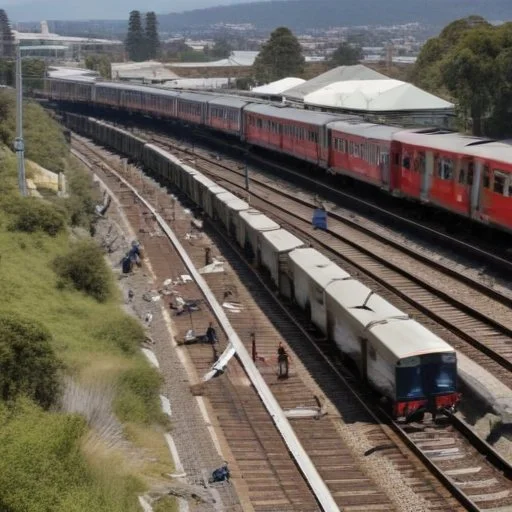
In the late 1970s, Sydney was on the cusp of rapid growth and urbanization, with the city's infrastructure struggling to keep pace. The railway network, a lifeline for the city's commuters, was no exception. As the population boomed, the demand for efficient and reliable transportation increased, putting immense pressure on the system.
On January 18, 1977, the 6:09 a.m. train from Mount Victoria to Sydney's Central Station embarked on its daily journey, carrying over 400 passengers. As the train rumbled towards Granville Station, it approached a curve that would change the course of history forever. The train, traveling at approximately 60 km/h, failed to negotiate the bend, derailing and colliding with the supports of a nearby bridge. The impact was cataclysmic, causing the concrete viaduct to collapse, crushing carriages and releasing a maelstrom of destruction.
In the hours that followed, rescue teams battled to extract survivors from the twisted wreckage. The scenes were apocalyptic, with mangled carriages, severed limbs, and the cries of the injured and bereaved filling the air. As the full extent of the tragedy became apparent, the city of Sydney was plunged into darkness, with flags flying at half-mast and a stunned population grappling with the loss of so many lives.
The Granville train disaster marked a watershed moment in Australian history, prompting a seismic shift in public perception and sparking a national conversation about safety, accountability, and the need for infrastructure reform. The tragedy led to a comprehensive overhaul of rail safety protocols, improved emergency response systems, and increased investment in transportation infrastructure.
Among the victims were students, professionals, and families, each with their own unique story. There was the young mother who had just dropped off her child at school, the businessman heading to a crucial meeting, and the elderly couple on their way to visit their grandchildren. As the stories of those who perished began to emerge, the nation was reminded that behind every statistic lies a human being, with hopes, dreams, and loved ones left behind.
In the decades since the Granville train disaster, Australia has made significant strides in rail safety, but the memory of that fateful day remains etched in the country's collective consciousness. As a testament to the victims and their families, the city of Sydney has established the Granville Memorial, a poignant reminder of the importance of vigilance, accountability, and the value of human life.
The Granville train disaster stands as a somber reminder of the devastating consequences of human error and the importance of prioritizing safety above all else. As we reflect on this dark chapter in Australian history, we honor the memories of those who perished and recommit ourselves to ensuring that such a tragedy never occurs again.
The Granville train disaster had a profound impact on Australian culture, sparking a national conversation about safety and accountability. The tragedy led to a shift in public perception, with many calling for greater investment in infrastructure and stricter safety protocols.
In the years following the disaster, the Australian media played a crucial role in shaping the public's response, with newspapers and television stations dedicating extensive coverage to the tragedy and its aftermath.
The disaster also had a lasting impact on the country's art and literature, with many artists and writers drawing inspiration from the tragedy. One notable example is the novel "The Railway Station" by Australian author, Helen Garner, which explores the human cost of the disaster and its impact on the community.

The Granville train disaster had significant economic implications for the city of Sydney and the Australian economy as a whole. The disaster led to a massive cleanup effort, with estimates suggesting that the cost of the operation exceeded AU$10 million.
In addition to the immediate costs, the disaster also had a long-term impact on the economy, with many businesses and industries feeling the effects of the tragedy. The tourism industry, in particular, was hard hit, with many visitors cancelling their plans to visit Sydney in the aftermath of the disaster.
Despite the challenges, the disaster also presented opportunities for growth and investment, with the government committing to a major overhaul of the city's infrastructure and transportation systems.
Richard Carroll: The Hero of Granville
Richard Carroll, a 25-year-old firefighter, was one of the first responders to arrive at the scene of the disaster. Without hesitation, he entered the wreckage, risking his own life to rescue survivors and provide medical aid to the injured.
Carroll's bravery that day earned him widespread recognition, including the George Cross, Australia's highest civilian honor. His selfless actions inspired a generation of Australians and cemented his place as a hero of the Granville train disaster.

The Granville train disaster led to a major overhaul of rail safety protocols in Australia, with a focus on improving safety technologies and infrastructure.
One of the key innovations to emerge from the disaster was the development of Automatic Warning Systems (AWS), which use sensors and warning systems to alert train drivers to potential hazards.
The disaster also prompted a review of the country's rail infrastructure, with a focus on improving signage, track maintenance, and rolling stock. These efforts have led to a significant reduction in rail accidents in Australia over the past several decades.
The Granville train disaster has been the subject of extensive historiographical analysis, with many historians seeking to understand the disaster's causes and consequences.
One notable interpretation is that the disaster was a symptom of a wider crisis in Australian infrastructure and governance, with many arguing that the tragedy was the result of inadequate investment and regulation.
Other historians have focused on the disaster's human impact, exploring the stories of those who perished and the communities that were affected by the tragedy.