


On September 12, 1683, the fate of Europe hung in the balance as the Ottoman Empire, having marched victoriously across the continent, laid siege to the Habsburg capital of Vienna. But on that fateful day, the tide of history turned, as a coalition of European forces, led by the Habsburgs, joined together to repel the Turkish invaders and secure a resounding victory that would shape the course of European history.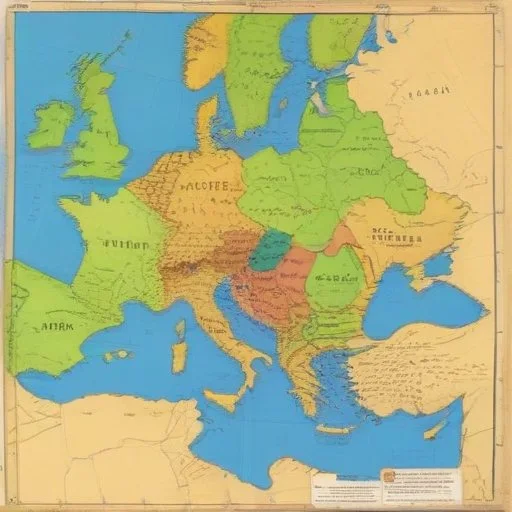
The Ottoman Empire, having conquered a vast swathe of Eastern Europe, had set its sights on the prized city of Vienna. In response, a broad coalition of European forces rallied to defend the city, including the Holy Roman Empire, led by Emperor Leopold I, the Polish-Lithuanian Commonwealth, led by King John III Sobieski, and the Venetian Republic, among others. This unlikely alliance of European powers would prove to be the decisive factor in the battle to come.
The Ottoman army, led by Grand Vizier Kara Mustafa Pasha, laid siege to Vienna on July 14, 1683, with an estimated 100,000 troops. The defenders, numbering around 11,000, were vastly outnumbered, but they had the advantage of familiarity with the terrain and a determination to protect their city. The siege lasted for two months, during which time the Ottomans bombarded the city with cannon fire, while the defenders launched periodic sorties to disrupt the enemy's lines.
The turning point of the battle came on September 12, when King Sobieski, leading a contingent of Polish cavalry, launched a daring charge against the Ottoman lines. This bold move, which would become known as the "Winged Hussars' Charge," caught the Turks off guard and sent them into disarray. The European forces seized the opportunity, pushing forward and breaking through the Ottoman defenses.
The Battle of Vienna was a decisive victory for the European coalition, with estimates suggesting that up to 20,000 Ottoman soldiers were killed or wounded. The defeat marked a significant turning point in the Austro-Ottoman War, as the Ottomans would never again threaten the heart of Europe in the same way. The victory also elevated the reputation of King Sobieski, who would go on to play a key role in the subsequent Great Turkish War.
The Battle of Vienna marked a significant shift in the balance of power in Europe, as the Ottoman Empire's seemingly unstoppable march into the continent was halted. The coalition of European forces that had come together to defend Vienna would serve as a model for future alliances, as the continent began to coalesce around a shared sense of purpose and destiny. The battle also sparked a new era of cultural and artistic exchange between East and West, as European powers began to look beyond their borders and engage with the rich cultural heritage of the Ottoman Empire.
The Battle of Vienna was a testament to the power of coalition and cooperation in the face of adversity. As the dust settled on that fateful day, the people of Europe knew that they had witnessed something momentous – a turning point in their history that would shape the course of their continent for centuries to come.
The Battle of Vienna was not an isolated event, but rather a culmination of centuries of Ottoman expansion into Eastern Europe. The Ottoman Empire had already conquered large swaths of territory, including Bulgaria, Serbia, and Hungary, and Vienna was a strategic prize that would have given them control over the Danube River and access to the heart of Europe.
The Geopolitical context of the battle is crucial to understanding its significance. The Ottoman Empire was seeking to expand its territories and establish itself as a dominant power in Europe, while the European powers were determined to halt its advance and protect their own territories. The battle was a clash of empires, with the fate of Europe hanging in the balance.
Leopold I: The Reluctant Leader
Leopold I, the Holy Roman Emperor, played a crucial role in the Battle of Vienna, but his leadership was not without controversy. Initially, Leopold was hesitant to engage with the Ottoman Empire, preferring to focus on internal conflicts within the Holy Roman Empire. However, as the Ottoman army approached Vienna, he was forced to act, and his leadership ultimately proved decisive in the battle.
Leopold's character was marked by caution and pragmatism, but he also possessed a deep sense of responsibility and duty. His decision to form an alliance with the Polish-Lithuanian Commonwealth was a testament to his ability to put aside differences and work towards a common goal.
The Battle of Vienna had a profound impact on European culture, particularly in the realm of art and architecture. The Ottoman Empire's involvement in the battle introduced European artists to new styles, motifs, and techniques, which would later influence the development of Baroque and Rococo art.
The battle also sparked a renewed interest in classical Greek and Roman culture, as European scholars and artists sought to reclaim their cultural heritage from the perceived threat of Ottoman domination. This led to a flowering of cultural production, as artists, writers, and thinkers sought to express the values and ideals of European civilization.
The Battle of Vienna marked a significant shift in the balance of power in Europe, as the Ottoman Empire's defeat temporarily halted its expansionist ambitions. The battle also led to a re-evaluation of the European system of alliances and led to the formation of new coalitions and partnerships.
The concert of Europe, as it came to be known, was a system of diplomacy and cooperation that sought to maintain peace and stability on the continent. The Battle of Vienna marked the beginning of this era of cooperation, as European powers recognized the need to work together to counter the Ottoman threat.
The immediate aftermath of the Battle of Vienna was marked by chaos and confusion, as the defeated Ottoman army retreated in disarray. The European forces, led by King Sobieski, pursued the Ottomans, capturing large quantities of supplies and equipment.
The victory was celebrated across Europe, with grand processions, festivals, and fireworks. The Pope, Innocent XI, hailed the victory as a triumph of Christendom over the forces of Islam. The battle was seen as a divine intervention, and it sparked a renewed sense of confidence and purpose among European leaders.