Robert Guiscard conquers last Byzantine Italian stronghold Bari
The curtain falls on Byzantine southern Italy as Robert Guiscard, the cunning Norman warlord, claims a resounding victory, seizing Bari, the last bastion of Byzantine power. For decades, the Eastern Roman Empire's grip on Italy had been tenuous, and Guiscard, with his battle-hardened armies, exploited the weakness, wresting control of the strategically important city. This pivotal event marked the Norman conquest of southern Italy, reconfiguring the peninsula's power dynamics, and ushering in a new era of Latin influence.
Bari, the Gateway to Southern Italy, Falls to Robert Guiscard
On April 16, 1071, the last stronghold of Byzantine power in southern Italy, Bari, surrendered to the cunning Norman warlord, Robert Guiscard, marking a pivotal moment in the region's history. This significant event signaled the end of Byzantine rule in Italy, paving the way for Norman dominance and a new era of Latin influence.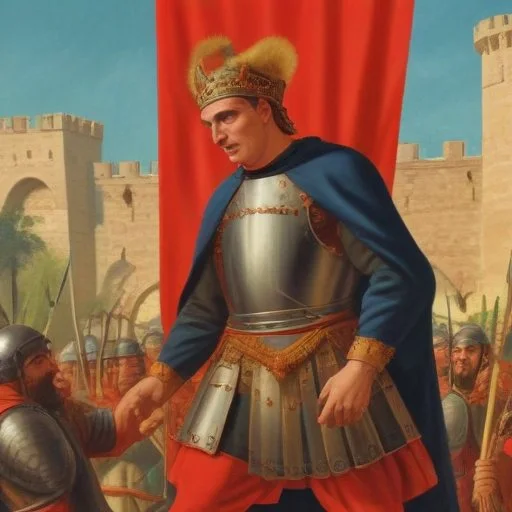
Historical Background
In the 11th century, the Byzantine Empire, also known as the Eastern Roman Empire, had been gradually losing its grip on Italy. The empire's resources were stretched thin, and its armies were weakened by constant wars with neighboring states. Meanwhile, the Normans, a group of Viking descendents, had been making inroads into southern Italy, exploiting the Byzantine weakness.
The Rise of Robert Guiscard
Robert Guiscard, a skilled military leader and strategist, emerged as a key figure in the Norman conquest of southern Italy. Born in Normandy, France, Guiscard had arrived in Italy in the 1040s, seeking fortune and glory. He quickly gained a reputation as a formidable warrior, earning the respect of his enemies and the loyalty of his followers.
The Siege of Bari
In 1068, Guiscard laid siege to Bari, a strategic port city and the last remaining Byzantine stronghold in southern Italy. The city was heavily fortified, and its defenses were bolstered by a large Byzantine garrison. However, Guiscard's armies were well-trained and determined, and after a grueling three-year siege, the city finally surrendered.
Major Outcomes and Impacts
- The fall of Bari marked the end of Byzantine rule in Italy, ending a centuries-long period of Eastern Roman Empire's influence in the region.
- The Norman conquest of southern Italy led to the establishment of a new power dynamic, with the Normans emerging as the dominant force in the region.
- The event paved the way for the Latinization of southern Italy, as Norman rule brought about significant cultural, linguistic, and religious changes.
Cultural and Social Influences
The Norman conquest of southern Italy had a profound impact on the region's culture and society. The Normans introduced their own language, customs, and traditions, which eventually blended with the existing Italian culture. The event also led to the construction of new buildings, roads, and infrastructure, which helped to modernize the region.
Personal Accounts and Anecdotes
According to historical records, Robert Guiscard was known for his cunning and bravery. During the siege of Bari, he personally led the charge against the city walls, inspiring his troops to fight on despite the odds. Guiscard's leadership and military prowess earned him the respect of his enemies, who often referred to him as the "resourceful and clever" warlord.
Impact on Future Events
The fall of Bari had far-reaching consequences, shaping the course of Italian history for centuries to come. The Norman conquest of southern Italy laid the groundwork for the eventual formation of the Kingdom of Sicily, a powerful state that would play a significant role in the region's politics and economy.
Inspirational Stories and Motivations
The story of Robert Guiscard's conquest of Bari serves as a testament to the power of determination and perseverance. Despite facing numerous challenges and setbacks, Guiscard remained focused on his goal, ultimately achieving a remarkable victory that would change the course of history.
As we reflect on this pivotal event, we are reminded of the importance of adaptability, leadership, and strategic thinking. The fall of Bari is a powerful reminder that even in the face of adversity, individuals can make a significant impact and shape the course of history.
Character Overview
Robert Guiscard's early life is shrouded in mystery, but it is known that he was born in Normandy, France, around 1015. He was the youngest of twelve sons, and his family was of modest means. Despite these humble beginnings, Guiscard was driven to succeed, and he quickly made a name for himself as a skilled warrior and leader.
Guiscard's rise to power was rapid, and he soon became known as one of the most feared and respected warlords in southern Italy. His military campaigns were marked by cunning and bravery, and he was feared by his enemies and admired by his followers.
Despite his reputation as a ruthless warlord, Guiscard was also a shrewd politician and strategist. He was able to forge alliances and negotiate treaties, often using his charm and charisma to achieve his goals.

In-Depth Cultural Influence Study
The Norman conquest of southern Italy had a profound impact on the region's culture and society. The Normans introduced their own language, customs, and traditions, which eventually blended with the existing Italian culture.
The Normans also brought about significant changes in the region's architecture, art, and literature. They introduced Romanesque architecture, which became a hallmark of southern Italian architecture, and patronized poets and writers who helped to develop the Italian language.
The Norman conquest also led to the development of a new feudal system, in which the Normans held power and influence over the local population. This system would shape the region's social and economic dynamics for centuries to come.
Comprehensive Geopolitical Review
The Byzantine Empire's decline in southern Italy was part of a larger trend of imperial decay and fragmentation. The empire was facing challenges on multiple fronts, including the rise of the Seljuk Turks in Anatolia and the Normans in Italy.
The Byzantine Empire's weakness in southern Italy created a power vacuum that the Normans were quick to exploit. The Normans saw an opportunity to expand their territory and influence, and they took advantage of the Byzantine Empire's inability to defend its territory.
The fall of Bari marked a significant shift in the balance of power in the Mediterranean, with the Normans emerging as a major player in regional politics.

In-Depth Political Study
The fall of Bari marked a significant turning point in the struggle for power in southern Italy. The Normans had finally expelled the Byzantine Empire from the region, and they were now the dominant force in the area.
The Norman conquest of southern Italy led to the establishment of a new power dynamic, with the Normans holding sway over the region. The Normans would go on to establish the Kingdom of Sicily, which would become a major power in the Mediterranean.
The fall of Bari also had significant implications for the Papacy, which had long been a rival of the Byzantine Empire. The Normans would go on to form an alliance with the Papacy, which would shape the course of Italian history for centuries to come.
Historiographical Insights
Historians have long debated the significance of Robert Guiscard's conquest of Bari. Some have seen it as a turning point in the decline of the Byzantine Empire, while others have viewed it as a key moment in the rise of the Normans.
Recent scholarship has emphasized the complexity and nuance of the Norman conquest of southern Italy. Historians have highlighted the role of local factions and rivalries in shaping the course of events, and have challenged the traditional view of the Normans as a monolithic and unified force.
Despite these debates, there is broad agreement that the fall of Bari was a pivotal moment in Italian history, marking the end of Byzantine rule and the beginning of a new era of Norman dominance.


