


The Battle of Baltimore, fought during the War of 1812, is etched in American history as a testament to the nation's unwavering spirit and defiance in the face of adversity. This pivotal event is renowned for inspiring Francis Scott Key's iconic poem, "Defence of Fort McHenry," which would later become the lyrics to the United States national anthem, "The Star-Spangled Banner."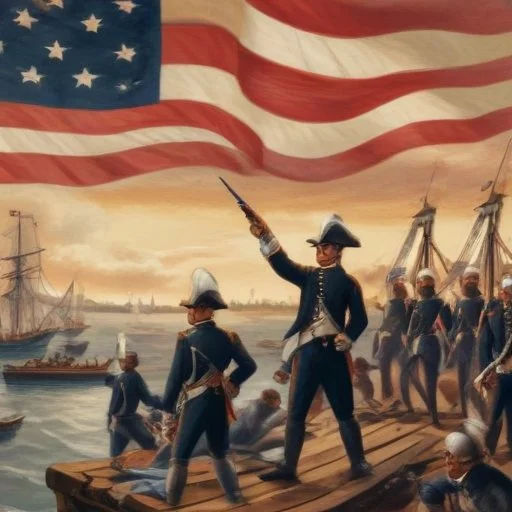
The War of 1812, sparked by British impressment of American sailors, trade restrictions, and British support for Native American resistance, had been raging for over a year. American forces had suffered a series of setbacks, including the burning of Washington, D.C. by British troops just weeks prior to the Battle of Baltimore.
In August 1814, a formidable British fleet, consisting of over 50 warships, sailed into the Chesapeake Bay, intent on capturing the strategic port city of Baltimore. The British Army, led by General Robert Ross, began its march towards the city, while the British Navy, commanded by Vice-Admiral Alexander Cochrane, laid siege to Fort McHenry, the American stronghold guarding the harbor.
Franics Scott Key, a Maryland lawyer and amateur poet, boarded a British ship to negotiate the release of American prisoners. As he witnessed the brutal 25-hour bombardment of Fort McHenry, Key was electrified by the bravery of the American defenders, who refused to surrender despite being vastly outnumbered and outgunned.
As the British bombardment subsided, Key beheld the American flag still waving proudly above Fort McHenry, a testament to the fort's resilience. Inspired by this moment, Key scribbled the iconic poem "Defence of Fort McHenry," which would later be set to the tune of a popular British song, becoming "The Star-Spangled Banner," the national anthem of the United States.
The Battle of Baltimore marked a turning point in the War of 1812, as American forces began to regain momentum and eventually secure a decisive victory at the Battle of New Orleans. The bravery and resilience displayed during the Battle of Baltimore inspired a nation, fostering a sense of patriotism and unity that would endure for generations.
The Battle of Baltimore has had a profound impact on American culture, with its legacy extending far beyond the battlefield. The "Defence of Fort McHenry" poem and "The Star-Spangled Banner" have become symbols of American identity, invoked during times of crisis and celebration alike.
In commemoration of the Battle of Baltimore, the American flag has become a powerful symbol of American patriotism, regularly displayed at government buildings, public events, and private residences. The Flag House and Star-Spangled Banner Museum in Baltimore, Maryland, serves as a testament to the battle's enduring legacy, preserving the history and significance of the American flag.
The Battle of Baltimore has inspired countless Americans, from Francis Scott Key's poem to the countless acts of bravery exhibited by the defenders of Fort McHenry. This heroic episode has become a beacon of hope, reminding Americans of the importance of perseverance, courage, and loyalty in the face of adversity.
The Battle of Baltimore has been viewed through various historical lenses, with different interpretations emerging over time. Early historians, such as Henry Adams, portrayed the battle as a testament to American patriotism and valor. In contrast, later historians, like Donald R. Hickey, have emphasized the British perspective, highlighting the military strategies and logistical challenges faced by the British Army.
Recent historiography has shifted focus towards the experiences of ordinary soldiers, sailors, and civilians, providing a more nuanced understanding of the battle's human dimension. Additionally, historians have explored the battle's significance within the broader context of the War of 1812, examining its impact on American identity, politics, and diplomacy.
Born on August 1, 1779, in Frederick, Maryland, Francis Scott Key was a Maryland lawyer, amateur poet, and passionate patriot. Key's early life was marked by a strong sense of morality and a commitment to public service, which would later inspire his iconic poem.
Key's experiences during the Battle of Baltimore, where he witnessed the bravery of American defenders and the bombardment of Fort McHenry, had a profound impact on his life and work. His poem, "Defence of Fort McHenry," became an instant sensation, capturing the essence of American resilience and patriotism.
The American flag flying above Fort McHenry during the Battle of Baltimore was a pivotal symbol of American defiance and resilience. Designed by Mary Young Pickersgill, a local seamstress, the flag measured 30 x 42 feet and featured 15 stars and 15 stripes, representing the 15 states that made up the United States at the time.
The flag's massive size and prominent display made it a visible target for the British bombardment, yet it withstood the intense shelling, inspiring Francis Scott Key's poem. Today, the flag is an iconic symbol of American patriotism, displayed at government buildings, public events, and private residences across the United States.
The Star-Spangled Banner, inspired by Francis Scott Key's poem, has become an integral part of American culture and identity. The anthem has been performed at presidential inaugurations, Olympic ceremonies, and numerous public events, evoking feelings of patriotism and national pride.
Throughout its history, the anthem has been translated into over 20 languages, reflecting its universal appeal. The song's cultural significance extends beyond its patriotic connotations, with its melody and lyrics inspiring countless adaptations, parodies, and artistic interpretations.
The Chesapeake Bay, a vital waterway connecting the Atlantic Ocean to the heart of the American mainland, played a crucial role in the Battle of Baltimore. The bay's strategic importance made it a coveted prize for both American and British forces, who sought to control its access and trade routes.
The British invasion of the Chesapeake Bay was part of a broader strategy to disrupt American trade and commerce, while the American defense of Baltimore was essential to preserving the country's economic and political independence. The battle's outcome had significant implications for the region's development, shaping the course of American history and its relationships with European powers.