


In the summer of 1900, the Eight-Nation Alliance, a coalition of international forces, marched into Beijing, China, to put an end to the brutal Boxer Rebellion, a violent anti-foreigner movement that had been terrorizing the city for months. The ensuing Battle of Peking would go down in history as a pivotal moment, marking the beginning of a new era of international relations in China and having far-reaching consequences for the country's future.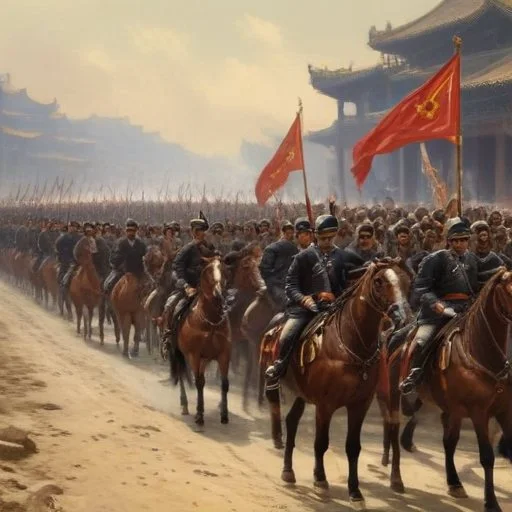
The Boxer Rebellion, a radical movement fueled by anti-foreigner sentiment, had been gaining momentum in China since the late 19th century. The movement's followers, mostly young men from rural areas, believed that the foreign presence in China was the source of the country's problems, and they sought to expel foreigners and restore China's traditional ways.
In June 1900, the Boxers, backed by the Qing dynasty, laid siege to the foreign legations in Beijing, trapping thousands of foreigners and Chinese Christians inside. The situation was dire, with food and water running low, and the besieged foreigners facing near-certain death.
In response to the crisis, eight nations – Austria-Hungary, France, Germany, Italy, Japan, Russia, the United Kingdom, and the United States – formed an alliance to rescue the trapped foreigners and put an end to the Boxer Rebellion. The alliance was a unique phenomenon, bringing together nations with competing interests to achieve a common goal.
Led by British General Alfred Gaselee, the alliance forces set out from the port city of Tianjin, determined to fight their way through the Boxer forces and Chinese imperial troops to reach Beijing. The journey was grueling, with the troops facing intense heat, disease, and guerrilla warfare along the way.
On August 14, 1900, the alliance forces finally reached Beijing, and the Battle of Peking began. The fighting was fierce, with the alliance forces struggling to overcome the well-entrenched Boxer and Chinese troops. After several days of intense combat, the alliance emerged victorious, and the city was finally under their control.
The consequences of the Battle of Peking were far-reaching. The Boxer Rebellion was crushed, and the Qing dynasty was forced to sign the Boxer Protocol, a humiliating treaty that imposed harsh penalties and reparations on China. The alliance's victory also marked the beginning of a new era of international relations in China, with the country forced to open up to foreign trade and influence.
The Battle of Peking had a profound impact on Chinese society, leading to a shift away from traditional ways and towards modernization and reform. The event also sparked a wave of nationalism, with many Chinese people calling for greater autonomy and self-determination.
The Battle of Peking was not without controversy, with many criticizing the alliance's brutal tactics and the subsequent exploitation of China by foreign powers. The event remains a sensitive topic in China to this day, with many regarding it as a national humiliation.
The Battle of Peking was a pivotal moment in China's history, marking the beginning of a new era of international relations and setting the stage for the country's future development. It serves as a reminder of the complex and often contentious relationship between China and the Western world, and the ongoing struggle for autonomy and self-determination.
| June 1900 | The Boxers lay siege to the foreign legations in Beijing |
|---|---|
| August 1900 | The Eight-Nation Alliance marches into Beijing, sparking the Battle of Peking |
| August 14, 1900 | The alliance forces emerge victorious, and the city is under their control |
| September 1901 | The Boxer Protocol is signed, imposing harsh penalties and reparations on China |
The Battle of Peking was a complex and multifaceted event, with far-reaching consequences for China and the world. It serves as a reminder of the importance of understanding the complexities of history and the ongoing struggle for autonomy and self-determination.
The Boxer Rebellion has been subject to various interpretations by historians, with some viewing it as a nationalist movement against foreign imperialism, while others see it as a reactionary and xenophobic response to modernization.
Some historians argue that the Boxer Rebellion was a justified response to the encroachment of Western powers on Chinese sovereignty, while others view it as a misguided and violent movement that hindered China's progress towards modernity.
The debate highlights the complexity of the event and the need for a nuanced understanding of the historical context.
General Alfred Gaselee was a British army officer who led the Eight-Nation Alliance forces during the march on Beijing.
A seasoned military commander, Gaselee played a crucial role in the alliance's victory, employing his tactical skills to overcome the challenging terrain and fierce resistance from the Boxer forces.
Gaselee's leadership was instrumental in the success of the mission, and he was hailed as a hero upon his return to Britain.The Boxer Rebellion had a profound impact on Chinese culture, marking a turning point in the country's transition from traditionalism to modernity.
The event led to a re-evaluation of traditional values and the embrace of Western ideas, as China sought to modernize and strengthen itself in the face of foreign encroachment.
The Boxer Rebellion also sparked a wave of nationalism, as Chinese people began to call for greater autonomy and self-determination.
The Boxer Protocol imposed harsh economic penalties on China, forcing the country to pay massive reparations to the foreign powers.
The protocol led to a significant increase in foreign investment in China, as Western powers sought to exploit the country's resources and markets.
The economic consequences of the Boxer Protocol were far-reaching, shaping China's economic development for decades to come.The Boxer Rebellion took place against the backdrop of intense great-power rivalry in East Asia, as European powers, Japan, and the United States vied for influence and territory.
The event highlighted the weakness of the Qing dynasty and the need for China to modernize and strengthen itself in order to resist foreign encroachment.
The Boxer Rebellion marked a significant shift in the global balance of power, as Western powers solidified their dominance in East Asia.