


The Battle of Zenta, fought on September 11, 1697, is etched in history as one of the most crushing defeats suffered by the Ottoman Empire. This pivotal engagement, which took place in Zenta, Hungary, marked a significant shift in the balance of power during the Great Turkish War (1683-1699), ultimately paving the way for the Treaty of Karlowitz and the cession of Ottoman territory to European powers.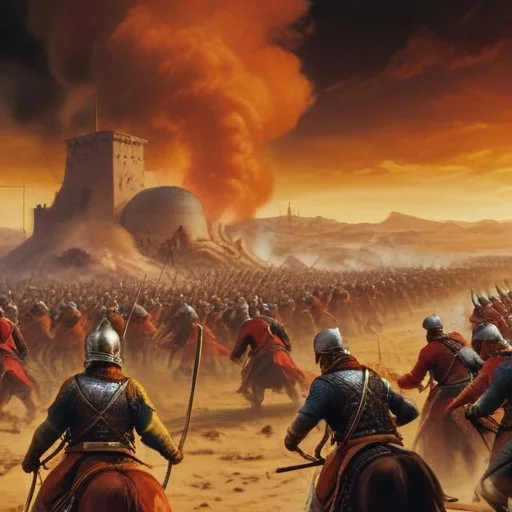
The Great Turkish War, sparked by the Ottoman Empire's failed attempt to capture Vienna in 1683, had been raging for over a decade. The war saw a series of brutal battles and sieges, with both the Ottomans and their European foes suffering heavy losses. By 1697, the Ottoman Empire, under the leadership of Sultan Mustafa II, was struggling to maintain its grip on its vast territories.
The Battle of Zenta was a testament to the adaptability and cunning of the Holy Roman Empire's forces, led by Emperor Leopold I. Anticipating the Ottoman cavalry's advantage, the Imperial army deployed troops in a series of trenches, effectively neutralizing the Janissary corps' mobility. The Ottomans, caught off guard, were unable to respond effectively to this unorthodox tactic.
The Battle of Zenta marked a turning point in the Great Turkish War, as the Ottoman Empire's fortunes continued to dwindle. The crushing defeat led to a re-evaluation of the empire's military strategy and eventually paved the way for the Treaty of Karlowitz (1699), which saw the Ottomans cede significant territory to European powers, including Hungary, Transylvania, and parts of Croatia and Slavonia.
The Battle of Zenta serves as a poignant reminder of the importance of adaptability and innovation on the battlefield. The Imperial army's tactical flexibility and willingness to challenge conventional wisdom ultimately proved decisive, highlighting the need for military leaders to remain nimble and responsive to changing circumstances.
In the annals of history, the Battle of Zenta will forever be remembered as a testament to the power of strategic thinking and the devastating consequences of complacency.
Historians have long debated the significance of the Battle of Zenta, with some viewing it as a decisive turning point in the Great Turkish War, while others see it as just one of many battles in a prolonged conflict. Recent scholarship has sought to reevaluate the battle's importance, highlighting its impact on the Ottoman Empire's military strategy and its eventual withdrawal from Eastern Europe.
One of the key challenges facing historians is the limited availability of primary sources from the Ottoman Empire, which can create an imbalance in the historical narrative. However, by incorporating sources from European powers and other contemporaneous accounts, a more comprehensive understanding of the battle and its context can be achieved.
The Battle of Zenta serves as a prime example of the need for a nuanced approach to historical analysis, taking into account the complexities and complexities of the time. By reexamining the battle through a variety of lenses, historians can gain a deeper understanding of the events that shaped the modern world.
Emperor Leopold I, the ruler of the Holy Roman Empire, played a crucial role in the Battle of Zenta. His strategic genius and adaptability were key factors in the Imperial army's decisive victory. Leopold's leadership and vision paved the way for the Treaty of Karlowitz, marking a significant shift in the balance of power in Eastern Europe.
Leopold's ability to outmaneuver the Ottoman Empire's military leaders, including the Grand Vizier Elmas Mehmed Pasha, was instrumental in securing the victory. His tactical decisions, such as the deployment of troops in trenches, caught the Ottomans off guard and neutralized their cavalry advantage.
Despite his significant contribution to the battle's outcome, Leopold I remains an underappreciated figure in history. His achievements, however, serve as a testament to the importance of effective leadership in times of conflict.
The Battle of Zenta was a clash of two empires, each with its own distinct military traditions and strategies. The Ottoman Empire, with its centuries-long experience of conquest, was known for its cavalry-based warfare, while the Holy Roman Empire relied on a more diversified approach, incorporating infantry, artillery, and cavalry.
The battle highlights the differences in the two empires' military structures and philosophies. The Ottomans, with their janissary corps, emphasized discipline and cohesion, while the Holy Roman Empire's forces were more adaptable and responsive to changing circumstances.
The contrast between the two empires' military approaches is a reflection of their broader cultural and societal values. The Ottoman Empire's rigidity and hierarchy were matched by the Holy Roman Empire's flexibility and pragmatism, ultimately proving decisive in the battle's outcome.

The Battle of Zenta took place against the backdrop of a complex and shifting geopolitical landscape. The Great Turkish War, sparked by the Ottoman Empire's failed attempt to capture Vienna in 1683, had drawn in numerous European powers, including the Holy Roman Empire, Poland, and Venice.
The battle was also influenced by the ongoing struggle for influence in Eastern Europe, with the Ottoman Empire seeking to maintain its dominance and the Holy Roman Empire aiming to expand its territories.
The battle's outcome had significant implications for the region's balance of power, as the Ottoman Empire's defeat weakened its grip on Eastern Europe, paving the way for the Treaty of Karlowitz and the eventual redrawing of the region's borders.
The Battle of Zenta had a profound impact on the economies of Eastern Europe, as the Ottoman Empire's defeat led to a significant shift in trade patterns and economic power dynamics.
The treaty of Karlowitz, which followed the battle, marked the beginning of a new era of economic cooperation between European powers, with the Holy Roman Empire emerging as a dominant force in the region.
The battle also led to an influx of trade and investment in the region, as European powers sought to capitalize on the Ottoman Empire's weakness. The resulting economic growth had far-reaching consequences, shaping the development of Eastern Europe for centuries to come.