


The Belgian Revolution, a pivotal moment in European history, took a dramatic turn when the provisional government officially seceded from the Netherlands, marking a bold step towards self-rule and independence. This courageous act, which occurred on October 4, 1830, would go on to shape the future of Belgium, forging a new path for the nation and its people.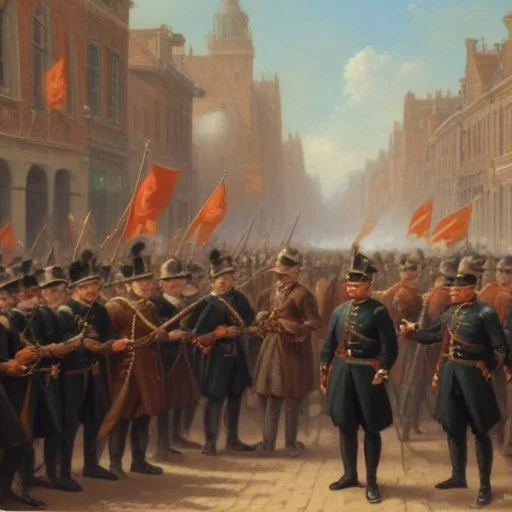
In the early 19th century, the Belgian people had grown increasingly dissatisfied with the authoritarian rule of William I of the Netherlands. The Dutch monarch's attempts to impose his own brand of governance on the Belgian people had sparked widespread discontent, fueling a growing desire for independence and self-determination.
| Date | Event |
|---|---|
| August 1830 | The Belgian Revolution begins, sparked by the performance of Daniel Auber's opera "La Muette de Portici" in Brussels. |
| September 1830 | The provisional government is established, with Charles Rogier as its leader. |
| October 4, 1830 | The provisional government officially secedes from the Netherlands, declaring Belgium's independence. |
| 1831 | The Belgian Constitution is ratified, solidifying the country's new status as an independent nation. |
The Belgian Revolution's success led to the establishment of a new, independent nation, with a constitutional monarchy and a parliamentary system of government. This, in turn, paved the way for Belgium's rapid industrialization, urbanization, and emergence as a major economic power in Europe.
The Belgian Revolution inspired a new era of cultural and artistic expression, with the nation's writers, artists, and musicians drawing inspiration from the struggle for independence. The revolution also sparked a renewed sense of national identity, as Belgians from diverse backgrounds came together to forge a common future.
"The country is not a prison, it is a cradle." - Charles Rogier
This quote, often attributed to Charles Rogier, captures the essence of the Belgian Revolution: the desire to break free from oppression and forge a new, independent path.
In his memoirs, Étienne Constantin de Gerlache wrote of the provisional government's tense negotiations with the Dutch, recalling the moment when the Belgian delegation boldly declared their nation's independence: "It was as if the very fate of the nation hung in the balance. We knew that our decision would have far-reaching consequences, but we were resolute in our pursuit of freedom."
The Belgian Revolution's success inspired similar independence movements throughout Europe, paving the way for the emergence of new nation-states and the reconfiguration of the continent's political landscape.
In conclusion, the Belgian Revolution's courageous declaration of independence on October 4, 1830, marked a pivotal moment in European history, shaping the future of Belgium and serving as a beacon of hope for nations striving for self-determination.
The Belgian Revolution not only shaped the country's political landscape but also had a profound impact on its cultural scene. The struggle for independence inspired a new wave of artistic and literary expression, as Belgians sought to define their national identity.
Writers like Hendrik Conscience and Karel Lodewijk Ledeganck drew inspiration from the revolution, producing works that celebrated the nation's newfound freedom and unity. The period also saw the emergence of a distinct Belgian art movement, characterized by its romantic and nationalistic themes.
The Belgian Revolution's cultural legacy continues to be felt today, with many artists and writers still drawing inspiration from the nation's rich history and heritage.
Historians have long debated the significance and causes of the Belgian Revolution, with some viewing it as a struggle for national unity and others seeing it as a clash of liberal and conservative ideologies.
One school of thought, led by historians like Henri Pirenne, emphasizes the revolution's role in forging a unified Belgian identity, transcending linguistic and regional differences.
Another perspective, advanced by scholars like Jean Stengers, highlights the revolution's ideological underpinnings, seeing it as a key moment in the struggle between liberal and conservative forces in Europe.
The Belgian Revolution had significant economic implications for the newly independent nation. With the Netherlands no longer in control, Belgium was free to develop its own trade policies and industrial strategies.
The country's industrial sector, particularly textiles and iron, experienced rapid growth, driven by investments from Belgian entrepreneurs and foreign capital.
The revolution's economic legacy can still be seen today, with Belgium's highly developed economy and strong international trade links.
The revolution's success was closely watched by other European nations, inspiring similar movements for independence and self-determination.
The events in Belgium also had implications for the European balance of power, as the great powers of Europe, including Britain, France, and Prussia, maneuvered to maintain their influence in the region.
The Belgian Constitution, ratified in 1831, established a constitutional monarchy, balancing the powers of the monarch, the government, and the people.
This innovative system, which combined elements of British, French, and American constitutional models, provided a framework for stable and effective governance.
The Belgian Constitution's enduring legacy is a testament to the country's commitment to democracy and the rule of law.