


The fateful day of August 7, 1998, etched a dark chapter in the annals of history as coordinated bombings ravaged the United States embassies in Dar es Salaam, Tanzania, and Nairobi, Kenya, claiming the lives of approximately 212 innocent people and leaving over 4,000 injured.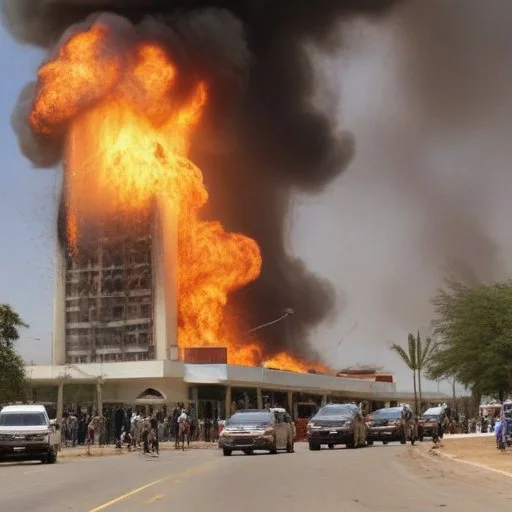
The devastating attacks, masterminded by Osama bin Laden's al-Qaeda network, sent shockwaves of fear and outrage around the world, jolting the international community into a grim reality.
In the early 1990s, al-Qaeda's influence began to spread, fueling anti-American sentiment across the Middle East and Africa. Osama bin Laden's ideology, rooted in radical Islamic extremism, posed a looming threat to global security.
The 1998 embassy bombings were not an isolated incident; rather, they marked a pivotal moment in al-Qaeda's campaign against the United States. The group's sinister plans had been unfolding in the shadows, awaiting the perfect moment to strike.
Two nearly simultaneous bombings, mere minutes apart, shook the embassies in Tanzania and Kenya. In Dar es Salaam, a suicide bomber drove an explosives-laden truck into the embassy's rear parking lot, detonating the payload at 10:30 am local time.
In Nairobi, a similar attack unfolded at 10:35 am, with a truck bomb exploding outside the embassy's front gate. The carefully coordinated strikes were designed to inflict maximum damage and casualties.
The 1998 embassy bombings had far-reaching consequences, reshaping global politics and counterterrorism strategies.
The attacks marked a turning point in the US War on Terror, prompting a significant increase in intelligence gathering and covert operations against al-Qaeda.
The bombings also led to the establishment of the FBI's Counterterrorism Division, tasked with investigating and disrupting terrorist plots worldwide.
The bombings had a profound impact on the global psyche, fostering an unprecedented sense of fear and uncertainty.
In the aftermath, anti-American sentiment surged in some parts of the world, while others rallied in solidarity with the victims and their families.
The attacks also sparked a renewed focus on international cooperation and diplomacy, as nations recognized the need for collective action against global terrorism.
The 1998 embassy bombings raised questions about US intelligence failures and the adequacy of security measures in place at the time.
Critics argued that the US had underestimated al-Qaeda's capabilities, while others pointed to intelligence lapses and bureaucratic inefficiencies as contributing factors.
The attacks also sparked debate on the role of the US in global politics, with some arguing that American foreign policy had created an environment conducive to anti-American sentiment.
Ruth Bradley, a survivor of the Nairobi bombing, recounted the horrors of that day: "I remember the sound of the blast, the smell of smoke and blood, and the screams of the injured. It was like nothing I've ever experienced."
Dr. Fahmi Hassan, a Tanzanian doctor who treated victims in Dar es Salaam, shared his own story: "The scene was like a war zone. I've never seen such destruction and loss of life. It was a day that will haunt me forever."
The 1998 embassy bombings served as a precursor to the devastating 9/11 attacks in 2001, further solidifying al-Qaeda's reputation as a formidable and ruthless terrorist organization.
The bombings also influenced the development of counterterrorism policies and strategies, shaping the course of global efforts to combat extremism.
In the end, the 1998 US embassy bombings remain a powerful reminder of the devastating consequences of terrorism and the urgent need for international cooperation to address this global menace.
The 1998 US Embassy bombings have been subject to varying interpretations by historians and scholars. Some have argued that the attacks marked a turning point in the global War on Terror, while others contend that they were a symptom of deeper political and socioeconomic issues in the region.
Historians have also debated the role of US foreign policy in the lead-up to the bombings, with some arguing that American interventionism in the Middle East created an environment conducive to anti-American sentiment.
Regardless of interpretation, the bombings serve as a somber reminder of the devastating consequences of extremism and the need for international cooperation to address this global menace.

Osama bin Laden: The Mastermind Behind the 1998 Embassy Bombings
Osama bin Laden, the founder of al-Qaeda, was the mastermind behind the 1998 US Embassy bombings. Born in Saudi Arabia in 1957, bin Laden was raised in a wealthy family and was educated in Islamic schools.
He became radicalized in the 1980s, fighting against Soviet forces in Afghanistan, and later turned his attention to the United States, which he saw as a colonial power occupying Muslim lands.
Bin Laden's ideology was rooted in a twisted interpretation of Islam, and he was determined to strike a blow against the West.
The Cultural Impact of the 1998 Embassy Bombings
The 1998 US Embassy bombings had a profound impact on global culture, fostering an unprecedented sense of fear and uncertainty.
In the aftermath, anti-American sentiment surged in some parts of the world, while others rallied in solidarity with the victims and their families.
The bombings also sparked a renewed focus on international cooperation and diplomacy, as nations recognized the need for collective action against global terrorism.

The Geopolitical Context of the 1998 Embassy Bombings
The 1998 US Embassy bombings took place against a backdrop of increasing tensions between the United States and Islamist extremist groups in the Middle East and Africa.
The bombings were part of a broader campaign of terror waged by al-Qaeda, which sought to drive the United States out of the Middle East and establish a global Islamic caliphate.
The attacks marked a significant escalation in the global War on Terror, which would dominate international relations for the next two decades.
The Political Consequences of the 1998 Embassy Bombings
The 1998 US Embassy bombings had significant political consequences, both in the United States and around the world.
In the United States, the bombings led to a major overhaul of the country's counterterrorism policies, including the establishment of the FBI's Counterterrorism Division.
Internationally, the bombings strengthened the resolve of nations to combat global terrorism, leading to increased cooperation and intelligence sharing between governments.