


The Boston Massacre, a pivotal event in American history, is remembered as a deadly clash between British soldiers and American colonists on March 5, 1770. This incident, which left five people dead, including Crispus Attucks, a sailor of African and Native American descent, played a significant role in fueling anti-British sentiment and ultimately contributing to the outbreak of the American Revolutionary War.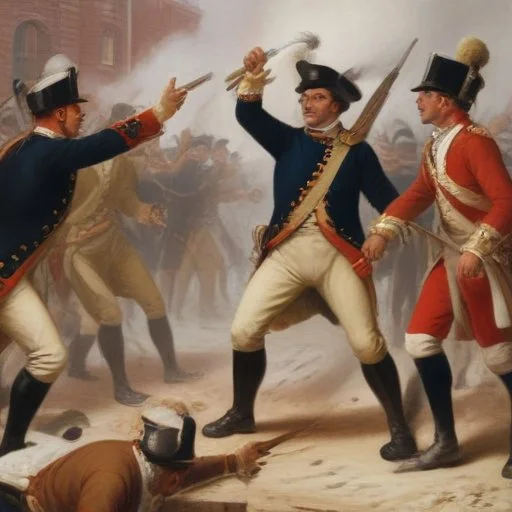
In the months leading up to the Boston Massacre, tensions between British soldiers and American colonists had been escalating. The British government, seeking to exert control over the colonies, had implemented a series of unpopular taxes, including the Townshend Acts, which provoked widespread protests and boycotts. American patriots, determined to resist British rule, began to organize and take action.
On that fateful day, a group of protesters, including Attucks, gathered in front of the Customs House, taunting and throwing snowballs at the British soldiers. The situation turned deadly when a soldier was knocked to the ground, and his comrades, fearing for his safety, opened fire on the crowd. In the chaos that followed, five people lay dead or dying, including Attucks, Samuel Gray, James Caldwell, Samuel Maverick, and Patrick Carr.
The Boston Massacre marked a turning point in American history, galvanizing opposition to British rule and paving the way for the American Revolutionary War. The event was widely publicized, with patriot leaders like Samuel Adams and Paul Revere using it to mobilize public opinion against the British. The massacre also inspired propaganda efforts, including engravings like Paul Revere's famous illustration, which depicted the event as a brutal attack on innocent civilians.
The Boston Massacre remains an important symbol of American resistance against British tyranny. The event is remembered annually on March 5, with commemorations and reenactments taking place in Boston and beyond. Crispus Attucks, the first martyr of the American Revolution, has become an iconic figure, with his legacy inspiring generations of Americans to fight for freedom and justice.
As a testament to the power of resistance, the Boston Massacre continues to inspire people around the world, serving as a reminder that even the most tragic events can spark meaningful change.
The Boston Massacre was not an isolated incident, but rather the culmination of years of growing tensions between British authorities and American colonists. As the British government imposed increasingly unpopular taxes and restrictions, American patriots began to organize and resist. The massacre served as a spark, igniting a flame of resistance that would eventually engulf the colonies and drive them towards independence.
One of the key factors contributing to the growing unrest was the economic strain imposed by British taxation. Merchants and traders, already struggling to make ends meet, found themselves facing ruinous duties and tariffs. This economic hardship created a sense of desperation among the colonists, who saw the British as callously indifferent to their plight.
In this volatile atmosphere, the Boston Massacre became a rallying cry for American patriots. The incident was seized upon by propagandists like Paul Revere, who used his famous engraving to inflame public opinion against the British. As news of the massacre spread, outrage and indignation swept through the colonies, galvanizing resistance and paving the way for the first shots of the Revolutionary War.
Crispus Attucks, the first martyr of the American Revolution, remains an enigmatic figure to this day. Little is known about his early life, but his courageous stand against British tyranny has become the stuff of legend.
Attucks was born to an African father and a Native American mother, making him a symbol of the complex diversity that defined colonial America. His experiences as a sailor and a rope maker would have given him a unique perspective on the British colonial system, and the unfair treatment of American colonists.
Attucks' fateful decision to join the protesters on that fateful night in March 1770 was a testament to his bravery and conviction. As he stood tall in the face of British aggression, he became an inspiration to his fellow colonists, and a powerful symbol of resistance against oppression.
The Boston Massacre has left an indelible mark on American popular culture, inspiring countless works of art, literature, and music. From Paul Revere's famous engraving to modern-day reenactments, the massacre has become a powerful symbol of resistance against oppression.
In the years following the massacre, American patriots used art and propaganda to mobilize public opinion against the British. Engravings, pamphlets, and broadsides all played a crucial role in shaping public perception of the event, and galvanizing support for the revolution.
Today, the Boston Massacre continues to inspire artists and activists around the world. From protest songs to public murals, the massacre serves as a potent reminder of the power of resistance and the importance of standing up against injustice.

The British government's decision to station troops in Boston was a deliberate provocation, designed to intimidate and cow the colonists. By placing a large garrison in the heart of the city, the British hoped to demonstrate their military power and crush the growing resistance movement.
However, this strategy backfired spectacularly, as the colonists saw the troops as an occupying force and resented their presence. The tensions between the British soldiers and American colonists were palpable, and it was only a matter of time before violence erupted.
The Boston Massacre was a turning point in this struggle, as it exposed the brutality and callousness of British rule and galvanized opposition to their authority. In the aftermath of the massacre, American patriots seized the initiative, using the incident to mobilize public opinion and build support for the revolution.
The Boston Massacre was not an isolated incident, but rather part of a larger global struggle for power and influence. The British Empire, which had grown exponentially in the 18th century, was facing challenges from rival European powers and restless colonists.
In this context, the Boston Massacre can be seen as a microcosm of the larger tensions between imperial powers and colonial subjects. The British government's attempts to assert its authority over the American colonies were mirrored in other parts of the empire, from Ireland to India.
As news of the massacre spread, it resonated with anti-colonial movements around the world, inspiring resistance and rebellion against European imperialism. The Boston Massacre became a beacon of hope for those fighting against oppression, and a powerful symbol of the struggle for independence and self-determination.