


The Buddhist Uprising, a pivotal event in South Vietnam's turbulent history, was marked by a series of protests and demonstrations against the government's religious policies. At the forefront of this uprising was the city of Nng, a hotbed of anti-government sentiment, where Prime Minister Nguyn Cao Ky made a bold, yet ultimately unsuccessful, attempt to personally lead the capture of the city.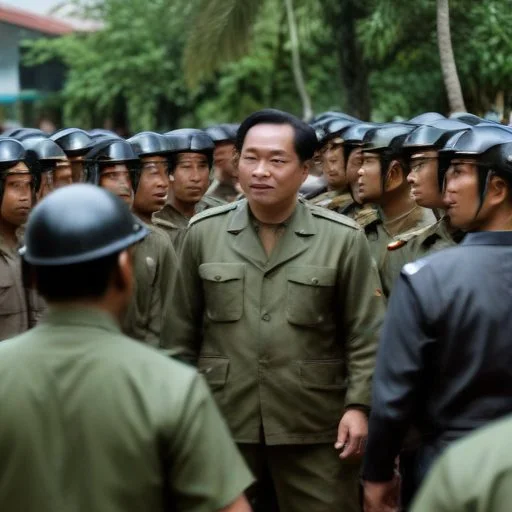
The Buddhist Uprising, which began in 1963, was a response to the South Vietnamese government's persecution of Buddhists. The government, dominated by Catholics, imposed strict laws restricting Buddhist practices, sparking widespread discontent among the Buddhist population. The uprising, led by Buddhist monks and nuns, sought to bring attention to the government's discriminatory policies and push for reforms.
In an effort to quell the uprising, Prime Minister Ky decided to take matters into his own hands. He arrived in Nng with a contingent of loyal troops, determined to crush the Buddhist resistance. This move was characteristic of Ky's bold and often impulsive leadership style, which had earned him both praise and criticism in the past.
As Ky faced off against the defiant Buddhist protesters, he soon realized the futility of his endeavor. The protesters, fueled by their conviction and determination, refused to back down, and Ky was forced to confront the reality of the situation. In a rare display of restraint, the outspoken leader retreated, acknowledging the government's inability to control the escalating anti-government sentiment sweeping South Vietnam.
Ky's failed attempt to capture Nng marked a turning point in the Buddhist Uprising. The retreat was seen as a significant victory for the Buddhist movement, and it galvanized support for their cause. The event also led to increased international pressure on the South Vietnamese government to address its discriminatory policies and engage in dialogue with the Buddhist community.
The Buddhist Uprising, and Ky's failed attempt to quell it, had far-reaching cultural and social implications. The event brought attention to the long-standing religious tensions in South Vietnam and highlighted the need for greater understanding and tolerance. It also paved the way for future social and political movements, inspiring generations of activists to fight for justice and equality.
In a rare moment of introspection, Ky later reflected on his decision to retreat, admitting that it was a difficult and humbling experience. "I realized that I had underestimated the resolve of the Buddhist community," he said. "It was a painful lesson, but one that ultimately made me a better leader."
Ky's failed attempt to capture Nng marked a significant shift in the dynamics of the Buddhist Uprising, paving the way for future social and political movements. The event remains an important chapter in South Vietnam's history, serving as a powerful reminder of the importance of tolerance, understanding, and dialogue in the face of adversity.
Nguyn Cao Ky: A Complex Leader
Ky's leadership style was marked by impulsiveness and boldness, as evident in his decision to personally lead the capture of Nng. However, this same trait also led to his retreat, showcasing a rare display of restraint. This paradox highlights the complexity of Ky's character, making him a fascinating figure in South Vietnamese history.
Ky's background in the Vietnamese Air Force and his experience as a commander may have influenced his decision-making during the Buddhist Uprising. His military career also afforded him a unique perspective on the conflict, which he reflected on in later years.

The Buddhist Uprising's Lasting Cultural Impact
The Buddhist Uprising not only brought attention to the South Vietnamese government's discriminatory policies but also paved the way for future social and cultural movements. The event inspired a generation of activists to fight for justice and equality, leaving a lasting impact on the country's cultural landscape.
The protests and demonstrations during the uprising also led to increased cultural exchange between Vietnam and the international community. The event sparked a renewed interest in Vietnamese culture, leading to a greater appreciation for the country's rich heritage.
The Geopolitical Context of the Buddhist Uprising
The Buddhist Uprising took place amidst a tumultuous geopolitical climate. The Cold War was in full swing, and the conflict in Vietnam was escalating. The South Vietnamese government, backed by the United States, was engaged in a bitter struggle against the communist North.
This geopolitical context had a significant impact on the Buddhist Uprising, as the South Vietnamese government's response to the protests was influenced by its relationship with the United States and fear of communist expansion.

Historiographical Perspectives on the Buddhist Uprising
Historians have interpreted the Buddhist Uprising in various ways, with some viewing it as a pivotal moment in South Vietnam's struggle for independence and others seeing it as a key factor in the country's descent into conflict.
Some historians have also drawn parallels between the Buddhist Uprising and other religiously motivated movements throughout history, highlighting the universal struggle for religious freedom and equality.
Political Fallout of the Buddhist Uprising
The Buddhist Uprising had significant political implications for the South Vietnamese government, leading to increased international pressure to address its discriminatory policies. The event also marked a turning point in the government's relationship with the Buddhist community, with many Buddhists becoming increasingly disillusioned with the ruling regime.
The uprising also had internal political repercussions, with some government officials questioning Ky's leadership and the military's response to the crisis.