


In a groundbreaking moment for international commerce, Canada, Mexico, and the United States successfully concluded negotiations for the North American Free Trade Agreement (NAFTA) in 1992. This sweeping accord aimed to dismantle tariffs, fuel economic growth, and fortify the bonds between the three neighboring nations.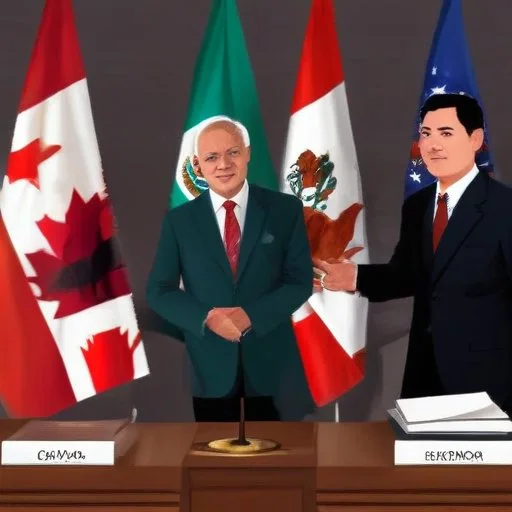
The concept of a North American free trade zone dates back to the 1960s, but it wasn't until the late 1980s that the idea gained significant traction. The desire to create a more integrated and competitive regional economy led these three nations to embark on a journey that would reshape the trade landscape.
The agreement was the brainchild of three visionary leaders: Canadian Prime Minister Brian Mulroney, Mexican President Carlos Salinas de Gortari, and United States President George H.W. Bush. These leaders recognized the immense potential of a unified market and worked tirelessly to bring their vision to life.
NAFTA's impact was profound, with the agreement reducing or eliminating tariffs on thousands of goods and services. This led to a significant surge in trade among the three nations, with the total value of trade increasing by over 150% in the decade following its implementation. The agreement also fostered greater economic integration, encouraging investment and job creation across the region.
The agreement had far-reaching cultural and social implications, facilitating the exchange of ideas, art, and culture between the three nations. It also led to increased tourism, educational exchanges, and greater people-to-people connections, further solidifying the bonds between Canada, Mexico, and the United States.
Despite its many benefits, NAFTA faced criticism from various quarters. Some argued that the agreement would lead to job losses, particularly in the manufacturing sector, as companies took advantage of lower labor costs in Mexico. Others expressed concerns about the potential impact on environmental and labor standards.
In conclusion, the North American Free Trade Agreement (NAFTA) represents a testament to the power of cooperation and diplomacy. By fostering greater economic integration and cooperation, this historic accord has left an indelible mark on the region, shaping the course of trade, investment, and people-to-people connections for generations to come.
As Canadian Prime Minister Brian Mulroney so eloquently stated, "NAFTA is a beacon of hope for a better future, a future of cooperation, of mutual respect, and of collective prosperity."
As the 18th Prime Minister of Canada, Brian Mulroney played a pivotal role in shaping the country's trade policy. His vision for a North American free trade zone was instrumental in bringing Canada, Mexico, and the United States to the negotiating table. Mulroney's leadership and diplomatic skills helped to build trust among the three nations, paving the way for the successful conclusion of NAFTA.
Throughout his political career, Mulroney was known for his ability to forge alliances and build consensus. These skills served him well during the NAFTA negotiations, as he worked closely with Mexican President Carlos Salinas de Gortari and US President George H.W. Bush to overcome the numerous hurdles that threatened to derail the agreement.
The implementation of NAFTA in 1994 marked the beginning of a decade of unprecedented economic growth in North America. The agreement's impact on trade was immediate, with the total value of trade among the three nations increasing by over 150% in the first decade.
The agreement also led to a significant increase in foreign direct investment (FDI), as companies took advantage of the newly created investment opportunities. The United States, in particular, saw a surge in FDI from Canada and Mexico, with investments in the manufacturing and service sectors leading the way.
Perhaps most notably, NAFTA helped to reduce inflation and stimulate economic growth, leading to the creation of millions of new jobs across the region.
NAFTA's impact extended far beyond the realm of economics, as the agreement helped to facilitate a cultural exchange between Canada, Mexico, and the United States. The agreement's provisions on cultural cooperation led to an increase in the exchange of art, music, and literature between the three nations.
The agreement also led to an increase in tourism, as citizens of each nation took advantage of the newly created opportunities to explore their neighboring countries. This, in turn, helped to foster greater understanding and appreciation between the three nations.
One notable example of this cultural exchange is the growth of the Mexican film industry, which was aided in part by the agreement's provisions on cultural cooperation. Mexican films began to gain international recognition, with many winning prestigious awards at film festivals around the world.
The road to NAFTA was paved with a series of critical meetings and negotiations that took place over the course of several years. One such meeting was the 1990 Houston Economic Summit, where the leaders of the three nations first discussed the idea of a free trade agreement.
Another key meeting took place in 1991, when Mexican President Carlos Salinas de Gortari hosted a bilateral meeting with US President George H.W. Bush in San Antonio, Texas. This meeting helped to build momentum for the negotiations, which were ongoing at the time.
Fast-forward to 1992, when the three nations held a trilateral meeting in Washington, D.C. It was here that the outlines of the agreement began to take shape, with the leaders of the three nations agreeing on the broad principles of the accord.
One of the most notable aspects of NAFTA's passage was the bipartisan support it received in the United States. The agreement was negotiated and signed by Republican President George H.W. Bush, but it was Democratic President Bill Clinton who ultimately signed it into law in 1993.
This bipartisan support was instrumental in helping to overcome the numerous hurdles that threatened to derail the agreement. It also helped to build trust among the three nations, as they worked together to implement the accord's provisions.
Today, NAFTA stands as a testament to the power of bipartisan cooperation, and a reminder that even in times of great political divide, it is possible to come together in the pursuit of a common goal.