Captain James Cook embarks on first voyage of discovery
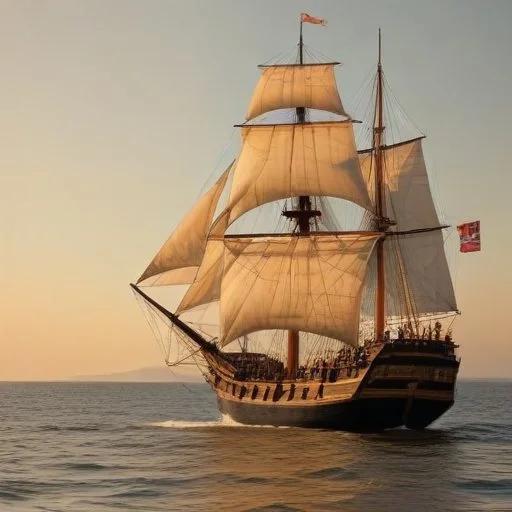
James Cook, a skilled navigator, stood at the helm of HMS Endeavour, his trusty vessel, as he set sail from Plymouth, England, bound for the Pacific. The year was 1768, and the British Royal Navy had commissioned this daring venture to observe the transit of Venus across the sun, a rare celestial event. Cook's expedition would chart new territories, collect valuable botanical specimens, and make contact with indigenous peoples. Little did he know that this maiden voyage would etch his name in history as one of the greatest explorers of all time.
Captain James Cook's Pioneering Voyage: Charting the Uncharted
A New Era of Exploration Begins
On August 26, 1768, Captain
James Cook set sail from Plymouth, England, on board the HMSEndeavour, embarking on a journey that would forever change the course of history. This epic voyage marked the beginning of a new era of exploration, as Cook and his crew ventured into the unknown, driven by a passion for discovery and a thirst for knowledge.
A Royal Commission and a Celestial Quest
The British Royal Navy had commissioned this daring expedition to observe the rare transit of Venus across the sun, a celestial event that would provide invaluable insights into the workings of the universe. Cook's mission was to chart the path of Venus, making precise astronomical observations that would help scientists back in England calculate the distance between the Earth and the Sun.
A Voyage of Discovery and Encounter
As the HMSEndeavour sailed across the Pacific, Cook and his crew encountered new lands, peoples, and cultures. They charted the coastlines of New Zealand and Australia, making contact with indigenous communities and collecting valuable botanical specimens. The crew braved treacherous seas, trekked through uncharted territories, and battled scurvy, all in the pursuit of expanding human knowledge.
A Testament to Human Ingenuity and Perseverance
Cook's voyage was a testament to human ingenuity and perseverance. The crew faced numerous challenges, from the ever-present threat of mutiny to the harsh conditions of the high seas. Yet, through it all, Cook remained steadfast, driven by his unwavering dedication to the pursuit of knowledge and his unshakeable faith in his crew.
The Legacy of Cook's Voyage
The impact of Cook's voyage was profound and far-reaching. His discoveries opened up new trade routes, expanded European knowledge of the Pacific, and paved the way for future explorers. The expedition's findings also contributed significantly to the development of astronomy, navigation, and cartography.
Cook's Cartographic Legacy
Cook's meticulous mapping of the Pacific and its surrounding lands left an indelible mark on the world of cartography. His charts and maps remained the standard for centuries, guiding future explorers and shaping our understanding of the world.
A Pioneer's Legacy: Honors and Recognition
Cook's remarkable achievements earned him numerous honors and accolades. He was awarded the Copley Medal in 1776 for his outstanding contributions to science, and he was posthumously honored with a plaque in Westminster Abbey.
Remembering a Marine Legend
Captain James Cook's pioneering voyage continues to inspire generations of explorers, scientists, and historians. His unwavering commitment to discovery and his unrelenting passion for knowledge have cemented his place in history as one of the greatest explorers of all time.
"Their situation is truly alarming, and affords a melancholy proof of the little knowledge we have of the various Climate, and the diseases that prevail in different parts of the world."
--- Captain James Cook, Journal Entry, 1768
The HMSEndeavour: A Vessel of Discovery
- Length: 98 feet 9 inches
- Beam: 29 feet 3 inches
- Draft: 11 feet 9 inches
- Crew: 94 men
- Armament: 12 guns
A Timeline of Key Events
- August 26, 1768: HMSEndeavour sets sail from Plymouth, England
- October 1768: Endeavour reaches the Cape of Good Hope, South Africa
- December 1768: Endeavour crosses the Pacific, bound for New Zealand
- April 1770: Endeavour reaches the coast of New South Wales, Australia
- July 1770: Endeavour returns to England, ending the historic voyage
Further Reading
Those seeking to delve deeper into the fascinating world of Captain James Cook and his pioneering voyage can explore the following resources:
- Cook's journals and logs, available online through the National Library of Australia
- The British Library's collection of Cook-related manuscripts and documents
- The National Maritime Museum's extensive exhibit on Cook's voyages
Character Overview
Who was Joseph Banks?
Joseph Banks, a British naturalist and botanist, played a crucial role in Cook's voyage as the expedition's chief botanist. Born in 1743, Banks was a wealthy and well-connected individual who shared Cook's passion for discovery. He was responsible for collecting and documenting over 1,000 plant species during the voyage, many of which were previously unknown to Europeans.
Banks' contributions to the expedition went beyond his botanical expertise. He also kept a detailed journal, which provided valuable insights into the daily life on board the Endeavour. His writings offer a unique perspective on the crew's experiences, relationships, and interactions with indigenous peoples.
Banks' legacy extends beyond the voyage, as he went on to become a prominent figure in British scientific circles, eventually becoming the President of the Royal Society.
Geopolitical Overview
The Geopolitical Context of Cook's Voyage
In the mid-18th century, European powers were engaged in a fervent competition for colonial expansion and territorial claims. Britain, France, Spain, and the Netherlands were all vying for control of the Pacific and its resources.
Cook's voyage was, in part, a response to this geopolitical landscape. The British government sought to expand its empire, establish new trade routes, and secure strategic territories. By charting the coastlines of New Zealand and Australia, Cook's expedition helped Britain stake its claim in the region.
The mission was also motivated by a desire to counterbalance French influence in the Pacific, as France had established a foothold in the region through its colonization of Tahiti and other islands.
Study of Scientific Contributions and Discoveries
The Scientific Contributions of Cook's Voyage
Cook's expedition marked a significant milestone in the history of astronomy, navigation, and cartography. The voyage's primary objective – to observe the transit of Venus – contributed significantly to the calculation of the distance between the Earth and the Sun.
The expedition's scientists, including Cook, Banks, and astronomer Charles Green, made precise observations of celestial events, including solar eclipses and planetary alignments. These findings enabled scientists to refine their understanding of the universe, facilitating more accurate navigational tools and cartographic representations.
Cook's voyages laid the foundation for future scientific expeditions, demonstrating the value of empirical observation and experimentation in advancing human knowledge.
Rich Document Analysis
Unpacking the Endeavour's Logbook
Cook's logbook, a meticulously kept record of the voyage, provides a unique window into the daily life on board the Endeavour. The logbook contains detailed accounts of navigational observations, weather conditions, and encounters with indigenous peoples.
A close examination of the logbook reveals the crew's struggles with scurvy, mutiny, and the ever-present threat of shipwreck. The logbook also highlights Cook's exceptional leadership, as he navigated treacherous waters and made difficult decisions to ensure the success of the mission.
The logbook has been digitized and is now available online, offering researchers and historians a valuable primary source for understanding the intricacies of Cook's voyage.
In-Depth Technology Impact Examination
The Technological Impact of Cook's Voyage
Cook's expedition showcased the importance of innovative technologies in facilitating exploration. The Endeavour was equipped with cutting-edge navigational tools, including the newly developed chronometer, which enabled Cook to accurately determine the ship's longitude.
The voyage also highlighted the significance of cartography in mapping uncharted territories. Cook's meticulous mapping of the Pacific and its surrounding lands introduced new cartographic techniques, which would later become the standard for future explorers.
Cook's voyage demonstrated the power of technology in expanding human knowledge, paving the way for future innovations that would transform the course of exploration and discovery.


