


On March 5, 1946, Winston Churchill, the former British Prime Minister, stood at the podium at Westminster College in Missouri, and with a few powerful words, coined a phrase that would come to define the Cold War era: "From Stettin in the Baltic to Trieste in the Adriatic, an iron curtain has descended across the continent."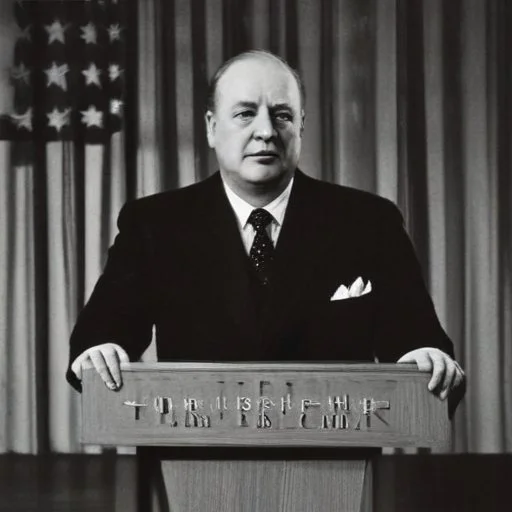
In his speech, "The Sinews of Peace," Churchill warned the Western world of the Soviet Union's expansionist ambitions, marking a pivotal moment in the Cold War. Churchill's words pierced the air, painting a vivid picture of a continent divided, and the Western world on the brink of a new era of tension and conflict.
Following World War II, the world was reeling from the devastation and loss of life. The Allied powers had emerged victorious, but the fragile peace was threatened by the rising tensions between the United States and the Soviet Union. The Soviet occupation of Eastern Europe had created a power vacuum, and the West was growing increasingly concerned about the spread of communism.
Winston Churchill, a seasoned statesman and visionary leader, had a profound understanding of global politics and the dangers of totalitarian regimes. Having led Britain through the darkest days of World War II, Churchill was well-equipped to articulate the Western world's fears and anxieties about the Soviet Union's expansionist ambitions.
Churchill's speech had far-reaching consequences, galvanizing public opinion and prompting the Western world to take a firm stance against Soviet expansion. The speech marked a turning point in the Cold War, as the West began to mobilize against the Soviet threat.
The phrase "iron curtain" became a powerful metaphor, symbolizing the division of Europe and the ideological struggle between East and West. The speech also inspired a new wave of anti-communist sentiment in the United States, fueling the Red Scare and McCarthyism.
"From Stettin in the Baltic to Trieste in the Adriatic, an iron curtain has descended across the continent."
Churchill's speech inspired a generation of leaders and citizens to stand against the spread of communism, embodying the spirit of resistance and determination that defined the Cold War era.
Churchill's Iron Curtain speech remains a testament to the power of rhetoric and the importance of standing up against tyranny. As we reflect on this pivotal moment in history, we are reminded of the enduring importance of freedom, democracy, and the unyielding spirit of humanity.
Winston Churchill was born on November 30, 1874, in Blenheim Palace, Oxfordshire, England. His early life was marked by privilege and adventure, with his father, Lord Randolph Churchill, serving as Chancellor of the Exchequer.
Churchill's fascination with politics began at a young age, and he went on to study at Harrow School and the Royal Military College at Sandhurst. His military career took him to Cuba, India, and South Africa, where he fought in the Boer War.
Churchill's early life experiences shaped his worldview and instilled in him a strong sense of duty and responsibility, which would later define his leadership during World War II and the Cold War era.

The aftermath of World War II left Europe in a state of flux, with the Soviet Union occupying Eastern Europe and the Western powers seeking to establish a foothold in the region.
The Potsdam Conference in 1945, attended by Churchill, US President Harry Truman, and Soviet leader Joseph Stalin, attempted to establish a united front against Germany, but ultimately failed to address the deepening divisions between East and West.
The Soviet Union's imposition of communist governments in Eastern Europe, combined with the Western powers' inability to effectively respond, created a power vacuum that would define the Cold War era.
The stage was set for Churchill's Iron Curtain speech, which would articulate the Western world's fears and anxieties about Soviet expansion.
The phrase "iron curtain" captured the imagination of the Western world, symbolizing the physical and ideological divisions between East and West.
The metaphor was seen as a powerful tool in the fight against communism, and its use by Churchill marked the beginning of a new era of anti-communist rhetoric.
The Iron Curtain became a cultural touchstone, influencing art, literature, and film, and shaping the way people perceived the Cold War era.
From George Orwell's 1984 to the cinematic depictions of espionage and intrigue, the Iron Curtain metaphor has continued to resonate with audiences, symbolizing the struggle for freedom and democracy.

Historians have long debated the significance of Churchill's Iron Curtain speech, with some viewing it as a call to action against Soviet aggression and others seeing it as a cynical attempt to bolster Western morale.
The speech has been interpreted as a reflection of Churchill's own anti-communist sentiments, shaped by his experiences during World War II and his perception of the Soviet Union as a threat to Western values.
Other historians have argued that the speech marked a turning point in the Cold War, galvanizing public opinion and prompting the Western powers to adopt a more confrontational approach to Soviet expansion.
The Soviet Union's occupation of Eastern Europe had significant economic implications, as the region became increasingly isolated from the Western world.
The Iron Curtain marked the beginning of a new era of economic competition between East and West, with the Soviet Union seeking to establish its own economic bloc and the Western powers responding with the Marshall Plan.
The economic divisions between East and West would have far-reaching consequences, shaping trade policies, influencing currency markets, and affecting the daily lives of millions of people.