


The Colfax massacre, one of the deadliest racial massacres in US history, is a harrowing tale of violence, brutality, and racial tension that continues to haunt America's conscience. On that fateful Easter Sunday in 1873, in the small town of Colfax, Louisiana, a group of former Confederate soldiers and Ku Klux Klan members mercilessly slaughtered more than 60 to 150 unarmed black men who had surrendered, leaving an indelible mark on the Reconstruction-era South.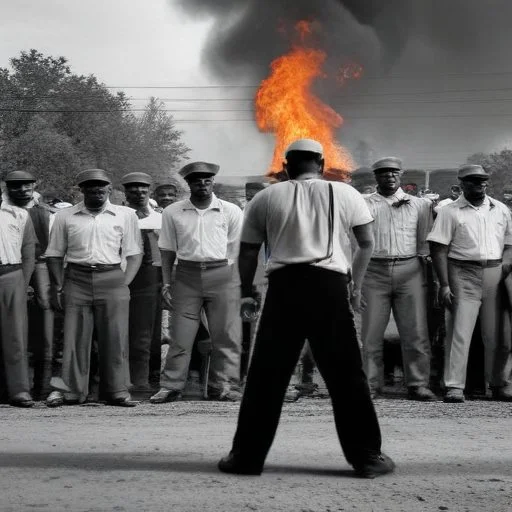
In the aftermath of the Civil War, the Reconstruction-era South was a cauldron of simmering racial tensions, as the newly freed slaves sought to assert their rights in a society still mired in segregation and discrimination. In Louisiana, the election of 1872 was particularly contentious, with white Democrats seeking to reclaim power from the newly empowered black population.
The tensions boiled over when a group of black men, who had been elected to local offices, sought to take control of the courthouse in Colfax, a symbol of political power in the area. A white militia, backed by former Confederate soldiers and Ku Klux Klan members, responded with force, surrounding the courthouse and demanding the surrender of the black men inside. Despite assurances of safety, the white mob turned on the unarmed black men, subjecting them to a brutal and merciless massacre.
The Colfax massacre sent shockwaves throughout the nation, but the perpetrators of the atrocity were never brought to justice. In fact, the US Supreme Court, in the landmark case of United States v. Cruikshank, effectively nullified the federal government's ability to prosecute the perpetrators, allowing them to walk free and emboldening further violence against black Americans.
The Colfax massacre had a profound impact on the psyche of black Americans, instilling a sense of fear and vulnerability that would persist for generations. It also galvanized the rise of white supremacist groups, who saw the massacre as a justification for their violent ideology. The event remains a poignant reminder of the ongoing struggle for racial justice and equality in America.
One of the few surviving witnesses of the massacre, a former slave named Levi Allen, recounted the horrors he witnessed that day: "I saw them kill my friends, my brothers, my family. They were shot, beaten, and burned alive. I saw the fear in their eyes, the pain in their bodies. I saw the inhumanity of it all."
The Colfax massacre is often compared to other racial atrocities of the era, such as the Wilmington Insurrection of 1898 and the Tulsa Race Riot of 1921. While each event has its unique characteristics, they share a common thread – the use of violence and terror to suppress the rights and aspirations of black Americans.
The Colfax massacre was one of the first instances of racial violence to be investigated by the federal government, although the investigation ultimately yielded no convictions.
The Colfax massacre served as a catalyst for the rise of white supremacist groups, including the Ku Klux Klan, and inspired a wave of racial terror that would last for decades. It also spurred the formation of organizations dedicated to racial justice and equality, such as the NAACP.
The Colfax massacre serves as a poignant reminder of the ongoing struggle for racial justice and equality in America. It inspires us to continue the fight against discrimination, to promote understanding and empathy, and to strive for a more just and equitable society.
The Reconstruction era, during which the Colfax massacre took place, has been the subject of intense historiographical debates. Historians have long grappled with the complexities of this period, marked by the abolition of slavery, the rise of Jim Crow laws, and the struggle for racial equality. Some historians have argued that the Reconstruction era was a missed opportunity for genuine racial reform, while others have seen it as a brief moment of possibility for radical social change.
Recent scholarship has highlighted the importance of understanding the Reconstruction era as a time of grassroots mobilization and activism, particularly among African Americans. This perspective has shed new light on the agency and resilience of black communities in the face of violence and intimidation.
The Colfax massacre, in this context, can be seen as a brutal suppression of black political power and a stark reminder of the limits of federal authority in the face of white supremacist violence.

The Colfax massacre has had a profound impact on American culture, shaping the way we think about race, violence, and power. The massacre has inspired countless works of literature, art, and music, from the poetry of Langston Hughes to the music of Nina Simone.
In literature, the Colfax massacre has been referenced in novels such as Blood on the Forge by William Attaway and The Marrow of Tradition by Charles W. Chesnutt. These works have helped to keep the memory of the massacre alive, even as it was erased from mainstream historical narratives.
In popular music, the Colfax massacre has been invoked in songs such as "Strange Fruit" by Billie Holiday and "This Little Light of Mine" by Odetta Holmes. These songs have become powerful symbols of resistance and protest, drawing on the trauma and horror of the Colfax massacre to inspire social change.
The Colfax massacre was part of a broader pattern of racial violence that swept the Reconstruction-era South. Other notable incidents include the Camilla Massacre in Georgia, the Opelousas Massacre in Louisiana, and the Hamburg Massacre in South Carolina.
These incidents share a common thread – the use of violence and terror to suppress black political power and maintain white supremacy. However, each incident has its unique characteristics, shaped by local political dynamics, economic pressures, and cultural tensions.
A comparative analysis of these incidents reveals the complex and multifaceted nature of racial violence in the Reconstruction era. It also highlights the importance of understanding these events within their specific historical contexts, rather than viewing them as isolated incidents.

Levi Allen, one of the few surviving witnesses of the Colfax massacre, was born into slavery in Louisiana in the 1840s. After emancipation, he became a prominent figure in local politics, serving as a justice of the peace and a delegate to the Louisiana state constitutional convention.
Allen's testimony about the Colfax massacre is one of the most powerful and haunting accounts of the event. His words convey the horror and trauma of that day, as well as the resilience and courage of the black community in the face of violence and intimidation.
Despite his bravery, Allen's life was marked by tragedy and hardship. He was forced to flee Louisiana after the massacre, leaving behind his family and friends. His story serves as a poignant reminder of the human cost of racial violence and the importance of preserving the memories of those who lived through it.
The Colfax massacre took place within a broader geopolitical context of Reconstruction-era politics and power struggles. The election of 1872, which sparked the violence, was part of a larger struggle for control of the South between white Democrats and black Republicans.
The massacre was also influenced by national and international events, including the rise of white supremacist groups, the decline of federal authority, and the growth of global imperialism. The massacre can be seen as a local manifestation of these larger forces, which shaped the trajectory of American history.
Understanding the Colfax massacre within its geopolitical context reveals the complex and interconnected nature of racial violence, politics, and power in the Reconstruction era.