


The Council of Nablus, a seminal gathering of clergy, nobles, and knights, etched its mark in history by establishing the earliest surviving written laws of the Crusader Kingdom of Jerusalem. This monumental event, which took place in 1120, laid the groundwork for a unified and orderly administration of the kingdom, thereby setting a crucial precedent for the tumultuous era of the Crusades.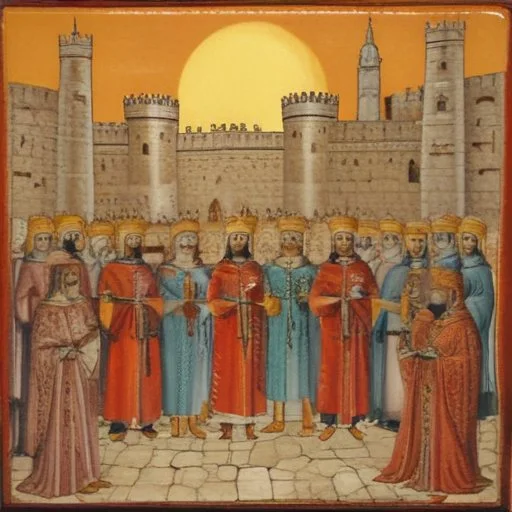
The Council of Nablus convened in the midst of a period of relative calm, following the First Crusade's conquest of Jerusalem in 1099. The subsequent establishment of the Crusader Kingdom of Jerusalem had brought about a semblance of stability, but the lack of a codified legal system hindered the kingdom's development. The need for a unified code of laws became increasingly pressing, as the kingdom's disparate territories and factions often operated under disparate rules and customs.
The Council of Nablus was convened by King Baldwin II, a shrewd and ambitious ruler who recognized the necessity of establishing a robust legal framework for his kingdom. The council was attended by a diverse assembly of clergy, nobles, and knights, including prominent figures such as Patriarch Warmund of Jerusalem and Bishop Roger of Lydda.
The Council of Nablus yielded significant outcomes, most notably the creation of a codified legal system that streamlined governance and administration throughout the kingdom. The written laws established clear guidelines for the resolution of disputes, the administration of justice, and the regulation of social conduct. Furthermore, the council's emphasis on the importance of law and order helped to promote a sense of unity and stability within the kingdom.
The Council of Nablus exerted a profound impact on the cultural and social fabric of the Crusader Kingdom of Jerusalem. The establishment of a unified legal system helped to promote a sense of shared identity and purpose among the kingdom's diverse population. Additionally, the council's emphasis on justice, order, and morality helped to foster a sense of community and social cohesion.
King Baldwin II, in his opening address to the Council of Nablus, declared, "Let us establish a code of laws that shall be a beacon of justice and wisdom, guiding our actions and decisions for generations to come."
The Council of Nablus is often compared to other notable gatherings of the medieval era, such as the Council of Clermont (1095) and the Council of Troyes (1129). While these councils addressed distinct issues and concerns, they shared a common goal of promoting unity, order, and governance within their respective realms.
A contemporary chronicler, Fulcher of Chartres, recorded a colorful anecdote about the council's proceedings, noting that a heated debate erupted over the issue of usury, with some attendees threatening to walk out unless the matter was resolved to their satisfaction.
The Council of Nablus set a crucial precedent for subsequent councils and gatherings, which would build upon its foundations to establish more comprehensive and nuanced legal systems. Furthermore, the council's emphasis on the importance of law and order helped to shape the development of governance and administration in the Crusader Kingdom of Jerusalem and beyond.
The Council of Nablus remains an enduring testament to the power of collective endeavor and the importance of establishing a robust legal framework for the governance of complex societies. As a pivotal moment in the history of the Crusader Kingdom of Jerusalem, it continues to inspire and inform scholars, historians, and legal scholars to this day.
Patriarch Warmund of Jerusalem was a pivotal figure in the Council of Nablus, bringing his vast experience and wisdom to the gathering. As the spiritual leader of the Crusader Kingdom of Jerusalem, Warmund played a crucial role in promoting unity and cooperation among the diverse factions attending the council.
Warmund's influence extended beyond the ecclesiastical realm, as he was well-versed in the intricacies of politics and governance. His input was invaluable in shaping the written laws of the kingdom, ensuring that they aligned with the moral and ethical principles of the Christian faith.
Warmund's legacy extends beyond the Council of Nablus, as he continued to play a key role in the kingdom's development throughout his tenure as Patriarch. His commitment to promoting unity and stability helped to foster a sense of community and shared purpose among the kingdom's inhabitants.

The Council of Nablus was driven, in part, by the economic necessity of establishing a unified legal system. The disparate territories and factions of the kingdom had hitherto operated under varied rules and customs, leading to confusion and instability.
A unified legal code provided a clear framework for commerce and trade, enabling merchants and traders to operate with confidence and predictability. This, in turn, contributed to the kingdom's economic growth and development, as trade and commerce flourished under the auspices of a stable and coherent legal system.
The council's emphasis on establishing clear guidelines for property rights, contracts, and dispute resolution helped to create an environment conducive to economic growth and investment. The written laws of the kingdom provided a foundation for the development of a robust and prosperous economy, which would become a hallmark of the Crusader Kingdom of Jerusalem.
The Council of Nablus was a product of its time, reflecting the medieval values and mores of the 12th century. The emphasis on establishing a unified legal system, grounded in Christian principles, was a testament to the prevailing cultural and social norms of the era.
The council's written laws, with their focus on justice, order, and morality, demonstrate the importance of these values in medieval society. The laws also reveal the church's significant influence on the governance and administration of the kingdom.
Furthermore, the council's proceedings, with their emphasis on dialogue and debate, highlight the importance of collective decision-making and collaboration in medieval politics. The Council of Nablus thus provides a fascinating glimpse into the cultural and social dynamics of the medieval world.

Historians have long debated the significance of the Council of Nablus, with some viewing it as a pivotal moment in the development of the Crusader Kingdom of Jerusalem, while others see it as a relatively minor event.
Some historians have argued that the council's written laws were largely symbolic, with little tangible impact on the kingdom's governance and administration. Others, however, contend that the council played a crucial role in establishing a unified legal system, which helped to promote stability and order in the kingdom.
Despite these differing perspectives, most historians agree that the Council of Nablus was a significant event in the history of the Crusader Kingdom of Jerusalem, providing valuable insights into the complexities of medieval politics and governance.
The Council of Nablus took place against the backdrop of a complex and tumultuous geopolitical landscape. The Crusader Kingdom of Jerusalem was situated in a region of immense strategic importance, with multiple powers vying for influence and control.
The council's proceedings were likely influenced by the kingdom's relationships with neighboring states, including the Byzantine Empire and the Fatimid Caliphate. The written laws of the kingdom may have been designed, in part, to address the challenges and opportunities presented by these relationships.
The council's emphasis on establishing a unified legal system may also have been driven by the need to consolidate power and authority within the kingdom, in the face of external threats and challenges. The Council of Nablus thus reflects the complex and dynamic nature of medieval geopolitics.