


On November 28, 1986, Taiwan witnessed a seismic shift in its political landscape when the Democratic Progressive Party (DPP) officially registered as the island's first opposition party, marking a monumental departure from decades of one-party rule under the Kuomintang (KMT). This bold move paved the way for a new era of democracy, signaling a growing desire for political plurality and autonomy among the Taiwanese people.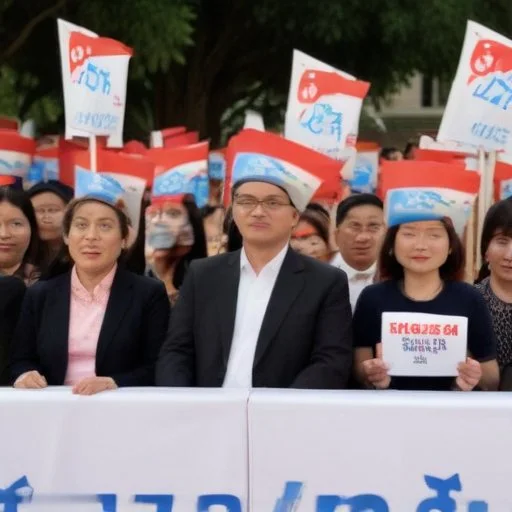
Taiwan's political landscape had been dominated by the KMT since the end of World War II, with the party exerting tight control over the island's political, economic, and social spheres. However, as the Taiwanese economy grew and urbanization increased, demands for democracy and human rights began to simmer beneath the surface. The DPP's emergence was a direct response to this growing discontent, as a group of activists, intellectuals, and politicians sought to challenge the KMT's stranglehold on power.
September 1986: A group of activists and intellectuals, led by Yao Chia-wen, founded the DPP, with the aim of creating a democratic and autonomous Taiwan.
October 1986: The DPP submitted its registration application to the Ministry of the Interior, despite threats from the KMT government.
November 28, 1986: The DPP officially registered as Taiwan's first opposition party, marking a historic milestone in the island's struggle for democracy.
The DPP's emergence as an opposition party sent shockwaves through Taiwan's political establishment, forcing the KMT to reassess its grip on power. The DPP's registration paved the way for:
The DPP's rise to prominence coincided with a growing sense of Taiwanese identity, as the island's citizens began to assert their cultural and linguistic heritage. The DPP's emphasis on democracy and human rights resonated with a population eager to break free from the KMT's authoritarian grip.
The DPP's registration was met with fierce resistance from the KMT, which viewed the new party as a threat to its power. The DPP was accused of being "pro-independence" and "anti-Chinese," labels that stuck despite the party's repeated denials. However, the DPP's persistence in the face of adversity earned it a reputation as a champion of democracy and human rights.
"We are not seeking to overthrow the government, but to build a democratic system that represents the will of the people." – Yao Chia-wen, addressing the DPP's inaugural conference in 1986
The DPP's registration as an opposition party marked the beginning of Taiwan's democratic awakening, drawing parallels with other democratic movements in East Asia, such as South Korea's pro-democracy protests in the 1980s. Both movements shared a common goal: to challenge authoritarian rule and establish genuinely democratic systems.
Chen Shui-bian, a former DPP member and future president of Taiwan, recalled the excitement and trepidation that accompanied the party's registration: "We knew we were taking a risk, but we also knew that we were fighting for something bigger than ourselves – the future of Taiwan."
The DPP's emergence as an opposition party paved the way for Taiwan's transition to democracy, culminating in the island's first direct presidential election in 1996. The DPP's influence extended beyond Taiwanese politics, inspiring democratic movements across East Asia and cementing Taiwan's status as a beacon of democracy in the region.
The roots of Taiwan's democratic movement can be traced back to the 1970s, when a group of intellectuals and activists, including Peng Ming-min, began to secretly meet to discuss democratic reforms. These clandestine gatherings, known as the "Kaohsiung Incident", were a precursor to the formation of the DPP and laid the foundation for Taiwan's transition to democracy.
In the years leading up to the DPP's registration, Taiwan's political landscape was marked by a series of protests and demonstrations, known as the "Tangwai movement". These protests, led by pro-democracy activists, demanded greater political freedom and an end to one-party rule.

Huang Hsin-chieh, a key figure in the DPP's early years, was a former political prisoner who had spent years in jail for his activism. Despite the risks, he continued to advocate for human rights and democracy, eventually becoming a prominent leader in the DPP.
Huang's experiences as a political prisoner had a profound impact on his views on democracy and human rights. He believed that a truly democratic system was essential for Taiwan's development and that the DPP had a crucial role to play in achieving this goal.
The DPP's registration as an opposition party was not an isolated event, but rather part of a broader democratic movement sweeping across East Asia in the 1980s. In South Korea, the "Gwangju Democratization Movement" was also challenging authoritarian rule, while in Hong Kong, the "Pressure Group movement" was pushing for greater political freedom.
These parallel movements shared a common goal: to challenge authoritarian rule and establish genuinely democratic systems. The DPP's registration was a key milestone in this broader democratic awakening, paving the way for Taiwan's transition to democracy.

The DPP's rise to prominence coincided with a growing sense of Taiwanese identity, as the island's citizens began to assert their cultural and linguistic heritage. The DPP's emphasis on democracy and human rights resonated with a population eager to break free from the KMT's authoritarian grip.
The DPP's influence extended beyond politics, inspiring a cultural renaissance in Taiwan. The party's focus on democracy and human rights helped to create a sense of Taiwanese identity, distinct from the dominant Chinese culture.
The DPP's registration as an opposition party sent shockwaves through Taiwan's political establishment, forcing the KMT to reassess its grip on power. The KMT, which had ruled Taiwan since the end of World War II, was initially resistant to the idea of an opposition party, viewing the DPP as a threat to its authority.
However, as the DPP gained momentum, the KMT was forced to adapt, introducing reforms to increase transparency and accountability. The DPP's persistence in the face of adversity earned it a reputation as a champion of democracy and human rights.