


In the midst of a seemingly ordinary day, the Diexi earthquake struck Mao County, Sichuan, China, leaving behind a trail of destruction and heartbreak that would be etched in the memories of its people forever. This catastrophic event, which occurred on August 25, 1933, claimed the lives of approximately 9,000 people, making it one of the deadliest earthquakes in Chinese history.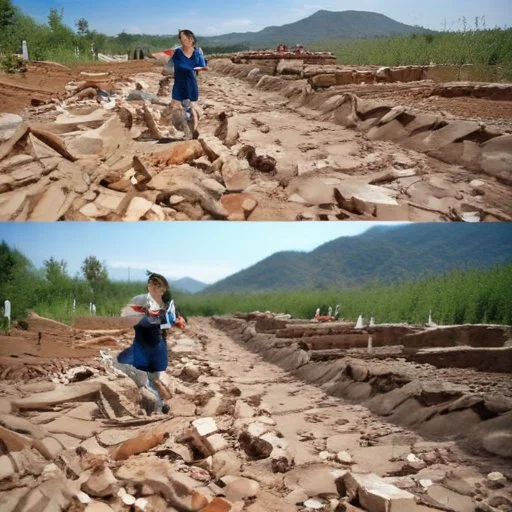
The Diexi earthquake was a catastrophic event that was triggered by the movement of the Longmenshan Fault, a major fault line that runs through the Sichuan Province. The earthquake's magnitude was estimated to be around 7.3-7.5 on the Richter scale, making it a powerful and devastating force of nature.
The Diexi earthquake had a profound impact on Mao County and the surrounding regions. The destruction was widespread, with entire villages and towns reduced to rubble. Thousands of people were left homeless, and the local economy was severely disrupted.
The earthquake also had a significant impact on the country as a whole, leading to a re-evaluation of China's disaster response and preparedness measures. It highlighted the need for improved infrastructure, better emergency planning, and more effective communication networks.
The Diexi earthquake had a profound impact on the cultural and social fabric of Mao County and beyond. It brought communities together, as people rallied to support those affected by the disaster. It also highlighted the importance of community, resilience, and the human spirit in the face of adversity.
In the years that followed, the Diexi earthquake inspired a new wave of disaster preparedness and awareness initiatives, which helped to save countless lives in subsequent natural disasters.
One of the most poignant accounts of the Diexi earthquake comes from a local teacher, Li Wen, who was on her way to school when the earthquake struck. She recalled the moment when the ground began to shake, and the sound of screams and crumbling buildings filled the air.
"It was like the whole world was coming to an end," she said in an interview many years later. "I remember seeing people running, crying, and screaming, and I knew that our lives would never be the same again."
The Diexi earthquake marked a turning point in China's approach to disaster management and preparedness. It led to significant reforms and innovations in earthquake engineering, emergency response, and disaster mitigation.
In the decades that followed, China became a global leader in disaster risk reduction and management, with the Diexi earthquake serving as a catalyst for change.
The story of the Diexi earthquake is a testament to the resilience and strength of the human spirit. It reminds us that even in the darkest of times, there is always hope, always a way forward.
As we reflect on this devastating event, let us draw inspiration from the courage, compassion, and determination of those who lived through it, and strive to build a safer, more resilient world for all.
The Diexi earthquake had a profound impact on the local economy, with estimates suggesting that the total economic loss was equivalent to 10% of Sichuan Province's annual GDP.
The earthquake led to a significant decline in agricultural production, as fertile lands were buried under debris and crops were destroyed. This had a ripple effect on the entire food supply chain, causing food prices to soar and leading to widespread food shortages.
In addition, the earthquake destroyed thousands of businesses, including factories, shops, and other commercial establishments. This not only led to massive job losses but also disrupted the supply of essential goods and services.

The Diexi earthquake had a profound impact on the cultural fabric of Mao County and beyond. It led to a renewed sense of community and solidarity, as people came together to support those affected by the disaster.
The earthquake also led to a resurgence of traditional cultural practices, such as folk music and dance, which played a vital role in comforting and uplifting the survivors.
In the years that followed, the Diexi earthquake inspired a new wave of cultural and artistic expression, as writers, artists, and musicians sought to capture the essence of the tragedy and the resilience of the people.
The Diexi earthquake led to a significant shift in the political landscape of China, as the government faced criticism for its slow response to the disaster.
The earthquake highlighted the need for more effective disaster management and preparedness, leading to reforms and innovations in the way the government responded to natural disasters.
In the aftermath of the earthquake, the Chinese government established a new national emergency response system, which improved the country's ability to respond to natural disasters and reduced the risk of future tragedies.

The Diexi earthquake occurred at a time of great political unrest in China, as the country was struggling to assert its independence and sovereignty in the face of foreign encroachment.
The earthquake was seen by many as a test of the Chinese government's ability to respond to natural disasters and protect its citizens, and its success or failure would have far-reaching implications for the country's international reputation.
In the years that followed, the Diexi earthquake became a symbol of China's resilience and determination, as the country sought to rebuild and emerge stronger than ever.
The Diexi earthquake exposed deep-seated social inequalities, as the poorest and most vulnerable members of society were disproportionately affected by the disaster.
The earthquake led to a significant shift in social dynamics, as people from different backgrounds and walks of life came together to support each other and rebuild their communities.
In the aftermath of the earthquake, social activists and reformers seized the opportunity to push for greater social and economic equality, arguing that a more equitable society would be better equipped to respond to natural disasters and other challenges.